Can Humans Be Free?
Augustine vs Kant
Augustine and Kant sit 1,400 years apart and circle, in very different languages, the same impossible-looking reconciliation. Freedom is the precondition of moral responsibility — no philosopher in this tradition is willing to give it up — but freedom looks ready to collapse under examination. Augustine has to reconcile human freedom with God's foreknowledge: if the outcome is already known, is my choice really a choice? Kant has to reconcile human freedom with the causal determinism of nature: if every event follows from prior events, is any act really mine?
Their answers run in opposite directions. For Augustine, the will is free because God made it so, and its freedom is expressed most truly in its submission to God — freedom is a motion toward a given good. For Kant, the will is free because it is self-legislating; it gives itself the moral law rather than receiving it from any external source — freedom is answerable only to reason. Augustinian freedom is freedom toward. Kantian freedom is freedom from. The entire modern conception of autonomy is Kant's reframing of a question Augustine asked first.
In the passages that follow you will read Augustine's analysis of the will in On Free Choice of the Will and the City of God, then Kant's Groundwork and selected passages from the Critique of Practical Reason. Kant is notoriously demanding; Augustine, deceptively accessible. Suggestion: read Augustine first, to feel how the question was alive before modernity. Then read Kant, to feel what modernity did to it.
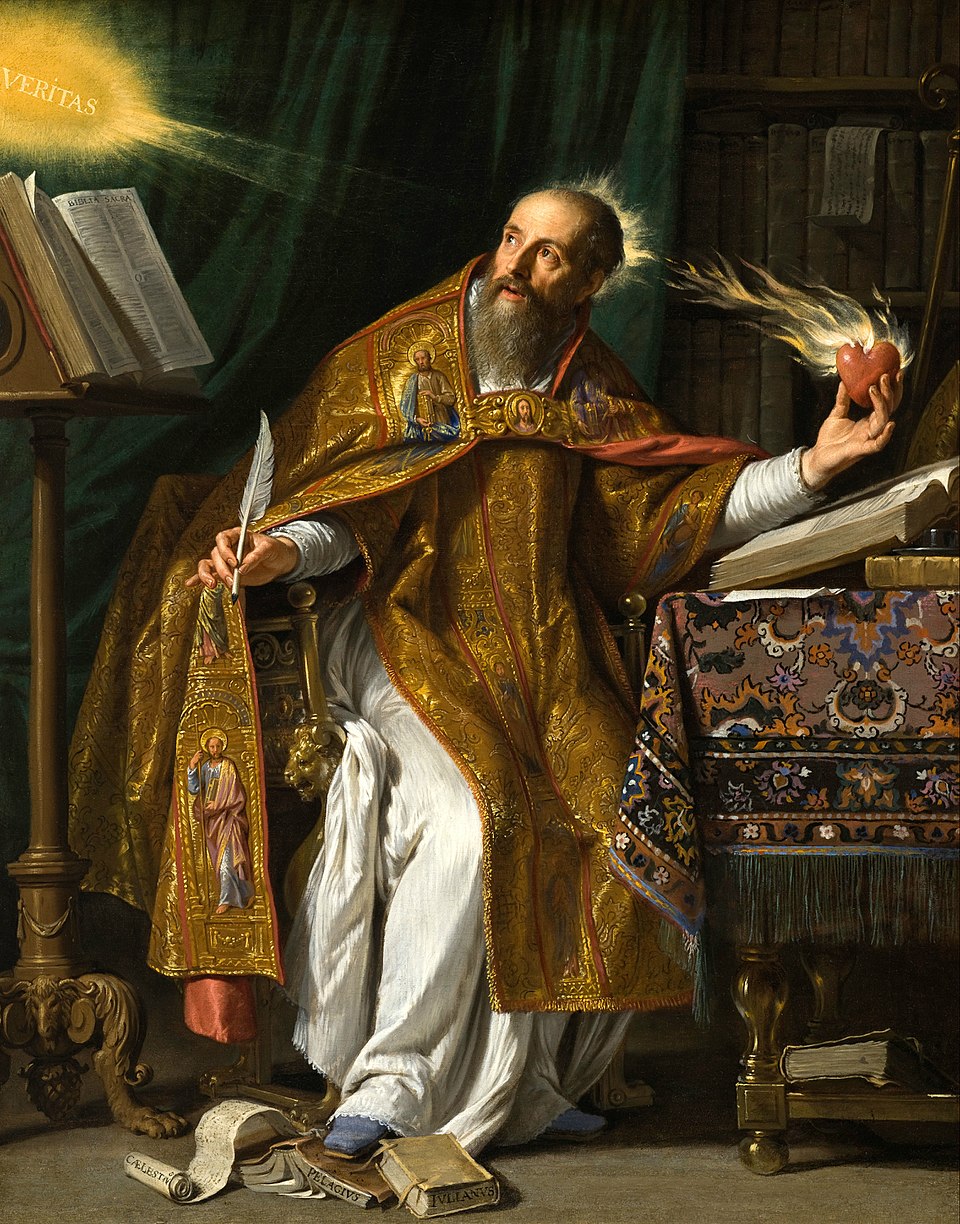 1Augustine354 – 430Confessions · Book 6
Thou, my hope from my youth, where wert Thou to me, and whither wert Thou gone? Hadst not Thou created me, and separated me from the beasts of the field, and fowls of the air? Thou hadst made me wiser, yet did I walk in darkness, and in slippery places, and sought Thee abroad out of myself, and found not the God of my heart; and had come into the depths of the sea, and distrusted and despaired of ever finding truth. My mother had now come to me, resolute through piety, following me over sea and land, in all perils confiding in Thee. For in perils of the sea, she comforted the very mariners (by whom passengers unacquainted with the deep, use rather to be comforted when troubled), assuring them of a safe arrival, because Thou hadst by a vision assured her thereof. She found me in grievous peril, through despair of ever finding truth. But when I had discovered to her that I was now no longer a Manichee, though not yet a Catholic Christian, she was not overjoyed, as at something unexpected; although she was now assured concerning that part of my misery, for which she bewailed me as one dead, though to be reawakened by Thee, carrying me forth upon the bier of her thoughts, that Thou mightest say to the son of the widow, Young man, I say unto thee, Arise; and he should revive, and begin to speak, and Thou shouldest deliver him to his mother. Her heart then was shaken with no tumultuous exultation, when she heard that what she daily with tears desired of Thee was already in so great part realised; in that, though I had not yet attained the truth, I was rescued from falsehood; but, as being assured, that Thou, Who hadst promised the whole, wouldest one day give the rest, most calmly, and with a heart full of confidence, she replied to me, “She believed in Christ, that before she departed this life, she should see me a Catholic believer.” Thus much to me. But to Thee, Fountain of mercies, poured she forth more copious prayers and tears, that Thou wouldest hasten Thy help, and enlighten my darkness; and she hastened the more eagerly to the Church, and hung upon the lips of Ambrose, praying for the fountain of that water, which springeth up unto life everlasting. But that man she loved as an angel of God, because she knew that by him I had been brought for the present to that doubtful state of faith I now was in, through which she anticipated most confidently that I should pass from sickness unto health, after the access, as it were, of a sharper fit, which physicians call “the crisis.”
When then my mother had once, as she was wont in Afric, brought to the Churches built in memory of the Saints, certain cakes, and bread and wine, and was forbidden by the door-keeper; so soon as she knew that the Bishop had forbidden this, she so piously and obediently embraced his wishes, that I myself wondered how readily she censured her own practice, rather than discuss his prohibition. For wine-bibbing did not lay siege to her spirit, nor did love of wine provoke her to hatred of the truth, as it doth too many (both men and women), who revolt at a lesson of sobriety, as men well-drunk at a draught mingled with water. But she, when she had brought her basket with the accustomed festival-food, to be but tasted by herself, and then given away, never joined therewith more than one small cup of wine, diluted according to her own abstemious habits, which for courtesy she would taste. And if there were many churches of the departed saints that were to be honoured in that manner, she still carried round that same one cup, to be used every where; and this, though not only made very watery, but unpleasantly heated with carrying about, she would distribute to those about her by small sips; for she sought there devotion, not pleasure. So soon, then, as she found this custom to be forbidden by that famous preacher and most pious prelate, even to those that would use it soberly, lest so an occasion of excess might be given to the drunken; and for these, as it were, anniversary funeral solemnities did much resemble the superstition of the Gentiles, she most willingly forbare it: and for a basket filled with fruits of the earth, she had learned to bring to the Churches of the martyrs a breast filled with more purified petitions, and to give what she could to the poor; that so the communication of the Lord’s Body might be there rightly celebrated, where, after the example of His Passion, the martyrs had been sacrificed and crowned. But yet it seems to me, O Lord my God, and thus thinks my heart of it in Thy sight, that perhaps she would not so readily have yielded to the cutting off of this custom, had it been forbidden by another, whom she loved not as Ambrose, whom, for my salvation, she loved most entirely; and he her again, for her most religious conversation, whereby in good works, so fervent in spirit, she was constant at church; so that, when he saw me, he often burst forth into her praises; congratulating me that I had such a mother; not knowing what a son she had in me, who doubted of all these things, and imagined the way to life could not be found out.
Nor did I yet groan in my prayers, that Thou wouldest help me; but my spirit was wholly intent on learning, and restless to dispute. And Ambrose himself, as the world counts happy, I esteemed a happy man, whom personages so great held in such honour; only his celibacy seemed to me a painful course. But what hope he bore within him, what struggles he had against the temptations which beset his very excellencies, or what comfort in adversities, and what sweet joys Thy Bread had for the hidden mouth of his spirit, when chewing the cud thereof, I neither could conjecture, nor had experienced. Nor did he know the tides of my feelings, or the abyss of my danger. For I could not ask of him, what I would as I would, being shut out both from his ear and speech by multitudes of busy people, whose weaknesses he served. With whom when he was not taken up (which was but a little time), he was either refreshing his body with the sustenance absolutely necessary, or his mind with reading. But when he was reading, his eye glided over the pages, and his heart searched out the sense, but his voice and tongue were at rest. Ofttimes when we had come (for no man was forbidden to enter, nor was it his wont that any who came should be announced to him), we saw him thus reading to himself, and never otherwise; and having long sat silent (for who durst intrude on one so intent?) we were fain to depart, conjecturing that in the small interval which he obtained, free from the din of others’ business, for the recruiting of his mind, he was loth to be taken off; and perchance he dreaded lest if the author he read should deliver any thing obscurely, some attentive or perplexed hearer should desire him to expound it, or to discuss some of the harder questions; so that his time being thus spent, he could not turn over so many volumes as he desired; although the preserving of his voice (which a very little speaking would weaken) might be the truer reason for his reading to himself. But with what intent soever he did it, certainly in such a man it was good.
I however certainly had no opportunity of enquiring what I wished of that so holy oracle of Thine, his breast, unless the thing might be answered briefly. But those tides in me, to be poured out to him, required his full leisure, and never found it. I heard him indeed every Lord’s day, rightly expounding the Word of truth among the people; and I was more and more convinced that all the knots of those crafty calumnies, which those our deceivers had knit against the Divine Books, could be unravelled. But when I understood withal, that “man created by Thee, after Thine own image,” was not so understood by Thy spiritual sons, whom of the Catholic Mother Thou hast born again through grace, as though they believed and conceived of Thee as bounded by human shape (although what a spiritual substance should be I had not even a faint or shadowy notion); yet, with joy I blushed at having so many years barked not against the Catholic faith, but against the fictions of carnal imaginations. For so rash and impious had I been, that what I ought by enquiring to have learned, I had pronounced on, condemning. For Thou, Most High, and most near; most secret, and most present; Who hast not limbs some larger, some smaller, but art wholly every where, and no where in space, art not of such corporeal shape, yet hast Thou made man after Thine own image; and behold, from head to foot is he contained in space.
Ignorant then how this Thy image should subsist, I should have knocked and proposed the doubt, how it was to be believed, not insultingly opposed it, as if believed. Doubt, then, what to hold for certain, the more sharply gnawed my heart, the more ashamed I was, that so long deluded and deceived by the promise of certainties, I had with childish error and vehemence, prated of so many uncertainties. For that they were falsehoods became clear to me later. However I was certain that they were uncertain, and that I had formerly accounted them certain, when with a blind contentiousness, I accused Thy Catholic Church, whom I now discovered, not indeed as yet to teach truly, but at least not to teach that for which I had grievously censured her. So I was confounded, and converted: and I joyed, O my God, that the One Only Church, the body of Thine Only Son (wherein the name of Christ had been put upon me as an infant), had no taste for infantine conceits; nor in her sound doctrine maintained any tenet which should confine Thee, the Creator of all, in space, however great and large, yet bounded every where by the limits of a human form.
I joyed also that the old Scriptures of the law and the Prophets were laid before me, not now to be perused with that eye to which before they seemed absurd, when I reviled Thy holy ones for so thinking, whereas indeed they thought not so: and with joy I heard Ambrose in his sermons to the people, oftentimes most diligently recommend this text for a rule, The letter killeth, but the Spirit giveth life; whilst he drew aside the mystic veil, laying open spiritually what, according to the letter, seemed to teach something unsound; teaching herein nothing that offended me, though he taught what I knew not as yet, whether it were true. For I kept my heart from assenting to any thing, fearing to fall headlong; but by hanging in suspense I was the worse killed. For I wished to be as assured of the things I saw not, as I was that seven and three are ten. For I was not so mad as to think that even this could not be comprehended; but I desired to have other things as clear as this, whether things corporeal, which were not present to my senses, or spiritual, whereof I knew not how to conceive, except corporeally. And by believing might I have been cured, that so the eyesight of my soul being cleared, might in some way be directed to Thy truth, which abideth always, and in no part faileth. But as it happens that one who has tried a bad physician, fears to trust himself with a good one, so was it with the health of my soul, which could not be healed but by believing, and lest it should believe falsehoods, refused to be cured; resisting Thy hands, Who hast prepared the medicines of faith, and hast applied them to the diseases of the whole world, and given unto them so great authority.
— Augustine, Confessions, Book 6
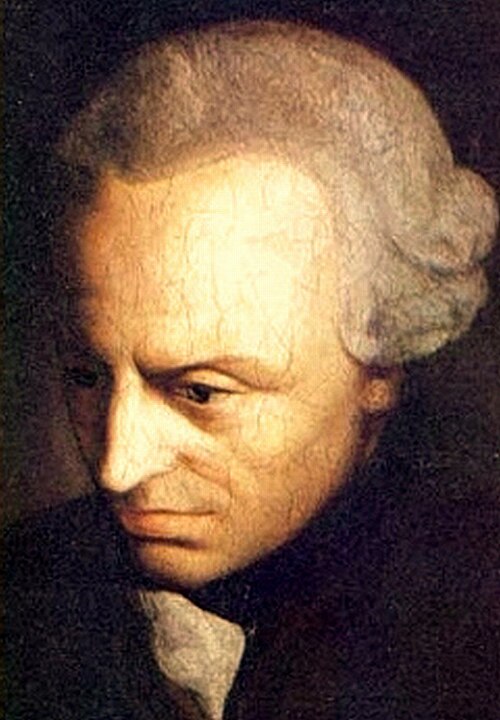 2Kant1724 – 1804Critique of Practical Reason · Abbott/Meiklejohn/Bernard (GBWW) translation
Practical principles are propositions which contain a general determination of the will, having under it several practical rules. They are subjective, or maxims, when the condition is regarded by the subject as valid only for his own will, but are objective, or practical laws, when the condition is recognized as objective, that is, valid for the will of every rational being.
Remark.
Supposing that pure reason contains in itself a practical motive, that is, one adequate to determine the will, then there are practical laws; otherwise all practical principles will be mere maxims. In case the will of a rational being is pathologically affected, there may occur a conflict of the maxims with the practical laws recognized by itself. For example, one may make it his maxim to let no injury pass unrevenged, and yet he may see that this is not a practical law, but only his own maxim; that, on the contrary, regarded as being in one and the same maxim a rule for the will of every rational being, it must contradict itself. In natural philosophy the principles of what happens, e.g., the principle of equality of action and reaction in the communication of motion) are at the same time laws of nature; for the use of reason there is theoretical and determined by the nature of the object. In practical philosophy, i.e., that which has to do only with the grounds of determination of the will, the principles which a man makes for himself are not laws by which one is inevitably bound; because reason in practical matters has to do with the subject, namely, with the faculty of desire, the special character of which may occasion variety in the rule. The practical rule is always a product of reason, because it prescribes action as a means to the effect. But in the case of a being with whom reason does not of itself determine the will, this rule is an imperative, i.e., a rule characterized by “shall,” which expresses the objective necessitation of the action and signifies that, if reason completely determined the will, the action would inevitably take place according to this rule. Imperatives, therefore, are objectively valid, and are quite distinct from maxims, which are subjective principles. The former either determine the conditions of the causality of the rational being as an efficient cause, i.e., merely in reference to the effect and the means of attaining it; or they determine the will only, whether it is adequate to the effect or not. The former would be hypothetical imperatives, and contain mere precepts of skill; the latter, on the contrary, would be categorical, and would alone be practical laws. Thus maxims are principles, but not imperatives. Imperatives themselves, however, when they are conditional (i.e., do not determine the will simply as will, but only in respect to a desired effect, that is, when they are hypothetical imperatives), are practical precepts but not laws. Laws must be sufficient to determine the will as will, even before I ask whether I have power sufficient for a desired effect, or the means necessary to produce it; hence they are categorical: otherwise they are not laws at all, because the necessity is wanting, which, if it is to be practical, must be independent of conditions which are pathological and are therefore only contingently connected with the will. Tell a man, for example, that he must be industrious and thrifty in youth, in order that he may not want in old age; this is a correct and important practical precept of the will. But it is easy to see that in this case the will is directed to something else which it is presupposed that it desires; and as to this desire, we must leave it to the actor himself whether he looks forward to other resources than those of his own acquisition, or does not expect to be old, or thinks that in case of future necessity he will be able to make shift with little. Reason, from which alone can spring a rule involving necessity, does, indeed, give necessity to this precept (else it would not be an imperative), but this is a necessity dependent on subjective conditions, and cannot be supposed in the same degree in all subjects. But that reason may give laws it is necessary that it should only need to presuppose itself, because rules are objectively and universally valid only when they hold without any contingent subjective conditions, which distinguish one rational being from another. Now tell a man that he should never make a deceitful promise, this is a rule which only concerns his will, whether the purposes he may have can be attained thereby or not; it is the volition only which is to be determined a priori by that rule. If now it is found that this rule is practically right, then it is a law, because it is a categorical imperative. Thus, practical laws refer to the will only, without considering what is attained by its causality, and we may disregard this latter (as belonging to the world of sense) in order to have them quite pure.
II. Theorem I.
All practical principles which presuppose an object (matter) of the faculty of desire as the ground of determination of the will are empirical and can furnish no practical laws.
By the matter of the faculty of desire I mean an object the realization of which is desired. Now, if the desire for this object precedes the practical rule and is the condition of our making it a principle, then I say (in the first place) this principle is in that case wholly empirical, for then what determines the choice is the idea of an object and that relation of this idea to the subject by which its faculty of desire is determined to its realization. Such a relation to the subject is called the pleasure in the realization of an object. This, then, must be presupposed as a condition of the possibility of determination of the will. But it is impossible to know a priori of any idea of an object whether it will be connected with pleasure or pain, or be indifferent. In such cases, therefore, the determining principle of the choice must be empirical and, therefore, also the practical material principle which presupposes it as a condition.
In the second place, since susceptibility to a pleasure or pain can be known only empirically and cannot hold in the same degree for all rational beings, a principle which is based on this subjective condition may serve indeed as a maxim for the subject which possesses this susceptibility, but not as a law even to him (because it is wanting in objective necessity, which must be recognized a priori); it follows, therefore, that such a principle can never furnish a practical law.
III. Theorem II.
All material practical principles as such are of one and the same kind and come under the general principle of self-love or private happiness.
Pleasure arising from the idea of the existence of a thing, in so far as it is to determine the desire of this thing, is founded on the susceptibility of the subject, since it depends on the presence of an object; hence it belongs to sense (feeling), and not to understanding, which expresses a relation of the idea to an object according to concepts, not to the subject according to feelings. It is, then, practical only in so far as the faculty of desire is determined by the sensation of agreeableness which the subject expects from the actual existence of the object. Now, a rational being’s consciousness of the pleasantness of life uninterruptedly accompanying his whole existence is happiness; and the principle which makes this the supreme ground of determination of the will is the principle of self-love. All material principles, then, which place the determining ground of the will in the pleasure or pain to be received from the existence of any object are all of the same kind, inasmuch as they all belong to the principle of self-love or private happiness.
Corollary.
All material practical rules place the determining principle of the will in the lower desires; and if there were no purely formal laws of the will adequate to determine it, then we could not admit any higher desire at all.
Remark I.
It is surprising that men, otherwise acute, can think it possible to distinguish between higher and lower desires, according as the ideas which are connected with the feeling of pleasure have their origin in the senses or in the understanding; for when we inquire what are the determining grounds of desire, and place them in some expected pleasantness, it is of no consequence whence the idea of this pleasing object is derived, but only how much it pleases. Whether an idea has its seat and source in the understanding or not, if it can only determine the choice by presupposing a feeling of pleasure in the subject, it follows that its capability of determining the choice depends altogether on the nature of the inner sense, namely, that this can be agreeably affected by it. However dissimilar ideas of objects may be, though they be ideas of the understanding, or even of the reason in contrast to ideas of sense, yet the feeling of pleasure, by means of which they constitute the determining principle of the will (the expected satisfaction which impels the activity to the production of the object), is of one and the same kind, not only inasmuch as it can only be known empirically, but also inasmuch as it affects one and the same vital force which manifests itself in the faculty of desire, and in this respect can only differ in degree from every other ground of determination. Otherwise, how could we compare in respect of magnitude two principles of determination, the ideas of which depend upon different faculties, so as to prefer that which affects the faculty of desire in the highest degree. The same man may return unread an instructive book which he cannot again obtain, in order not to miss a hunt; he may depart in the midst of a fine speech, in order not to be late for dinner; he may leave a rational conversation, such as he otherwise values highly, to take his place at the gaming-table; he may even repulse a poor man whom he at other times takes pleasure in benefiting, because he has only just enough money in his pocket to pay for his admission to the theatre. If the determination of his will rests on the feeling of the agreeableness or disagreeableness that he expects from any cause, it is all the same to him by what sort of ideas he will be affected. The only thing that concerns him, in order to decide his choice, is, how great, how long continued, how easily obtained, and how often repeated, this agreeableness is. Just as to the man who wants money to spend, it is all the same whether the gold was dug out of the mountain or washed out of the sand, provided it is everywhere accepted at the same value; so the man who cares only for the enjoyment of life does not ask whether the ideas are of the understanding or the senses, but only how much and how great pleasure they will give for the longest time. It is only those that would gladly deny to pure reason the power of determining the will, without the presupposition of any feeling, who could deviate so far from their own exposition as to describe as quite heterogeneous what they have themselves previously brought under one and the same principle. Thus, for example, it is observed that we can find pleasure in the mere exercise of power, in the consciousness of our strength of mind in overcoming obstacles which are opposed to our designs, in the culture of our mental talents, etc.; and we justly call these more refined pleasures and enjoyments, because they are more in our power than others; they do not wear out, but rather increase the capacity for further enjoyment of them, and while they delight they at the same time cultivate. But to say on this account that they determine the will in a different way and not through sense, whereas the possibility of the pleasure presupposes a feeling for it implanted in us, which is the first condition of this satisfaction; this is just as when ignorant persons that like to dabble in metaphysics imagine matter so subtle, so supersubtle that they almost make themselves giddy with it, and then think that in this way they have conceived it as a spiritual and yet extended being. If with Epicurus we make virtue determine the will only by means of the pleasure it promises, we cannot afterwards blame him for holding that this pleasure is of the same kind as those of the coarsest senses. For we have no reason whatever to charge him with holding that the ideas by which this feeling is excited in us belong merely to the bodily senses. As far as can be conjectured, he sought the source of many of them in the use of the higher cognitive faculty, but this did not prevent him, and could not prevent him, from holding on the principle above stated, that the pleasure itself which those intellectual ideas give us, and by which alone they can determine the will, is just of the same kind. Consistency is the highest obligation of a philosopher, and yet the most rarely found. The ancient Greek schools give us more examples of it than we find in our syncretistic age, in which a certain shallow and dishonest system of compromise of contradictory principles is devised, because it commends itself better to a public which is content to know something of everything and nothing thoroughly, so as to please every party.
— Kant, Critique of Practical Reason
3Augustine354 – 430Confessions · Book 5
Thou hast formed and stirred up to confess unto Thy name. Heal Thou all my bones, and let them say, O Lord, who is like unto Thee? For he who confesses to Thee doth not teach Thee what takes place within him; seeing a closed heart closes not out Thy eye, nor can man’s hard-heartedness thrust back Thy hand: for Thou dissolvest it at Thy will in pity or in vengeance, and nothing can hide itself from Thy heat. But let my soul praise Thee, that it may love Thee; and let it confess Thy own mercies to Thee, that it may praise Thee. Thy whole creation ceaseth not, nor is silent in Thy praises; neither the spirit of man with voice directed unto Thee, nor creation animate or inanimate, by the voice of those who meditate thereon: that so our souls may from their weariness arise towards Thee, leaning on those things which Thou hast created, and passing on to Thyself, who madest them wonderfully; and there is refreshment and true strength.
Let the restless, the godless, depart and flee from Thee; yet Thou seest them, and dividest the darkness. And behold, the universe with them is fair, though they are foul. And how have they injured Thee? or how have they disgraced Thy government, which, from the heaven to this lowest earth, is just and perfect? For whither fled they, when they fled from Thy presence? or where dost not Thou find them? But they fled, that they might not see Thee seeing them, and, blinded, might stumble against Thee (because Thou forsakest nothing Thou hast made); that the unjust, I say, might stumble upon Thee, and justly be hurt; withdrawing themselves from thy gentleness, and stumbling at Thy uprightness, and falling upon their own ruggedness. Ignorant, in truth, that Thou art every where, Whom no place encompasseth! and Thou alone art near, even to those that remove far from Thee. Let them then be turned, and seek Thee; because not as they have forsaken their Creator, hast Thou forsaken Thy creation. Let them be turned and seek Thee; and behold, Thou art there in their heart, in the heart of those that confess to Thee, and cast themselves upon Thee, and weep in Thy bosom, after all their rugged ways. Then dost Thou gently wipe away their tears, and they weep the more, and joy in weeping; even for that Thou, Lord, — not man of flesh and blood, but — Thou, Lord, who madest them, re-makest and comfortest them. But where was I, when I was seeking Thee? And Thou wert before me, but I had gone away from Thee; nor did I find myself, how much less Thee!
I would lay open before my God that nine-and-twentieth year of mine age. There had then come to Carthage a certain Bishop of the Manichees, Faustus by name, a great snare of the Devil, and many were entangled by him through that lure of his smooth language: which though I did commend, yet could I separate from the truth of the things which I was earnest to learn: nor did I so much regard the service of oratory as the science which this Faustus, so praised among them, set before me to feed upon. Fame had before bespoken him most knowing in all valuable learning, and exquisitely skilled in the liberal sciences. And since I had read and well remembered much of the philosophers, I compared some things of theirs with those long fables of the Manichees, and found the former the more probable; even although they could only prevail so far as to make judgment of this lower world, the Lord of it they could by no means find out. For Thou art great, O Lord, and hast respect unto the humble, but the proud Thou beholdest afar off. Nor dost Thou draw near, but to the contrite in heart, nor art found by the proud, no, not though by curious skill they could number the stars and the sand, and measure the starry heavens, and track the courses of the planets.
For with their understanding and wit, which Thou bestowedst on them, they search out these things; and much have they found out; and foretold, many years before, eclipses of those luminaries, the sun and moon, — what day and hour, and how many digits, — nor did their calculation fail; and it came to pass as they foretold; and they wrote down the rules they had found out, and these are read at this day, and out of them do others foretell in what year and month of the year, and what day of the month, and what hour of the day, and what part of its light, moon or sun is to be eclipsed, and so it shall be, as it is foreshowed. At these things men, that know not this art, marvel and are astonished, and they that know it, exult, and are puffed up; and by an ungodly pride departing from Thee, and failing of Thy light, they foresee a failure of the sun’s light, which shall be, so long before, but see not their own, which is. For they search not religiously whence they have the wit, wherewith they search out this. And finding that Thou madest them, they give not themselves up to Thee, to preserve what Thou madest, nor sacrifice to Thee what they have made themselves; nor slay their own soaring imaginations, as fowls of the air, nor their own diving curiosities (wherewith, like the fishes of the seal they wander over the unknown paths of the abyss), nor their own luxuriousness, as beasts of the field, that Thou, Lord, a consuming fire, mayest burn up those dead cares of theirs, and re-create themselves immortally.
But they knew not the way, Thy Word, by Whom Thou madest these things which they number, and themselves who number, and the sense whereby they perceive what they number, and the understanding, out of which they number; or that of Thy wisdom there is no number. But the Only Begotten is Himself made unto us wisdom, and righteousness, and sanctification, and was numbered among us, and paid tribute unto Caesar. They knew not this way whereby to descend to Him from themselves, and by Him ascend unto Him. They knew not this way, and deemed themselves exalted amongst the stars and shining; and behold, they fell upon the earth, and their foolish heart was darkened. They discourse many things truly concerning the creature; but Truth, Artificer of the creature, they seek not piously, and therefore find Him not; or if they find Him, knowing Him to be God, they glorify Him not as God, neither are thankful, but become vain in their imaginations, and profess themselves to be wise, attributing to themselves what is Thine; and thereby with most perverse blindness, study to impute to Thee what is their own, forging lies of Thee who art the Truth, and changing the glory of uncorruptible God into an image made like corruptible man, and to birds, and four-footed beasts, and creeping things, changing Thy truth into a lie, and worshipping and serving the creature more than the Creator.
Yet many truths concerning the creature retained I from these men, and saw the reason thereof from calculations, the succession of times, and the visible testimonies of the stars; and compared them with the saying of Manichaeus, which in his frenzy he had written most largely on these subjects; but discovered not any account of the solstices, or equinoxes, or the eclipses of the greater lights, nor whatever of this sort I had learned in the books of secular philosophy. But I was commanded to believe; and yet it corresponded not with what had been established by calculations and my own sight, but was quite contrary.
Doth then, O Lord God of truth, whoso knoweth these things, therefore please Thee? Surely unhappy is he who knoweth all these, and knoweth not Thee: but happy whoso knoweth Thee, though he know not these. And whoso knoweth both Thee and them is not the happier for them, but for Thee only, if, knowing Thee, he glorifies Thee as God, and is thankful, and becomes not vain in his imaginations. For as he is better off who knows how to possess a tree, and return thanks to Thee for the use thereof, although he know not how many cubits high it is, or how wide it spreads, than he that can measure it, and count all its boughs, and neither owns it, nor knows or loves its Creator: so a believer, whose all this world of wealth is, and who having nothing, yet possesseth all things, by cleaving unto Thee, whom all things serve, though he know not even the circles of the Great Bear, yet is it folly to doubt but he is in a better state than one who can measure the heavens, and number the stars, and poise the elements, yet neglecteth Thee who hast made all things in number, weight, and measure.
But yet who bade that Manichaeus write on these things also, skill in which was no element of piety? For Thou hast said to man, Behold piety and wisdom; of which he might be ignorant, though he had perfect knowledge of these things; but these things, since, knowing not, he most impudently dared to teach, he plainly could have no knowledge of piety. For it is vanity to make profession of these worldly things even when known; but confession to Thee is piety. Wherefore this wanderer to this end spake much of these things, that convicted by those who had truly learned them, it might be manifest what understanding he had in the other abstruser things. For he would not have himself meanly thought of, but went about to persuade men, “That the Holy Ghost, the Comforter and Enricher of Thy faithful ones, was with plenary authority personally within him.” When then he was found out to have taught falsely of the heaven and stars, and of the motions of the sun and moon (although these things pertain not to the doctrine of religion), yet his sacrilegious presumption would become evident enough, seeing he delivered things which not only he knew not, but which were falsified, with so mad a vanity of pride, that he sought to ascribe them to himself, as to a divine person.
For when I hear any Christian brother ignorant of these things, and mistaken on them, I can patiently behold such a man holding his opinion; nor do I see that any ignorance as to the position or character of the corporeal creation can injure him, so long as he doth not believe any thing unworthy of Thee, O Lord, the Creator of all. But it doth injure him, if he imagine it to pertain to the form of the doctrine of piety, and will yet affirm that too stiffly whereof he is ignorant. And yet is even such an infirmity, in the infancy of faith, borne by our mother Charity, till the new-born may grow up unto a perfect man, so as not to be carried about with every wind of doctrine. But in him who in such wise presumed to be the teacher, source, guide, chief of all whom he could so persuade, that whoso followed him thought that he followed, not a mere man, but Thy Holy Spirit; who would not judge that so great madness, when once convicted of having taught any thing false, were to be detested and utterly rejected? But I had not as yet clearly ascertained whether the vicissitudes of longer and shorter days and nights, and of day and night itself, with the eclipses of the greater lights, and whatever else of the kind I had read of in other books, might be explained consistently with his sayings; so that, if they by any means might, it should still remain a question to me whether it were so or no; but I might, on account of his reputed sanctity, rest my credence upon his authority.
— Augustine, Confessions, Book 5
4Kant1724 – 1804Critique of Pure Reason · Abbott/Meiklejohn/Bernard (GBWW) translation
In the foregoing chapter we have merely considered the general conditions under which alone the transcendental faculty of judgement is justified in using the pure conceptions of the understanding for synthetical judgements. Our duty at present is to exhibit in systematic connection those judgements which the understanding really produces a priori. For this purpose, our table of the categories will certainly afford us the natural and safe guidance. For it is precisely the categories whose application to possible experience must constitute all pure a priori cognition of the understanding; and the relation of which to sensibility will, on that very account, present us with a complete and systematic catalogue of all the transcendental principles of the use of the understanding.
Principles a priori are so called, not merely because they contain in themselves the grounds of other judgements, but also because they themselves are not grounded in higher and more general cognitions. This peculiarity, however, does not raise them altogether above the need of a proof. For although there could be found no higher cognition, and therefore no objective proof, and although such a principle rather serves as the foundation for all cognition of the object, this by no means hinders us from drawing a proof from the subjective sources of the possibility of the cognition of an object. Such a proof is necessary, moreover, because without it the principle might be liable to the imputation of being a mere gratuitous assertion.
In the second place, we shall limit our investigations to those principles which relate to the categories. For as to the principles of transcendental aesthetic, according to which space and time are the conditions of the possibility of things as phenomena, as also the restriction of these principles, namely, that they cannot be applied to objects as things in themselves — these, of course, do not fall within the scope of our present inquiry. In like manner, the principles of mathematical science form no part of this system, because they are all drawn from intuition, and not from the pure conception of the understanding. The possibility of these principles, however, will necessarily be considered here, inasmuch as they are synthetical judgements a priori, not indeed for the purpose of proving their accuracy and apodeictic certainty, which is unnecessary, but merely to render conceivable and deduce the possibility of such evident a priori cognitions.
But we shall have also to speak of the principle of analytical judgements, in opposition to synthetical judgements, which is the proper subject of our inquiries, because this very opposition will free the theory of the latter from all ambiguity, and place it clearly before our eyes in its true nature.
System of the Principles of the Pure Understanding.
Section I. Of the Supreme Principle of all Analytical Judgements.
Whatever may be the content of our cognition, and in whatever manner our cognition may be related to its object, the universal, although only negative conditions of all our judgements is that they do not contradict themselves; otherwise these judgements are in themselves (even without respect to the object) nothing. But although there may exist no contradiction in our judgement, it may nevertheless connect conceptions in such a manner that they do not correspond to the object, or without any grounds either a priori or a posteriori for arriving at such a judgement, and thus, without being self-contradictory, a judgement may nevertheless be either false or groundless.
Now, the proposition: “No subject can have a predicate that contradicts it,” is called the principle of contradiction, and is a universal but purely negative criterion of all truth. But it belongs to logic alone, because it is valid of cognitions, merely as cognitions and without respect to their content, and declares that the contradiction entirely nullifies them. We can also, however, make a positive use of this principle, that is, not merely to banish falsehood and error (in so far as it rests upon contradiction), but also for the cognition of truth. For if the judgement is analytical, be it affirmative or negative, its truth must always be recognizable by means of the principle of contradiction. For the contrary of that which lies and is cogitated as conception in the cognition of the object will be always properly negatived, but the conception itself must always be affirmed of the object, inasmuch as the contrary thereof would be in contradiction to the object.
We must therefore hold the principle of contradiction to be the universal and fully sufficient Principle of all analytical cognition. But as a sufficient criterion of truth, it has no further utility or authority. For the fact that no cognition can be at variance with this principle without nullifying itself, constitutes this principle the sine qua non, but not the determining ground of the truth of our cognition. As our business at present is properly with the synthetical part of our knowledge only, we shall always be on our guard not to transgress this inviolable principle; but at the same time not to expect from it any direct assistance in the establishment of the truth of any synthetical proposition.
There exists, however, a formula of this celebrated principle — a principle merely formal and entirely without content — which contains a synthesis that has been inadvertently and quite unnecessarily mixed up with it. It is this: “It is impossible for a thing to be and not to be at the same time.” Not to mention the superfluousness of the addition of the word impossible to indicate the apodeictic certainty, which ought to be self-evident from the proposition itself, the proposition is affected by the condition of time, and as it were says: “A thing = A, which is something = B, cannot at the same time be non-B.” But both, B as well as non-B, may quite well exist in succession. For example, a man who is young cannot at the same time be old; but the same man can very well be at one time young, and at another not young, that is, old. Now the principle of contradiction as a merely logical proposition must not by any means limit its application merely to relations of time, and consequently a formula like the preceding is quite foreign to its true purpose. The misunderstanding arises in this way. We first of all separate a predicate of a thing from the conception of the thing, and afterwards connect with this predicate its opposite, and hence do not establish any contradiction with the subject, but only with its predicate, which has been conjoined with the subject synthetically — a contradiction, moreover, which obtains only when the first and second predicate are affirmed in the same time. If I say: “A man who is ignorant is not learned,” the condition “at the same time” must be added, for he who is at one time ignorant, may at another be learned. But if I say: “No ignorant man is a learned man,” the proposition is analytical, because the characteristic ignorance is now a constituent part of the conception of the subject; and in this case the negative proposition is evident immediately from the proposition of contradiction, without the necessity of adding the condition “the same time.” This is the reason why I have altered the formula of this principle — an alteration which shows very clearly the nature of an analytical proposition.
Section II. Of the Supreme Principle of all Synthetical Judgements.
The explanation of the possibility of synthetical judgements is a task with which general logic has nothing to do; indeed she needs not even be acquainted with its name. But in transcendental logic it is the most important matter to be dealt with — indeed the only one, if the question is of the possibility of synthetical judgements a priori, the conditions and extent of their validity. For when this question is fully decided, it can reach its aim with perfect ease, the determination, to wit, of the extent and limits of the pure understanding.
In an analytical judgement I do not go beyond the given conception, in order to arrive at some decision respecting it. If the judgement is affirmative, I predicate of the conception only that which was already cogitated in it; if negative, I merely exclude from the conception its contrary. But in synthetical judgements, I must go beyond the given conception, in order to cogitate, in relation with it, something quite different from that which was cogitated in it, a relation which is consequently never one either of identity or contradiction, and by means of which the truth or error of the judgement cannot be discerned merely from the judgement itself.
Granted, then, that we must go out beyond a given conception, in order to compare it synthetically with another, a third thing is necessary, in which alone the synthesis of two conceptions can originate. Now what is this tertium quid that is to be the medium of all synthetical judgements? It is only a complex in which all our representations are contained, the internal sense to wit, and its form a priori, time.
The synthesis of our representations rests upon the imagination; their synthetical unity (which is requisite to a judgement), upon the unity of apperception. In this, therefore, is to be sought the possibility of synthetical judgements, and as all three contain the sources of a priori representations, the possibility of pure synthetical judgements also; nay, they are necessary upon these grounds, if we are to possess a knowledge of objects, which rests solely upon the synthesis of representations.
If a cognition is to have objective reality, that is, to relate to an object, and possess sense and meaning in respect to it, it is necessary that the object be given in some way or another. Without this, our conceptions are empty, and we may indeed have thought by means of them, but by such thinking we have not, in fact, cognized anything, we have merely played with representation. To give an object, if this expression be understood in the sense of “to present” the object, not mediately but immediately in intuition, means nothing else than to apply the representation of it to experience, be that experience real or only possible. Space and time themselves, pure as these conceptions are from all that is empirical, and certain as it is that they are represented fully a priori in the mind, would be completely without objective validity, and without sense and significance, if their necessary use in the objects of experience were not shown. Nay, the representation of them is a mere schema, that always relates to the reproductive imagination, which calls up the objects of experience, without which they have no meaning. And so it is with all conceptions without distinction.
The possibility of experience is, then, that which gives objective reality to all our a priori cognitions. Now experience depends upon the synthetical unity of phenomena, that is, upon a synthesis according to conceptions of the object of phenomena in general, a synthesis without which experience never could become knowledge, but would be merely a rhapsody of perceptions, never fitting together into any connected text, according to rules of a thoroughly united (possible) consciousness, and therefore never subjected to the transcendental and necessary unity of apperception. Experience has therefore for a foundation, a priori principles of its form, that is to say, general rules of unity in the synthesis of phenomena, the objective reality of which rules, as necessary conditions even of the possibility of experience can which rules, as necessary conditions — even of the possibility of experience — can always be shown in experience. But apart from this relation, a priori synthetical propositions are absolutely impossible, because they have no third term, that is, no pure object, in which the synthetical unity can exhibit the objective reality of its conceptions.
— Kant, Critique of Pure Reason
5Augustine354 – 430City of God · Book 19 · Dods (CCEL) translation
As I see that I have still to discuss the fit destinies of the two cities, the earthly and the heavenly, I must first explain, so far as the limits of this work allow me, the reasonings by which men have attempted to make for themselves a happiness in this unhappy life, in order that it may be evident, not only from divine authority, but also from such reasons as can be adduced to unbelievers, how the empty dreams of the philosophers differ from the hope which God gives to us, and from the substantial fulfillment of it which He will give us as our blessedness. Philosophers have expressed a great variety of diverse opinions regarding the ends of goods and of evils, and this question they have eagerly canvassed, that they might, if possible, discover what makes a man happy. For the end of our good is that for the sake of which other things are to be desired, while it is to be desired for its own sake; and the end of evil is that on account of which other things are to be shunned, while it is avoided on its own account. Thus, by the end of good, we at present mean, not that by which good is destroyed, so that it no longer exists, but that by which it is finished, so that it becomes complete; and by the end of evil we mean, not that which abolishes it, but that which completes its development. These two ends, therefore, are the supreme good and the supreme evil; and, as I have said, those who have in this vain life professed the study of wisdom have been at great pains to discover these ends, and to obtain the supreme good and avoid the supreme evil in this life. And although they erred in a variety of ways, yet natural insight has prevented them from wandering from the truth so far that they have not placed the supreme good and evil, some in the soul, some in the body, and some in both. From this tripartite distribution of the sects of philosophy, Marcus Varro, in his book De Philosophia, has drawn so large a variety of opinions, that, by a subtle and minute analysis of distinctions, he numbers without difficulty as many as 288 sects,--not that these have actually existed, but sects which are possible.
To illustrate briefly what he means, I must begin with his own introductory statement in the above-mentioned book, that there are four things which men desire, as it were by nature without a master, without the help of any instruction, without industry or the art of living which is called virtue, and which is certainly learned: either pleasure, which is an agreeable stirring of the bodily sense; or repose, which excludes every bodily inconvenience; or both these, which Epicurus calls by the one name, pleasure; or the primary objects of nature, which comprehend the things already named and other things, either bodily, such as health, and safety, and integrity of the members, or spiritual, such as the greater and less mental gifts that are found in men. Now these four things--pleasure, repose, the two combined, and the primary objects of nature--exist in us in such sort that we must either desire virtue on their account, or them for the sake of virtue, or both for their own sake; and consequently there arise from this distinction twelve sects, for each is by this consideration tripled. I will illustrate this in one instance, and, having done so, it will not be difficult to understand the others. According, then, as bodily pleasure is subjected, preferred, or united to virtue, there are three sects. It is subjected to virtue when it is chosen as subservient to virtue. Thus it is a duty of virtue to live for one's country, and for its sake to beget children, neither of which can be done without bodily pleasure. For there is pleasure in eating and drinking, pleasure also in sexual intercourse. But when it is preferred to virtue, it is desired for its own sake, and virtue is chosen only for its sake, and to effect nothing else than the attainment or preservation of bodily pleasure. And this, indeed, is to make life hideous; for where virtue is the slave of pleasure it no longer deserves the name of virtue. Yet even this disgraceful distortion has found some philosophers to patronize and defend it. Then virtue is united to pleasure when neither is desired for the other's sake, but both for their own. And therefore, as pleasure, according as it is subjected, preferred, or united to virtue, makes three sects, so also do repose, pleasure and repose combined, and the prime natural blessings, make their three sects each. For as men's opinions vary, and these four things are sometimes subjected, sometimes preferred, and sometimes united to virtue, there are produced twelve sects. But this number again is doubled by the addition of one difference, viz., the social life; for whoever attaches himself to any of these sects does so either for his own sake alone, or for the sake of a companion, for whom he ought to wish what he desires for himself. And thus there will be twelve of those who think some one of these opinions should be held for their own sakes, and other twelve who decide that they ought to follow this or that philosophy not for their own sakes only, but also for the sake of others whose good they desire as their own. These twenty-four sects again are doubled, and become forty-eight by adding a difference taken from the New Academy. For each of these four and twenty sects can hold and defend their opinion as certain, as the Stoics defended the position that the supreme good of man consisted solely in virtue; or they can be held as probable, but not certain, as the New Academics did. There are, therefore, twenty-four who hold their philosophy as certainly true, other twenty-four who hold their opinions as probable, but not certain. Again, as each person who attaches himself to any of these sects may adopt the mode of life either of the Cynics or of the other philosophers, this distinction will double the number, and so make ninety-six sects. Then, lastly, as each of these sects may be adhered to either by men who love a life of ease, as those who have through choice or necessity addicted themselves to study, or by men who love a busy life, as those who, while philosophizing, have been much occupied with state affairs and public business, or by men who choose a mixed life, in imitation of those who have apportioned their time partly to erudite leisure, partly to necessary business: by these differences the number of the sects is tripled, and becomes 288.
I have thus, as briefly and lucidly as I could, given in my own words the opinions which Varro expresses in his book. But how he refutes all the rest of these sects, and chooses one, the Old Academy, instituted by Plato, and continuing to Polemo, the fourth teacher of that school of philosophy which held that their system was certain; and how on this ground he distinguishes it from the New Academy, which began with Polemo's successor Arcesilaus, and held that all things are uncertain; and how he seeks to establish that the Old Academy was as free from error as from doubt,--all this, I say, were too long to enter upon in detail, and yet I must not altogether pass it by in silence. Varro then rejects, as a first step, all those differences which have multiplied the number of sects; and the ground on which he does so is that they are not differences about the supreme good. He maintains that in philosophy a sect is created only by its having an opinion of its own different from other schools on the point of the ends-in-chief. For man has no other reason for philosophizing than that he may be happy; but that which makes him happy is itself the supreme good. In other words, the supreme good is the reason of philosophizing; and therefore that cannot be called a sect of philosophy which pursues no way of its own towards the supreme good. Thus, when it is asked whether a wise man will adopt the social life, and desire and be interested in the supreme good of his friend as in his own, or will, on the contrary, do all that he does merely for his own sake, there is no question here about the supreme good, but only about the propriety of associating or not associating a friend in its participation: whether the wise man will do this not for his own sake, but for the sake of his friend in whose good he delights as in his own. So, too, when it is asked whether all things about which philosophy is concerned are to be considered uncertain, as by the New Academy, or certain, as the other philosophers maintain, the question here is not what end should be pursued, but whether or not we are to believe in the substantial existence of that end; or, to put it more plainly, whether he who pursues the supreme good must maintain that it is a true good, or only that it appears to him to be true, though possibly it may be delusive,--both pursuing one and the same good. The distinction, too, which is founded on the dress and manners of the Cynics, does not touch the question of the chief good, but only the question whether he who pursues that good which seems to himself true should live as do the Cynics. There were, in fact, men who, though they pursued different things as the supreme good, some choosing pleasure, others virtue, yet adopted that mode of life which gave the Cynics their name. Thus, whatever it is which distinguishes the Cynics from other philosophers, this has no bearing on the choice and pursuit of that good which constitutes happiness. For if it had any such bearing, then the same habits of life would necessitate the pursuit of the same chief good, and diverse habits would necessitate the pursuit of different ends.
— Augustine, City of God, Book 19
6Kant1724 – 1804The Metaphysical Elements of Ethics · Abbott/Meiklejohn/Bernard (GBWW) translation
Table of Contents
Preface
Introduction to the Metaphysical Elements of Ethics
Exposition of the Conception of Ethics
Exposition of the Notion of an End which is also a Duty
Of the Reason for conceiving an End which is also a Duty
What are the Ends which are also Duties?
Explanation of these two Notions
Ethics does not supply Laws for Actions (which is done by Jurisprudence), but only for the Maxims of Action
Ethical Duties are of indeterminate, Juridical Duties of strict, Obligation
Exposition of the Duties of Virtue as Intermediate Duties
What is a Duty of Virtue?
The Supreme Principle of Jurisprudence was Analytical; that of Ethics is Synthetical
According to the preceding Principles, the Scheme of Duties of Virtue may be thus exhibited
Preliminary Notions of the Susceptibility of the Mind for Notions of Duty generally
General Principles of the Metaphysics of Morals in the treatment of Pure Ethics
Of Virtue in General
Of the Principle on which Ethics is separated from Jurisprudence
Virtue requires, first of all, Command over Oneself
Virtue necessarily presupposes Apathy (considered as Strength)
On Conscience
Preface
If there exists on any subject a philosophy (that is, a system of rational knowledge based on concepts), then there must also be for this philosophy a system of pure rational concepts, independent of any condition of intuition, in other words, a metaphysic. It may be asked whether metaphysical elements are required also for every practical philosophy, which is the doctrine of duties, and therefore also for Ethics, in order to be able to present it as a true science (systematically), not merely as an aggregate of separate doctrines (fragmentarily). As regards pure jurisprudence, no one will question this requirement; for it concerns only what is formal in the elective will, which has to be limited in its external relations according to laws of freedom; without regarding any end which is the matter of this will. Here, therefore, deontology is a mere scientific doctrine (doctrina scientiae).1
Now in this philosophy (of ethics) it seems contrary to the idea of it that we should go back to metaphysical elements in order to make the notion of duty purified from everything empirical (from every feeling) a motive of action. For what sort of notion can we form of the mighty power and herculean strength which would be sufficient to overcome the vice-breeding inclinations, if Virtue is to borrow her "arms from the armoury of metaphysics," which is a matter of speculation that only few men can handle? Hence all ethical teaching in lecture rooms, pulpits, and popular books, when it is decked out with fragments of metaphysics, becomes ridiculous. But it is not, therefore, useless, much less ridiculous, to trace in metaphysics the first principles of ethics; for it is only as a philosopher that anyone can reach the first principles of this conception of duty, otherwise we could not look for either certainty or purity in the ethical teaching. To rely for this reason on a certain feeling which, on account of the effect expected from it, is called moral, may, perhaps, even satisfy the popular teacher, provided he desires as the criterion of a moral duty to consider the problem: "If everyone in every case made your maxim the universal law, how could this law be consistent with itself?" But if it were merely feeling that made it our duty to take this principle as a criterion, then this would not be dictated by reason, but only adopted instinctively and therefore blindly.
But in fact, whatever men imagine, no moral principle is based on any feeling, but such a principle is really nothing else than an obscurely conceived metaphysic which inheres in every man's reasoning faculty; as the teacher will easily find who tries to catechize his pupils in the Socratic method about the imperative of duty and its application to the moral judgement of his actions. The mode of stating it need not be always metaphysical, and the language need not necessarily be scholastic, unless the pupil is to be trained to be a philosopher. But the thought must go back to the elements of metaphysics, without which we cannot expect any certainty or purity, or even motive power in ethics.
If we deviate from this principle and begin from pathological, or purely sensitive, or even moral feeling (from what is subjectively practical instead of what is objective), that is, from the matter of the will, the end, not from its form that is the law, in order from thence to determine duties; then, certainly, there are no metaphysical elements of ethics, for feeling by whatever it may be excited is always physical. But then ethical teaching, whether in schools, or lecture-rooms, etc., is corrupted in its source. For it is not a matter of indifference by what motives or means one is led to a good purpose (the obedience to duty). However disgusting, then, metaphysics may appear to those pretended philosophers who dogmatize oracularly, or even brilliantly, about the doctrine of duty, it is, nevertheless, an indispensable duty for those who oppose it to go back to its principles even in ethics, and to begin by going to school on its benches.
We may fairly wonder how, after all previous explanations of the principles of duty, so far as it is derived from pure reason, it was still possible to reduce it again to a doctrine of happiness; in such a way, however, that a certain moral happiness not resting on empirical causes was ultimately arrived at, a self-contradictory nonentity. In fact, when the thinking man has conquered the temptations to vice, and is conscious of having done his (often hard) duty, he finds himself in a state of peace and satisfaction which may well be called happiness, in which virtue is her own reward. Now, says the eudaemonist, this delight, this happiness, is the real motive of his acting virtuously. The notion of duty, says he, does not immediately determine his will; it is only by means of the happiness in prospect that he is moved to his duty. Now, on the other hand, since he can promise himself this reward of virtue only from the consciousness of having done his duty, it is clear that the latter must have preceded: that is, he must feel himself bound to do his duty before he thinks, and without thinking, that happiness will be the consequence of obedience to duty. He is thus involved in a circle in his assignment of cause and effect. He can only hope to be happy if he is conscious of his obedience to duty: and he can only be moved to obedience to duty if he foresees that he will thereby become happy. But in this reasoning there is also a contradiction. For, on the one side, he must obey his duty, without asking what effect this will have on his happiness, consequently, from a moral principle; on the other side, he can only recognize something as his duty when he can reckon on happiness which will accrue to him thereby, and consequently on a pathological principle, which is the direct opposite of the former.
I have in another place (the Berlin Monatsschrift), reduced, as I believe, to the simplest expressions the distinction between pathological and moral pleasure. The pleasure, namely, which must precede the obedience to the law in order that one may act according to the law is pathological, and the process follows the physical order of nature; that which must be preceded by the law in order that it may be felt is in the moral order. If this distinction is not observed; if eudaemonism (the principle of happiness) is adopted as the principle instead of eleutheronomy (the principle of freedom of the inner legislation), the consequence is the euthanasia (quiet death) of all morality.
The cause of these mistakes is no other than the following: Those who are accustomed only to physiological explanations will not admit into their heads the categorical imperative from which these laws dictatorially proceed, notwithstanding that they feel themselves irresistibly forced by it. Dissatisfied at not being able to explain what lies wholly beyond that sphere, namely, freedom of the elective will, elevating as is this privilege, that man has of being capable of such an idea. They are stirred up by the proud claims of speculative reason, which feels its power so strongly in the fields, just as if they were allies leagued in defence of the omnipotence of theoretical reason and roused by a general call to arms to resist that idea; and thus they are at present, and perhaps for a long time to come, though ultimately in vain, to attack the moral concept of freedom and if possible render it doubtful.
1 One who is acquainted with practical philosophy is not, therefore, a practical philosopher. The latter is he who makes the rational end the principle of his actions, while at the same time he joins with this the necessary knowledge which, as it aims at action, must not be spun out into the most subtile threads of metaphysic, unless a legal duty is in question; in which case meum and tuum must be accurately determined in the balance of justice, on the principle of equality of action and action, which requires something like mathematical proportion, but not in the case of a mere ethical duty. For in this case the question is not only to know what it is a duty to do (a thing which on account of the ends that all men naturally have can be easily decided), but the chief point is the inner principle of the will namely that the consciousness of this duty be also the spring of action, in order that we may be able to say of the man who joins to his knowledge this principle of wisdom that he is a practical philosopher.
Introduction to the Metaphysical Elements of Ethics
Ethics in ancient times signified moral philosophy (philosophia moral is) generally, which was also called the doctrine of duties. Subsequently it was found advisable to confine this name to a part of moral philosophy, namely, to the doctrine of duties which are not subject to external laws (for which in German the name Tugendlehre was found suitable). Thus the system of general deontology is divided into that of jurisprudence (jurisprudentia), which is capable of external laws, and of ethics, which is not thus capable, and we may let this division stand.
I. Exposition of the Conception of Ethics
The notion of duty is in itself already the notion of a constraint of the free elective will by the law; whether this constraint be an external one or be self-constraint. The moral imperative, by its categorical (the unconditional ought) announces this constraint, which therefore does not apply to all rational beings (for there may also be holy beings), but applies to men as rational physical beings who are unholy enough to be seduced by pleasure to the transgression of the moral law, although they themselves recognize its authority; and when they do obey it, to obey it unwillingly (with resistance of their inclination); and it is in this that the constraint properly consists.2 Now, as man is a free (moral) being, the notion of duty can contain only self-constraint (by the idea of the law itself), when we look to the internal determination of the will (the spring), for thus only is it possible to combine that constraint (even if it were external) with the freedom of the elective will. The notion of duty then must be an ethical one.
— Kant, The Metaphysical Elements of Ethics
7Augustine354 – 430City of God · Book 4 · Dods (CCEL) translation
Having begun to speak of the city of God, I have thought it necessary first of all to reply to its enemies, who, eagerly pursuing earthly joys and gaping after transitory things, throw the blame of all the sorrow they suffer in them--rather through the compassion of God in admonishing than His severity in punishing--on the Christian religion, which is the one salutary and true religion. And since there is among them also an unlearned rabble, they are stirred up as by the authority of the learned to hate us more bitterly, thinking in their inexperience that things which have happened unwontedly in their days were not wont to happen in other times gone by; and whereas this opinion of theirs is confirmed even by those who know that it is false, and yet dissemble their knowledge in order that they may seem to have just cause for murmuring against us, it was necessary, from books in which their authors recorded and published the history of bygone times that it might be known, to demonstrate that it is far otherwise than they think; and at the same time to teach that the false gods, whom they openly worshipped, or still worship in secret, are most unclean spirits, and most malignant and deceitful demons, even to such a pitch that they take delight in crimes which, whether real or only fictitious, are yet their own, which it has been their will to have celebrated in honor of them at their own festivals; so that human infirmity cannot be called back from the perpetration of damnable deeds, so long as authority is furnished for imitating them that seems even divine. These things we have proved, not from our own conjectures, but partly from recent memory, because we ourselves have seen such things celebrated, and to such deities, partly from the writings of those who have left these things on record to posterity, not as if in reproach but as in honor of their own gods. Thus Varro, a most learned man among them, and of the weightiest authority, when he made separate books concerning things human and things divine, distributing some among the human, others among the divine, according to the special dignity of each, placed the scenic plays not at all among things human, but among things divine; though, certainly, if only there were good and honest men in the state, the scenic plays ought not to be allowed even among things human. And this he did not on his own authority, but because, being born and educated at Rome, he found them among the divine things. Now as we briefly stated in the end of the first book what we intended afterwards to discuss, and as we have disposed of a part of this in the next two books, we see what our readers will expect us now to take up. __________________________________________________________________
Chapter 2.--Of Those Things Which are Contained in Books Second and Third.
We had promised, then, that we would say something against those who attribute the calamities of the Roman republic to our religion, and that we would recount the evils, as many and great as we could remember or might deem sufficient, which that city, or the provinces belonging to its empire, had suffered before their sacrifices were prohibited, all of which would beyond doubt have been attributed to us, if our religion had either already shone on them, or had thus prohibited their sacrilegious rites. These things we have, as we think, fully disposed of in the second and third books, treating in the second of evils in morals, which alone or chiefly are to be accounted evils; and in the third, of those which only fools dread to undergo--namely, those of the body or of outward things--which for the most part the good also suffer. But those evils by which they themselves become evil, they take, I do not say patiently, but with pleasure. And how few evils have I related concerning that one city and its empire! Not even all down to the time of Cæsar Augustus. What if I had chosen to recount and enlarge on those evils, not which men have inflicted on each other; such as the devastations and destructions of war, but which happen in earthly things, from the elements of the world itself. Of such evils Apuleius speaks briefly in one passage of that book which he wrote, De Mundo, saying that all earthly things are subject to change, overthrow, and destruction. For, to use his own words, by excessive earthquakes the ground has burst asunder, and cities with their inhabitants have been clean destroyed: by sudden rains whole regions have been washed away; those also which formerly had been continents, have been insulated by strange and new-come waves, and others, by the subsiding of the sea, have been made passable by the foot of man: by winds and storms cities have been overthrown; fires have flashed forth from the clouds, by which regions in the East being burnt up have perished; and on the western coasts the like destructions have been caused by the bursting forth of waters and floods. So, formerly, from the lofty craters of Etna, rivers of fire kindled by God have flowed like a torrent down the steeps. If I had wished to collect from history wherever I could, these and similar instances, where should I have finished what happened even in those times before the name of Christ had put down those of their idols, so vain and hurtful to true salvation? I promised that I should also point out which of their customs, and for what cause, the true God, in whose power all kingdoms are, had deigned to favor to the enlargement of their empire; and how those whom they think gods can have profited them nothing, but much rather hurt them by deceiving and beguiling them; so that it seems to me I must now speak of these things, and chiefly of the increase of the Roman empire. For I have already said not a little, especially in the second book, about the many evils introduced into their manners by the hurtful deceits of the demons whom they worshipped as gods. But throughout all the three books already completed, where it appeared suitable, we have set forth how much succor God, through the name of Christ, to whom the barbarians beyond the custom of war paid so much honor, has bestowed on the good and bad, according as it is written, "Who maketh His sun to rise on the good and the evil, and giveth rain to the just and the unjust."
— Augustine, City of God, Book 4
8Kant1724 – 1804The Science of Right · Abbott/Meiklejohn/Bernard (GBWW) translation
I am so connected with it, that if any other person should make use of it without my consent, he would do me a lesion or injury. The subjective condition of the use of anything is possession of it.
An external thing, however as such could only be mine, if I may assume it to be possible that I can be wronged by the use which another might make of it when it is not actually in my possession. Hence it would be a contradiction to have anything external as one’s own, were not the conception of possession capable of two different meanings, as sensible possession that is perceivable by the senses, and rational possession that is perceivable only by the intellect. By the former is to be understood a physical possession, and by the latter, a purely juridical possession of the same object.
The description of an object as “external to me” may signify either that it is merely “different and distinct from me as a subject,” or that it is also “a thing placed outside of me, and to be found elsewhere in space or time.” Taken in the first sense, the term possession signifies rational possession; and, in the second sense, it must mean empirical possession. A rational or intelligible possession, if such be possible, is possession viewed apart from physical holding or detention (detentio).
2. Juridical Postulate of the Practical Reason.
It is possible to have any external object of my will as mine. In other words, a maxim to this effect — were it to become law — that any object on which the will can be exerted must remain objectively in itself without an owner, as res nullius, is contrary to the principle of right.
For an object of any act of my will, is something that it would be physically within my power to use. Now, suppose there were things that by right should absolutely not be in our power, or, in other words, that it would be wrong or inconsistent with the freedom of all, according to universal law, to make use of them. On this supposition, freedom would so far be depriving itself of the use of its voluntary activity, in thus putting useable objects out of all possibility of use. In practical relations, this would be to annihilate them, by making them res nullius, notwithstanding the fact act acts of will in relation to such things would formally harmonize, in the actual use of them, with the external freedom of all according to universal laws. Now the pure practical reason lays down only formal laws as principles to regulate the exercise of the will; and therefore abstracts from the matter of the act of will, as regards the other qualities of the object, which is considered only in so far as it is an object of the activity of the will. Hence the practical reason cannot contain, in reference to such an object, an absolute prohibition of its use, because this would involve a contradiction of external freedom with itself. An object of my free will, however, is one which I have the physical capability of making some use of at will, since its use stands in my power (in potentia). This is to be distinguished from having the object brought under my disposal (in postestatem meam reductum), which supposes not a capability merely, but also a particular act of the free-will. But in order to consider something merely as an object of my will as such, it is sufficient to be conscious that I have it in my power. It is therefore an assumption a priori of the practical reason to regard and treat every object within the range of my free exercise of will as objectively a possible mine or thine.
This postulate may be called “a permissive law” of the practical reason, as giving us a special title which we could not evolve out of the mere conceptions of right generally. And this title constitutes the right to impose upon all others an obligation, not otherwise laid upon them, to abstain from the use of certain objects of our free choice, because we have already taken them into our possession. Reason wills that this shall be recognised as a valid principle, and it does so as practical reason; and it is enabled by means of this postulate a priori to enlarge its range of activity in practice.
3. Possession and Ownership.
Any one who would assert the right to a thing as his must be in possession of it as an object. Were he not its actual possessor or owner, he could not be wronged or injured by the use which another might make of it without his consent. For, should anything external to him, and in no way connected with him by right, affect this object, it could not affect himself as a subject, nor do him any wrong, unless he stood in a relation of ownership to it.
4. Exposition of the Conception of the External Mine and Thine.
There can only be three external objects of my will in the activity of choice:
(1) A corporeal thing external to me;
(2) The free-will of another in the performance of a particular act (praestatio);
(3) The state of another in relation to myself.
These correspond to the categories of substance, causality, and reciprocity; and they form the practical relations between me and external objects, according to the laws of freedom.
A. I can only call a corporeal thing or an object in space “mine,” when, even although not in physical possession of it, I am able to assert that I am in possession of it in another real nonphysical sense. Thus, I am not entitled to call an apple mine merely because I hold it in my hand or possess it physically; but only when I am entitled to say, “I possess it, although I have laid it out of my hand, and wherever it may lie.” In like manner, I am not entitled to say of the ground, on which I may have laid myself down, that therefore it is mine; but only when I can rightly assert that it still remains in my possession, although I may have left the spot. For any one who, in the former appearances of empirical possession, might wrench the apple out of my hand, or drag me away from my resting-place, would, indeed, injure me in respect of the inner “mine” of freedom, but not in respect of the external “mine,” unless I could assert that I was in the possession of the object, even when not actually holding it physically. And if I could not do this, neither could I call the apple or the spot mine.
B. I cannot call the performance of something by the action of the will of another “mine,” if I can only say “it has come into my possession at the same time with a promise” (pactum re initum); but only if I am able to assert “I am in possession of the will of the other, so as to determine him to the performance of a particular act, although the time for the performance of it has not yet come.” In the latter case, the promise belongs to the nature of things actually held as possessed, and as an active obligation I can reckon it mine; and this holds good not only if I have the thing promised — as in the first case — already in my possession, but even although I do not yet possess it in fact. Hence, I must be able to regard myself in thought as independent of that empirical form of possession that is limited by the condition of time and as being, nevertheless, in possession of the object.
C. I cannot call a wife, a child, a domestic, or, generally, any other person “mine” merely because I command them at present as belonging to my household, or because I have them under control, and in my power and possession. But I can call them mine, if, although they may have withdrawn themselves from my control and I do not therefore possess them empirically, I can still say “I possess them by my mere will, provided they exist anywhere in space or time; and, consequently, my possession of them is purely juridical.” They belong, in fact, to my possessions, only when and so far as I can assert this as a matter of right.
5. Definition of the Conception of the External Mine and Thine.
Definitions are nominal or real. A nominal definition is sufficient merely to distinguish the object defined from all other objects, and it springs out of a complete and definite exposition of its conception. A real definition further suffices for a deduction of the conception defined, so as to furnish a knowledge of the reality of the object. The nominal definition of the external “mine” would thus be: “The external mine is anything outside of myself, such that any hindrance of my use of it at will would be doing me an injury or wrong as an infringement of that freedom of mine which may coexist with the freedom of all others according to a universal law.” The real definition of this conception may be put thus: “The external mine is anything outside of myself, such that any prevention of my use of it would be a wrong, although I may not be in possession of it so as to be actually holding it as an object.” I must be in some kind of possession of an external object, if the object is to be regarded as mine; for, otherwise, anyone interfering with this object would not, in doing so, affect me; nor, consequently, would he thereby do me any wrong. Hence, according to SS 4, a rational possession (possessio noumenon) must be assumed as possible, if there is to be rightly an external mine and thine. Empirical possession is thus only phenomenal possession or holding (detention) of the object in the sphere of sensible appearance (possessio phenomenon), although the object which I possess is not regarded in this practical relation as itself a phenomenon — according to the exposition of the Transcendental Analytic in the Critique of Pure Reason — but as a thing in itself. For in the Critique of Pure Reason the interest of reason turns upon the theoretical knowledge of the nature of things and how far reason can go in such knowledge. But here reason has to deal with the practical determination of the action of the will according to laws of freedom, whether the object is perceivable through the senses or merely thinkable by the pure understanding. And right, as under consideration, is a pure practical conception of the reason in relation to the exercise of the will under laws of freedom.
And, hence, it is not quite correct to speak of “possessing” a right to this or that object, but it should rather be said that an object is possessed in a purely juridical way; for a right is itself the rational possession of an object, and to “possess a possession,” would be an expression without meaning.
6. Deduction of the Conception of a Purely Juridical Possession of an External Object (Possessio Noumenon).
The question, “How is an external mine and thine possible?” resolves itself into this other question: “How is a merely juridical or rational possession possible?” And this second question resolves itself again into a third: “How is a synthetic proposition in right possible a priori?”
— Kant, The Science of Right
Join the Great Conversation
Add your reading notes, a question, or a response. Others in this lesson will see your contribution — and the editor will read every submission before it goes live.