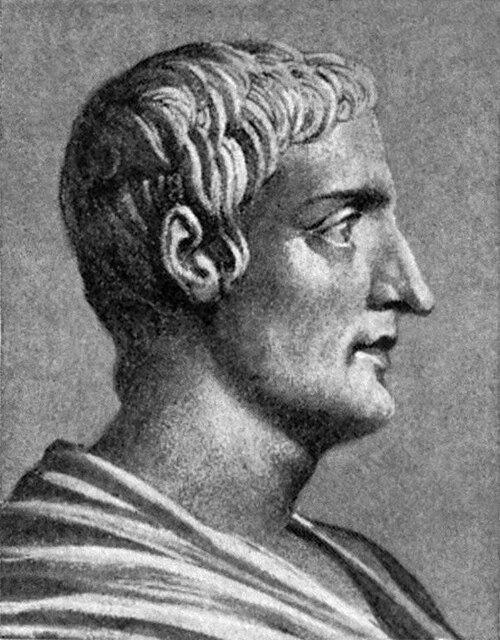
via Wikipedia · CC-BY-SA
67
Ideas
17
Passages
394
Citations
Works cited (2)
Ideas this author touches 67 Ideas · click an Idea to read in context
State23War And Peace21Wealth19Government17Monarchy16God15Tyranny14Revolution13Constitution12Family11Honor11Aristocracy10Law10Liberty10Punishment10Justice9Religion9Slavery8Virtue And Vice8Custom And Convention7Happiness7Democracy6Emotion6Man6Courage5Love5Oligarchy5Opinion5Progress5Prophecy5Rhetoric5Temperance5Citizen4Education4Good And Evil4History4Pleasure And Pain4Truth4Art3Desire3Fate3Language3Life And Death3Memory And Imagination3Prudence3Astronomy2Chance2Knowledge2Medicine2Necessity And Contingency2Philosophy2Poetry2Sign And Symbol2Will2Angel1Cause1Change1Experience1Habit1Immortality1Labor1Logic1Nature1Opposition1Sin1Time1Wisdom1
This MindMap is generated using weights to determine which ideas this thinker debates with others.
Passages by work
The Annals12 passages
Annals, BK n, 35d-36a; BK m, 59d-60c / Histories, BK 11, 214d-215a; BK iv, 293b-294a; BK v, 294d-296a✓ correct
IN the consulship of Sisenna Statilius Taurus and Lucius Libo there was a commotion in the kingdoms and Roman provinces of the East. It had its origin among the Parthians, who disdained as a foreigner a king whom they had sought and received from Rome, though he was of the family of the Arsacids. This was Vonones, who had been given as an hostage to Augustus by Phraates. For although he had… Read the rest of this passage →
Annals, BK xi, 106a-107b✓ correct
The power of his wife Messalina was then at its height. She was, it seems, jealous of a certain Poppaea Sabina, who is mentioned in Book XIII., as “having surpassed in beauty all the ladies of her day.” This Poppaea was the daughter of the Poppaeus Sabinus alluded to in Book VI., and the mother of the more famous Poppaea, afterwards the wife of the emperor Nero. Messalina contrived to involve… Read the rest of this passage →
Annals, BK iv, 72a-b✓ correct
THE year when Caius Asinius and Caius Antistius were consuls was the ninth of Tiberius’s reign, a period of tranquillity for the State and prosperity for his own house, for he counted Germanicus’s death a happy incident. Suddenly fortune deranged everything; the emperor became a cruel tyrant, as well as an abettor of cruelty in others. Of this the cause and origin was Aelius Sejanus, commander of… Read the rest of this passage →
Annals, BK vi, 97b✓ correct
Scribonianus had entered on the consulship when the emperor, after crossing the channel which divides Capreae from Surrentum, sailed along Campania, in doubt whether he should enter Rome, or, possibly, simulating the intention of going thither, because he had resolved otherwise. He often landed at points in the neighborhood, visited the gardens by the Tiber, but went back again to the cliffs and… Read the rest of this passage →
Annals, BK i, lb-2a; 3a-b / His- tories, BK i, 193c-194a✓ correct
ROME at the beginning was ruled by kings. Freedom and the consulship were established by Lucius Brutus. Dictatorships were held for a temporary crisis. The power of the decemvirs did not last beyond two years, nor was the consular jurisdiction of the military tribunes of long duration. The despotisms of Cinna and Sulla were brief; the rule of Pompeius and of Crassus soon yielded before Caesar;… Read the rest of this passage →
Annals, BK xiv, 146b-d✓ correct
IN the year of the consulship of Caius Vipstanus and Caius Fonteius, Nero deferred no more a long meditated crime. Length of power had matured his daring, and his passion for Poppaea daily grew more ardent. As the woman had no hope of marriage for herself or of Octavia’s divorce while Agrippina lived, she would reproach the emperor with incessant vituperation and sometimes call him in jest a mere… Read the rest of this passage →
Annals, BK in, 49c; BK iv, 69a; BK vi, 91b-d✓ correct
WITHOUT pausing in her winter voyage Agrippina arrived at the island of Corcyra, facing the shores of Calabria. There she spent a few days to compose her mind, for she was wild with grief and knew not how to endure. Meanwhile on hearing of her arrival, all her intimate friends and several officers, every one indeed who had served under Germanicus, many strangers too from the neighbouring towns,… Read the rest of this passage →
Annals, BK xn, 117a; BK xvi, 180d- 184a / Histories, BK iv, 271 b ft✓ correct
THE destruction of Messalina shook the imperial house; for a strife arose among the freedmen, who should choose a wife for Claudius, impatient as he was of a single life and submissive to the rule of wives. The ladies were fired with no less jealousy. Each insisted on her rank, beauty, and fortune, and pointed to her claims to such a marriage. But the keenest competition was between Lollia… Read the rest of this passage →
Annals, BK xni, 125d-126a; BK xiv, 153d-155a✓ correct
THE first death under the new emperor, that of Junius Silanus, proconsul of Asia, was, without Nero’s knowledge, planned by the treachery of Agrippina. Not that Silanus had provoked destruction by any violence of temper, apathetic as he was, and so utterly despised under former despotisms, that Caius Caesar used to call him the golden sheep. The truth was that Agrippina, having contrived the… Read the rest of this passage →
Annals, BK xv, 172c-173c; BK xvi, 180d-184a,c✓ correct
MEANWHILE, the Parthian king, Vologeses, when he heard of Corbulo’s achievements and of a foreign prince, Tigranes, having been set over Armenia, though he longed at the same time to avenge the majesty of the Arsacids, which had been insulted by the expulsion of his brother Tiridates, was, on the other hand, drawn to different thoughts as he reflected on the greatness of Rome, and felt reverence… Read the rest of this passage →
Annals, BK xu, lllb-c; BK xiv, 151d-152c✓ correct
XI, which are lost, contained the history of a period of nearly ten years, from A.D. 37 to A.D. 47. These years included the reign of Caius Caesar (Caligula), the son of Germanicus by the elder Agrippina, and the first six years of the reign of Claudius. Caius Caesar’s reign was three years ten months and eight days in duration. Claudius (Tiberius Claudius Drusus Nero Germanicus), the brother of… Read the rest of this passage →
Annals, BK xvi, 183a-c✓ correct
FORTUNE soon afterwards made a dupe of Nero through his own credulity and the promises of Caesellius Bassus, a Carthaginian by birth and a man of a crazed imagination, who wrested a vision seen in the slumber of night into a confident expectation. He sailed to Rome, and having purchased admission to the emperor, he explained how he had discovered on his land a cave of immense depth, which… Read the rest of this passage →
Cited under: Angel · Aristocracy · Art · Astronomy · Cause · Chance · Citizen · Constitution · Courage · Custom And Convention · Democracy · Desire · Education · Emotion · Experience · Family · Fate · God · Good And Evil · Government · Habit · Happiness · History · Honor · Justice · Knowledge · Labor · Language · Law · Liberty · Life And Death · Logic · Love · Man · Medicine · Memory And Imagination · Monarchy · Nature · Necessity And Contingency · Oligarchy · Opinion · Opposition · Philosophy · Pleasure And Pain · Poetry · Progress · Prophecy · Prudence · Punishment · Religion · Revolution · Rhetoric · Sign And Symbol · Sin · Slavery · State · Temperance · Time · Truth · Tyranny · Virtue And Vice · War And Peace · Wealth · Will · Wisdom
Histories5 passages
Histories, BK i, 193c-194a✓ correct
BEGIN my work with the time when Servius Galba was consul for the second time with Titus Vinius for his colleague. Of the former period, the 820 years dating from the founding of the city, many authors have treated; and while they had to record the transactions of the Roman people, they wrote with equal eloquence and freedom. After the conflict at Actium, and when it became essential to peace,… Read the rest of this passage →
Histories, BK v, 295c✓ correct
EARLY in this year Titus Caesar, who had been selected by his father to complete the subjugation of Judaea, and who had gained distinction as a soldier while both were still subjects, began to rise in power and reputation, as armies and provinces emulated each other in their attachment to him. The young man himself, anxious to be thought superior to his station, was ever displaying his… Read the rest of this passage →
Histories, BK n, 227a✓ correct
A distant part of the world fortune was now preparing the origin and rise of a new dynasty, whose varied destinies brought happiness or misery on the State, prosperity or destruction on the Princes of its line. Titus Vespasian had been sent from Judaea by his father while Galba still lived, and alleged as a reason for his journey the homage due to the Emperor, and his age, which now qualified him… Read the rest of this passage →
Histories, BK in, 257c-d✓ correct
UNDER happier auspices and in a more loyal spirit the Flavianist leaders were discussing the plans of the campaign. They had assembled at Petovio, the winter-quarters of the 13th legion. There they debated, whether they should blockade the passes of the Pannonian Alps till the whole strength of their party should be gathered in their rear, or whether it would be the more vigorous policy to close… Read the rest of this passage →
Histories, BK iv, 292c-294a✓ correct
Vitellius was dead, the war had indeed come to an end, but peace had yet to begin. Sword in hand, throughout the capital, the conquerors hunted down the conquered with merciless hatred. The streets were choked with carnage, the squares and temples reeked with blood, for men were massacred everywhere as chance threw them in the way. Soon, as their license increased, they began to search for and… Read the rest of this passage →
Cited under: Aristocracy · Astronomy · Chance · Change · Citizen · Constitution · Courage · Custom And Convention · Desire · Emotion · Family · God · Good And Evil · Government · Happiness · History · Honor · Immortality · Justice · Law · Liberty · Love · Man · Monarchy · Opinion · Pleasure And Pain · Prudence · Punishment · Religion · Revolution · Rhetoric · Slavery · State · Truth · Tyranny · Virtue And Vice · War And Peace · Wealth