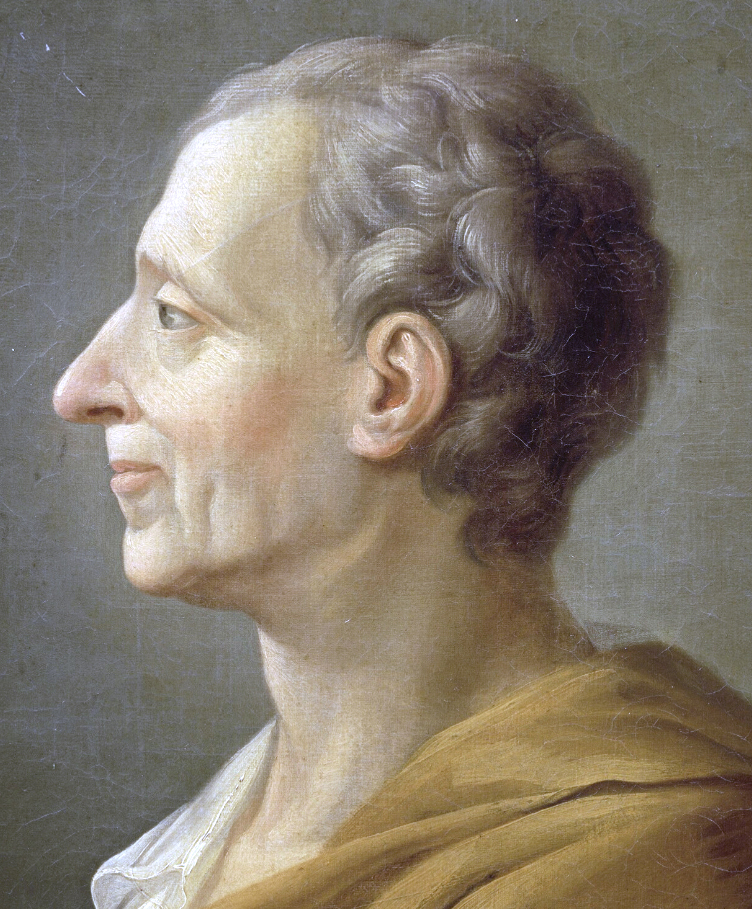
via Wikipedia · CC-BY-SA
70
Ideas
21
Passages
535
Citations
Works cited (1)
Ideas this author touches 70 Ideas · click an Idea to read in context
State42Wealth38Government36Law27Democracy24Justice19Monarchy19Constitution18Family17Religion17Slavery16War And Peace15Punishment14Tyranny14Aristocracy13Man12Custom And Convention11Revolution11Liberty10Citizen9Virtue And Vice9Love8Education7Emotion7God7Honor6Oligarchy6Progress6Courage5Nature5Necessity And Contingency5Temperance5Animal4Art4Happiness4Immortality4Labor4Sense4World4Habit3Knowledge3Mind3Opinion3Pleasure And Pain3Duty2Fate2Good And Evil2Life And Death2One And Many2Opposition2Prudence2Truth2Angel1Being1Cause1Change1Language1Mechanics1Medicine1Philosophy1Poetry1Reasoning1Relation1Rhetoric1Science1Sign And Symbol1Soul1Universal And Particular1Will1Wisdom1
This MindMap is generated using weights to determine which ideas this thinker debates with others.
Passages by work
The Spirit of the Laws21 passages
Spirit of Laws, BK xn, 86d- 87b✓ correct
I.: Of offensive Force.
OFFENSIVE force is regulated by the law of nations; which is the political law of each country, considered in its relation to every other.
CHAP. II.: Of War.
THE life of governments is like that of man. The latter has a right to kill in case of natural defence; the former have a right to wage war for their own preservation.
In the case of natural defence I have a right… Read the rest of this passage →
Spirit of Laws, BK xiv, 103a-c la(4) to \b CHAPTER 2: ANIMAL 31 BK ix, CH 4 [611*9-14] 136d …✓ correct
I.: General Idea.
IF it be true, that the temper of the mind and the passions of the heart are extremely different in different climates, the laws ought to be relative both to the variety of those passions, and to the variety of those tempers.
CHAP. II.: Of the Difference of Men in different Climates.
A cold air* constringes the extremities of the external fibres of the body; this increases… Read the rest of this passage →
Spirit of Laws, BK i, ld-2a✓ correct
I.: Of the Relation of Laws to different Beings.
LAWS, in their most general signification, are the necessary relations arising from the nature of things. In this sense, all beings have their laws; the Deity his* laws, the material world its laws, the intelligence superior to man their laws, the beasts their laws, man his laws.
They who assert, that a blind fatality produced the various effects… Read the rest of this passage →
Spirit of Laws, BK xxin, 190c-d✓ correct
I.: Some general Considerations.
THOUGH commerce be subject to great revolutions, yet it is possible that certain physical causes, as the quality of the soil or the climate, may fix its nature for ever.
We at present carry on the trade of the Indies merely by means of the silver which we send thither. The* Romans carried annually thither about fifty millions of sesterces; and this silver, as… Read the rest of this passage →
Spirit of Laws, BK xvi, 116d- 117a✓ correct
I.: Of domestic Servitude.
SLAVES are established for the family, but they are not a part of it. Thus I distinguish their servitude from that which the women, in some countries, suffer, and which I shall properly call domestic servitude. CHAP. II.: That, in the Countries of the South, there is a natural Inequality between the two Sexes.
WOMEN, in hot climates, are* marriageable at eight, nine,… Read the rest of this passage →
Spirit of Laws, BK n, 6b-7c; BK HI, lOc-lla; BK v, 23a-25a; BK VH, 45b-c✓ correct
I.: Idea of this Book.
THAT the laws of education ought to be relative to the principle of each government has been shewn in the preceding book. Now, the same may be said of those which the legislator gives to the whole society. The relation of laws to this principle strengthens the several springs of government; and this principle derives from thence, in its turn, a new degree of vigour. And… Read the rest of this passage →
Spirit of Laws, BK n, 4a; BK vi, 34d-35a; BK vni, 52c-d; BK xi, 70c; 78d- 79b; BK xv, 109a-b✓ correct
I.: Of the Simplicity of civil Laws in different Governments.
MONARCHIES do not permit of so great a simplicity of laws as despotic governments: for, in monarchies, there must be courts of judicature: these must give their decisions: the decisions must be preserved and learnt, that we may judge in the same manner to-day as yesterday, and that the lives and property of the citizens may be as… Read the rest of this passage →
Spirit of Laws, BK 11, 7c✓ correct
I.: A general Idea.
I make a distinction between the laws that establish political liberty, as it relates to the constitution, and those by which it is established, as it relates to the citizen. The former shall be the subject of this book; the latter I shall examine in the next.
CHAP. II.: Different Significations of the Word, Liberty.
THERE is no word that admits of more various… Read the rest of this passage →
Spirit of Laws, BK ii-ni 4a- 13d✓ correct
I.: Of the Nature of three different Governments.
THERE are three species of government; republican, monarchical, and despotic. In order to discover their nature, it is sufficient to recollect the common notion, which supposes three definitions, or rather three facts: “That a republican government is that in which the body or only a part of the people is possessed of the supreme power: monarchy,… Read the rest of this passage →
Spirit of Laws, BK ix-x 58b,d- 68d✓ correct
I.: In what Manner Republics provide for their Safety.
IF a republic be small, it is destroyed by a foreign force; if it be large, it is ruined by an internal imperfection.
To this twofold inconveniency democracies and aristocracies are equally liable, whether they be good or bad. The evil is in the very thing itself, and no form can redress it.
It is therefore very probable that mankind would… Read the rest of this passage →
Spirit of Laws, BK iv, 17b-✓ correct
I.: Of the Laws of Education.
THE laws of education are the first impressions we receive; and, as they prepare us for civil life, every private family ought to be governed by the plan of that great household which comprehends them all.
If the people in general have a principle, their constituent parts, that is, the several families, will have one also. The laws of education will be therefore… Read the rest of this passage →
Spint of Laws, BK n, 4a-6b; BK xv, 114c-115b; BK xxni, 189a✓ correct
I.: Of civil Slavery.
SLAVERY, properly so called, is the establishment of a right which gives to one man such a power over another as renders him absolute master of his life and fortune. The state of slavery is, in its own nature, bad. It is neither useful to the master nor to the slave; not to the slave, because he can do nothing through a motive of virtue; nor to the master, because, by… Read the rest of this passage →
Spirit of Laws, BK xxiv-xxvi, 200a-215a; BK xxvi, 218a-219d✓ correct
I.: Of Religion in general.
AS amidst several degrees of darkness we may form a judgment of those which are the least thick, and among precipices, which are the least deep; so we may search among false religions for those that are most conformable to the welfare of society; for those which, though they have not the effect of leading men to the felicity of another life, may contribute most to… Read the rest of this passage →
Spirit of Laws, BK XXVIH, 239d-240a✓ correct
I.: Idea of this Book.
MEN are governed by several kinds of laws; by the law of nature; by the divine law, which is that of religion; by ecclesiastical, otherwise called canon law, which is that of religious polity; by the law of nations, which may be considered as the civil law of the whole globe, in which sense every nation is a citizen; by the general political law, which relates to that… Read the rest of this passage →
Spirit of Laws, BK xix, 137c- d; 138c-140c✓ correct
I.: Of the Subject of this Book.
THIS subject is very extensive. In that croud of ideas, which present themselves to my mind, I shall be more attentive to the order of things than to the things themselves. I shall be obliged to wander to the right and to the left, that I may investigate and discover the truth.
CHAP. II.: That it is necessary People’s Minds should be prepared for the Reception… Read the rest of this passage →
Spirit of Laws, BK xxv, 209a-b; 209d-210a; 211a-c✓ correct
I.: Of religious Sentiments.
THE pious man and the atheist always talk of religion; the one speaks of what he loves, and the other of what he fears.
CHAP. II.: Of the Motives of Attachment to different Religions.
THE different religions of the world do not give to those who profess them equal motives of attachment; this depends greatly on the manner in which they agree with the turn of thought… Read the rest of this passage →
Spirit of Laws, BK xxix, 266b-268c✓ correct
I.: Of the Spirit of a Legislator.
I SAY it, and methinks I have undertaken this work with no other view than to prove it; the spirit of a legislator ought to be that of moderation; political, like moral evil, lying always between two extremes. Let us produce an example.
The set forms of justice are necessary to liberty; but the number of them might be so great as to be contrary to the end of… Read the rest of this passage →
Spirit of Laws, BK xx, 148d- 149a; 149c-d 39 SMI m. Wealth of Nations, BK i, 42a,c; 51a-62a passim; BK n, 142d; BK iv 182a-300d passim✓ correct
I.: Of Commerce.
THE following subjects deserve to be treated in a more extensive manner than the nature of this work will permit. Fain would I glide down a gentle river; but I am carried away by a torrent.
Commerce is a cure for the most destructive prejudices; for it is almost a general rule, that whereever we find agreeable manners, there commerce flourishes; and that wherever there is… Read the rest of this passage →
Spirit of Laws, BK xxiii, 191a-c✓ correct
I.: Of Men and Animals, with respect to Multiplication of their Species.
DELIGHT of human kind,‡ and Gods above;
Parent of Rome, propitious queen of love;
* * * * * * * * *
For when the rising spring adorns the mead,
And a new scene of nature stands display’d; When teeming buds, and chearful greens appear,
And western gales unlock the lazy year;
The joyous birds thy welcome first… Read the rest of this passage →
Spirit of Laws, BK xii, 85d; BK xxvi, 222d-223a; BK xxix, 263c✓ correct
I.: Idea of this Book.
IT is not sufficient to have treated of political liberty as relative to the constitution; we must examine it likewise in the relation it bears to the subject.
We have observed, that, in the former case, it arises from a certain distribution of the three powers; but, in the latter, we must consider it in another light. It consists in security, or in the opinion people… Read the rest of this passage →
Spirit of Laws, BK xxx-xxxi 269a-315d passim✓ correct
I.: Of feudal Laws.
I SHOULD think my work imperfect, were I to pass over in silence an event which never again, perhaps, will happen; were I not to speak of those laws which suddenly appeared over all Europe, without being connected with any of the former institutions; of those laws which have done infinite good and infinite mischief; which have suffered rights to remain when the demesne has… Read the rest of this passage →
Cited under: Angel · Animal · Aristocracy · Art · Being · Cause · Change · Citizen · Constitution · Courage · Custom And Convention · Democracy · Duty · Education · Emotion · Family · Fate · God · Good And Evil · Government · Habit · Happiness · Honor · Immortality · Justice · Knowledge · Labor · Language · Law · Liberty · Life And Death · Love · Man · Mechanics · Medicine · Mind · Monarchy · Nature · Necessity And Contingency · Oligarchy · One And Many · Opinion · Opposition · Philosophy · Pleasure And Pain · Poetry · Progress · Prudence · Punishment · Reasoning · Relation · Religion · Revolution · Rhetoric · Science · Sense · Sign And Symbol · Slavery · Soul · State · Temperance · Truth · Tyranny · Universal And Particular · Virtue And Vice · War And Peace · Wealth · Will · Wisdom · World