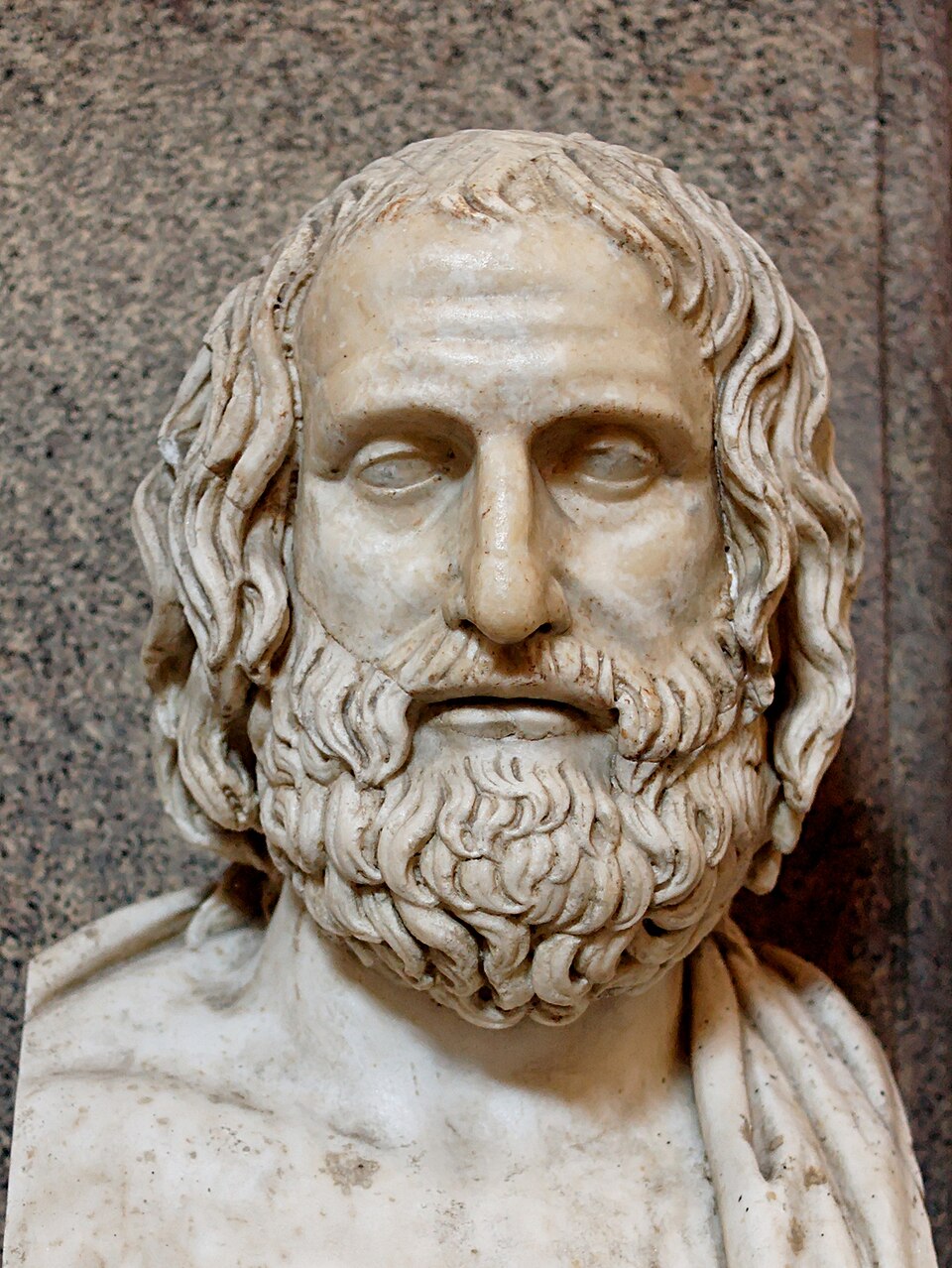
via Wikipedia · CC-BY-SA
66
Ideas
19
Passages
294
Citations
Works cited (19)
Ideas this author touches 66 Ideas · click an Idea to read in context
Justice16Family14Love14Democracy12War And Peace11God10Honor10Law10Tyranny9Courage8Happiness8Punishment8State8Government7Man7Monarchy6Pleasure And Pain6Prophecy6Virtue And Vice6Wealth6Immortality5Life And Death5Religion5Sin5Temperance5Duty4Good And Evil4Knowledge4Mind4Opposition4Wisdom4Citizen3Constitution3Desire3Emotion3Liberty3Prudence3Slavery3Truth3Chance2Custom And Convention2Education2Fate2Language2Memory And Imagination2Nature2Necessity And Contingency2Rhetoric2Sign And Symbol2Time2Will2Angel1Animal1Aristocracy1Art1Astronomy1Cause1Change1Experience1Habit1Infinity1Labor1Medicine1Opinion1Progress1Soul1
This MindMap is generated using weights to determine which ideas this thinker debates with others.
Passages by work
Rhesus1 passage
Rhesus [890-982] 210d-211d/H//7- polytus 225a-236d✓ correct
Lift up thy head! Prop thine arm beneath it! Unseal that louring eye from its repose; thy lowly couch of scattered leaves, O Hector, quit! 'Tis time to hearken.
(Enter HECTOR.)
HECTOR. Who goes there? Is it a friend who calls? Who art thou? Thy watchword? Speak! Who in the dark hours comes nigh my couch, must tell me who he is.
CHORUS. Sentinels we of the army.
HECTOR. Why this tumultuous…
Cited under: Angel · Courage · Fate · God · Honor · Life And Death · Love · Man · Prudence · War And Peace
The Trojan Women1 passage
Trojan Women [669-672] 275d✓ correct
POSEIDON Lo! from the depths of salt Aegean floods I, Poseidon, come, where choirs of Nereids trip in the mazes of the graceful dance; for since the day that Phoebus and myself with measurement exact set towers of stone about this land of Troy and ringed it round, never from my heart hath passed away a kindly feeling for my Phrygian town, which now is smouldering and o'erthrown, a prey to Argive…
Suppliants1 passage
Suppliants [632-730] 264a-d / Trojan Women [1-14] 270a; [511-571] 274b-d / Heracles Mad [188-205] 366d✓ correct
AETHRA O DEMETER, guardian of this Eleusinian land, and ye servants of the goddess who attend her fane, grant happiness to me and my son Theseus, to the city of Athens and the country of Pittheus, wherein my father reared me, Aethra, in a happy home, and gave me in marriage to Aegeus, Pandion's son, according to the oracle of Loxias. This prayer I make, when I behold these aged dames, who,… Read the rest of this passage →
Cited under: Art · Citizen · Constitution · Courage · Democracy · Duty · God · Government · Habit · Happiness · Justice · Labor · Language · Law · Liberty · Life And Death · Love · Man · Mind · Monarchy · Nature · Opposition · Progress · Rhetoric · Slavery · State · Temperance · Tyranny · Virtue And Vice · War And Peace · Wealth
Orestes1 passage
Orestes [1625-1693] 410b-d✓ correct
Electra There is naught so terrible to describe, be it physical pain or heaven-sent affliction, that man's nature may not have to bear the burden of it. Tantalus, they say, once so prosperous,-and I am not now taunting him with his misfortunes,-Tantalus, the reputed son of Zeus, hangs suspended in mid air, quailing at the crag which looms above his head; paying this penalty, they say, for the…
Helen1 passage
Helen [703-733] 304d-305a [94-142] 107b-d;✓ correct
Lo! These are the fair virgin streams of Nile, the river that waters Egypt's tilth, fed by pure melting snow instead of rain from heaven. Proteus during his life-time was king of this land, dwelling in the isle of Pharos, and ruling o'er Egypt; and he took to wife one of the daughters of the sea, Psamathe, after she left the embraces of Aeacus. Two children she bare in this his palace, a son…
Heraclidae1 passage
Heracleidae 248a-257a,c✓ correct
IOLAUS I HOLD this true, and long have held: Nature hath made one man upright for his neighbours' good, while another hath a disposition wholly given over to gain, useless alike to the state and difficult to have dealings with, but for himself the best of men; and this I know, not from mere hearsay. For I, from pure regard and reverence for my kith and kin, though might have lived at peace in…
The Phoenician Women1 passage
Phoenician Maidens [697-747] 384a-d 6 TnucYDWESiPeloponnesian War, BK i,370a-c; BK ii, 402d-403b; 411b-c; BK vn, 555b-557b✓ correct
JOCASTA O SUN-GOD, who cleavest thy way along the starry sky, mounted on golden-studded car, rolling on thy path of flame behind fleet coursers, how curst the beam thou didst shed on Thebes, the day that Cadmus left Phoenicia's realm beside the sea and reached this land! He it was that in days long gone wedded Harmonia, the daughter of Cypris, and begat Polydorus from whom they say sprung…
Cited under: Courage · Happiness · Infinity · Justice · Law · Love · Necessity And Contingency · Opinion · Prophecy · Punishment · Sin · State · Truth · War And Peace · Wealth
Bacchae1 passage
Bacchantes [877-911] 347b-c f Hecuba [798-805] 359d✓ correct
Lo! I am come to this land of Thebes, Dionysus, the son of Zeus, of whom on a day Semele, the daughter of Cadmus, was delivered by a flash of lightning. I have put off the god and taken human shape, and so present myself at Dirce’s springs and the waters of Ismenus. Yonder I see my mother’s monument where the bolt slew her nigh her house, and there are the ruins of her home smouldering with the…
Cited under: Custom And Convention · Experience · God · Happiness · Justice · Knowledge · Law · Medicine · Mind · Pleasure And Pain · Religion · Wisdom
Hecuba1 passage
Hecuba [798-805] 359d / Phoeni- cian Maidens [499-522] 382b-c✓ correct
GHOST Lo! I AM come from out the charnel-house and gates of gloom, where Hades dwells apart from gods, I Polydorus, a son of Hecuba the daughter of Cisseus and of Priam. Now my father, when Phrygia's capital was threatened with destruction by the spear of Hellas, took alarm and conveyed me secretly from the land of Troy unto Polymestor's house, his friend in Thrace, who sows these fruitful plains… Read the rest of this passage →
Cited under: Good And Evil · Honor · Justice · Law · Necessity And Contingency · Sign And Symbol · Wealth
Andromache1 passage
Andromache [147-245] 316c-317b✓ correct
Andromache O CITY of Thebes, glory of Asia, whence on a day I came to Priam's princely home with many a rich and costly thing in my dower, affianced unto Hector to be the mother of his children, I Andromache, envied name in days of yore, but now of all women that have been or yet shall be the most unfortunate; for I have lived to see my husband Hector slain by Achilles, and the babe Astyanax,…
Medea1 passage
Medea [623-641] 217c✓ correct
ATTENDANT Why dost thou, so long my lady's own handmaid, stand here at the gate alone, loudly lamenting to thyself the piteous tale? how comes it that Medea will have thee leave her to herself?
NURSE Old man, attendant on the sons of Jason, our masters' fortunes when they go awry make good slaves grieve and touch their hearts. Oh! have come to such a pitch of grief that there stole a yearning…
Cited under: Desire · Education · Emotion · Family · Happiness · Justice · Love · Man · Monarchy · Pleasure And Pain · Punishment · Temperance · Time · Virtue And Vice · Wisdom
Hippolytus1 passage
Hippolytus 225a-236d✓ correct
APHRODITE WIDE o'er man my realm extends, and proud the name that I, the goddess Cypris, bear, both in heaven's courts and 'mongst all those who dwell within the limits of the sea and the bounds of Atlas, beholding the sun-god's light; those that respect my power I advance to honour, but bring to ruin all who vaunt themselves at me. For even in the race of gods this feeling finds a home, even…
Cited under: Duty · Education · Family · God · Good And Evil · Honor · Knowledge · Love · Mind · Opposition · Pleasure And Pain · Religion · Sin · Temperance · Virtue And Vice · Will
Alcestis1 passage
Alcestis 237a-247a,c✓ correct
Death Ha! Phoebus! You! Before this Palace! Lawlessly would you grasp, abolish the rights of the Lower Gods! Did you not beguile the Fates and snatch Admetus from the grave? Does not that suffice? Now, once again, you have armed your hand with the bow, to guard the daughter of Pelias who must die in her husband's stead!
Apollo Fear not! I hold for right, and proffer you just words.
Death If you…
Cited under: Fate · Good And Evil · Happiness · Honor · Immortality · Love · Man · Pleasure And Pain
Ion1 passage
Ion [585-647] 287d>288b / Bac- chantes [878-91 1] 347b-c✓ correct
I will take care."
To gratify my brother thence I bore
The osier-woven ark, and placed the boy
Here at the temple's base, the wreathed lid
Uncovering, that the infant might be seen.
It chanced, as the orient sun the steep of heav'n
Ascended, to the god's oracular seat
The priestess entering, on the infant cast
Her eye, and marvelled, deeming that some nymph
Of Delphi at the fane had… Read the rest of this passage →
Iphigenia at Aulis1 passage
Iphtgenia at Aulis [543-589] 429d- 430a✓ correct
Agamemnon Old man, come hither and stand before my dwelling.
Attendant I come; what new schemes now, king Agamemnon?
Agamemnon Thou shalt hear.
Attendant I am all eagerness. ’Tis little enough sleep old age allows me and keenly it watches o’er my eyes.
Agamemnon What can that star be, steering his course yonder?
Attendant Sirius, still shooting o’er the zenith on his way near the Pleiads’…
Electra1 passage
Electra [367-400] 330c-d✓ correct
PEASANT O ARGOS, ancient land, and streams of Inachus, whence on a day king Agamemnon sailed to the realm of Troy, carrying his warriors aboard a thousand ships; and after he had slain Priam who was reigning in Ilium and captured the famous city of Dardanus, he came hither to Argos and has set up high on the temple-walls many a trophy, spoil of the barbarians. Though all went well with him in…
Heracles1 passage
Heracles Mad [1313-1353] 376c-d / Iphigenia Among the Tauri [1435-1499] 424a-d✓ correct
AMPHITRYON WHAT mortal hath not heard of him who shared a wife with Zeus, Amphitryon of Argos, whom on a day Alcaeus, son of Perseus begat, Amphitryon the father of Heracles? He it was dwelt here in Thebes, where from the sowing of the dragon's teeth grew up a crop of earth-born giants; for of these Ares saved a scanty band, and their children's children people the city of Cadmus. Hence sprung… Read the rest of this passage →
Iphigenia in Tauris1 passage
Iphigenia Among the Tauri [376- : OT ' 391] 414b✓ correct
Whatever Grecian to this savage shore
Is driven: the previous rites are mine; the deed
Of blood, too horrid to be told, devolves
On others in the temple: but the rest,
In reverence to the goddess, I forbear.
But the strange visions which the night now past
Brought with it, to the air, if that may soothe
My troubled thought, I will relate. I seem'd,
As I lay sleeping, from this land…