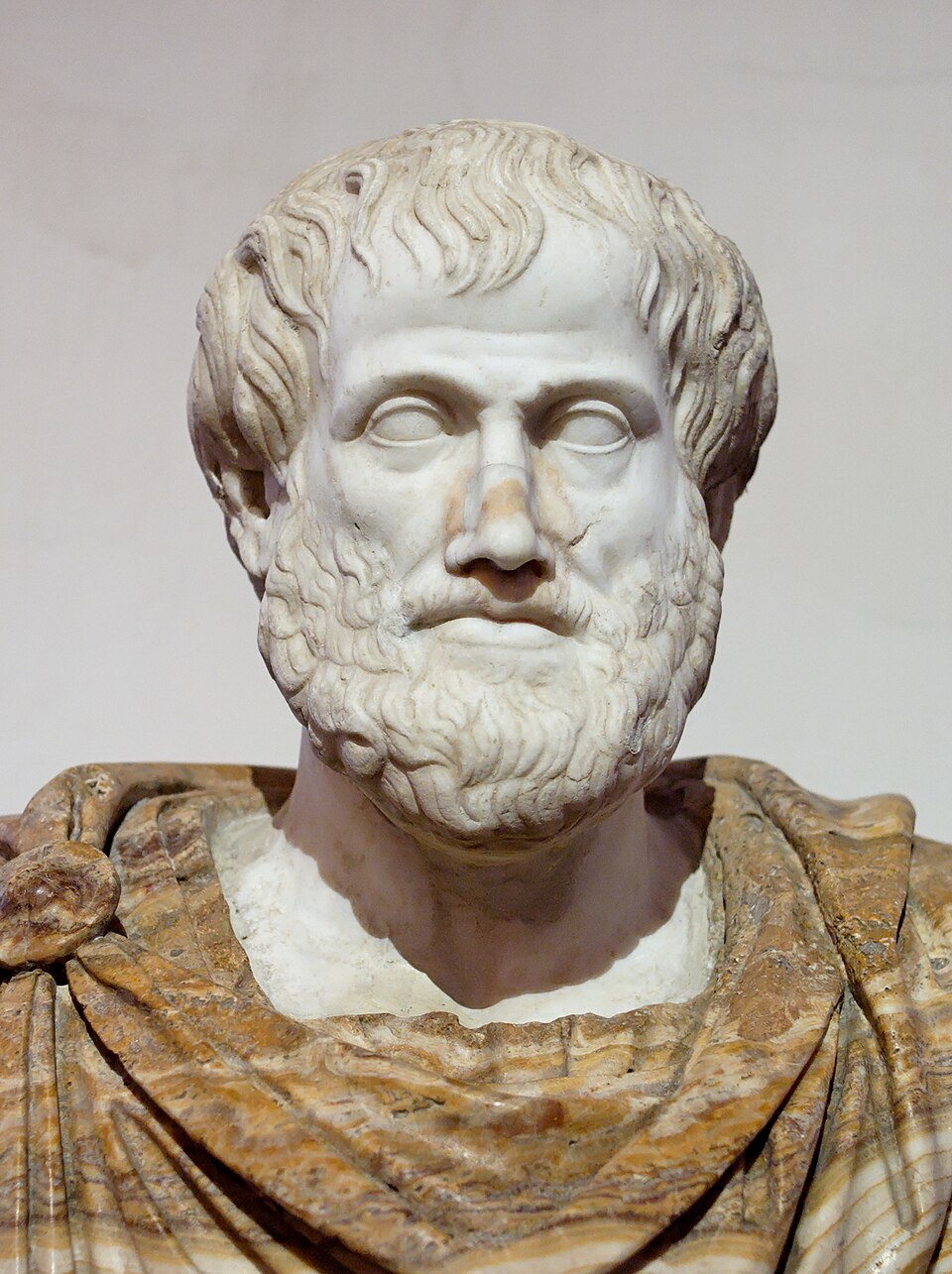
via Wikipedia · CC-BY-SA
102
Ideas
606
Passages
2,330
Citations
Works cited (29)
Nicomachean Ethics68Metaphysics65Politics62Topics47Physics46History of Animals45Prior Analytics28Posterior Analytics27On the Generation of Animals25Rhetoric20The Athenian Constitution18On the Heavens17On the Soul17Categories15On the Parts of Animals12On Generation and Corruption12Poetics12On Sophistical Refutations12On Interpretation11On the Motion of Animals10Meteorology9On Youth, Life, and Breathing6On Sense and the Sensible5On the Gait of Animals4On Sleep and Sleeplessness3On Memory and Reminiscence3On Prophesying by Dreams3On Dreams2On Longevity and Shortness of Life2
Ideas this author touches 102 Ideas · click an Idea to read in context
Animal73Reasoning57Knowledge54State51Change50Sense47Man45Mind45Being42One And Many41Good And Evil40Nature39Justice38Truth38Pleasure And Pain37God36Habit35Memory And Imagination34Wealth34Government33Science33Medicine32Virtue And Vice32Emotion31Sign And Symbol30Will30Law29Desire28Life And Death28Mathematics28Philosophy28Quantity28Art27Love27Necessity And Contingency27Opposition27Principle27Rhetoric27Same And Other27Soul27Astronomy26Education26Poetry26Relation26Democracy24Time24Cause22Universal And Particular22Language21Idea20Quality20Definition19Family19Happiness19Monarchy19Opinion19Form18Labor18Logic18Tyranny18War And Peace18World18Beauty17Constitution17Prudence17Honor16Mechanics16Slavery16Element15Infinity15Space15Aristocracy14Custom And Convention14Liberty14Punishment14Chance13Evolution13Induction13Judgment13Matter13Revolution13Temperance13Wisdom13Experience12Progress11Citizen10Courage10Dialectic10Physics10Eternity9Oligarchy8Religion8Immortality7Hypothesis6Prophecy6Metaphysics5Angel3Duty3History2Theology2Fate1Sin1
This MindMap is generated using weights to determine which ideas this thinker debates with others.
Passages by work
Nicomachean Ethics67 passages
Ethics, BK viii, CH 10 [n6ob 32- n6i a2] 413a-b; CH 11 [n6i ft23-25] 413c / Poli- tics, BK CH 7 [1279*33-37] 476d; CH 9 in, b [1281*2-8] 478c-d …✓ correct
There are three kinds of constitution, and an equal number of deviation-forms — perversions, as it were, of them. The constitutions are monarchy, aristocracy, and thirdly that which is based on a property qualification, which it seems appropriate to call timocratic, though most people are wont to call it polity. The best of these is monarchy, the worst timocracy. The deviation from monarchy is… Read the rest of this passage →
Ethics, BK vin, en n [1161*23-24] 413c / Politics, BK HI, CH 7 [i27Q R 28-38] 476d; CH 15 [i28(> h 3-7J 484d; CH 18 487a,c; BK iv, CH 7 493a b; CH 8 [i294 H 9-24] 493d-494a✓ correct
SINCE we have previously said that one ought to choose that which is intermediate, not the excess nor the defect, and that the intermediate is determined by the dictates of the right rule, let us discuss the nature of these dictates. In all the states of character we have mentioned, as in all other matters, there is a mark to which the man who has the rule looks, and heightens or relaxes his… Read the rest of this passage →
Ethics, BK v, CH 3 [ii3i 24-29] ft✓ correct
(A) We have shown that both the unjust man and the unjust act are unfair or unequal; now it is clear that there is also an intermediate between the two unequals involved in either case. And this is the equal; for in any kind of action in which there’s a more and a less there is also what is equal. If, then, the unjust is unequal, just is equal, as all men suppose it to be, even apart from… Read the rest of this passage →
Ethics, BK i, CH i 339a-b; CH 7 [1097*15-23] 342c / Politics, BK i, CH n 23] 542c-d / Rhetoric, BK i, CH 2 [i355 26~36] 595b / Poetics, CH 1-3 681a<682c✓ correct
EVERY art and every inquiry, and similarly every action and pursuit, is thought to aim at some good; and for this reason the good has rightly been declared to be that at which all things aim. But a certain difference is found among ends; some are activities, others are products apart from the activities that produce them. Where there are ends apart from the actions, it is the nature of the… Read the rest of this passage →
Ethics, BK n, CH i [no3 a26-b i3) b 348d-349a; BK x, CH 9 [ii8o 29-ii8i 23J 435d-436a,c / Rhetoric, BK i, CH i [1354*1-12]✓ correct
AFTER these matters we ought perhaps next to discuss pleasure. For it is thought to be most intimately connected with our human nature, which is the reason why in educating the young we steer them by the rudders of pleasure and pain; it is thought, too, that to enjoy the things we ought and to hate the things we ought has the greatest bearing on virtue of character. For these things extend right… Read the rest of this passage →
Ethics, BK vii, CH ii [ii52b i8-i9 403d; CH 12 [1153*24-27] 404c; BK ix, CH 7 b a CH 3 [ I 337l>2 7- I 338 a29] 543a-c …✓ correct
Now we may ask (1) how a man who judges rightly can behave incontinently. That he should behave so when he has knowledge, some say is impossible; for it would be strange-so Socrates thought-if when knowledge was in a man something else could master it and drag it about like a slave. For Socrates was entirely opposed to the view in question, holding that there is no such thing as incontinence; no… Read the rest of this passage →
Ethics, BK i, CH 7 [1097^3- a b 1098*18] 343a-c; BK n, CH 6 [no6 2o- i5] b 351d-352a; BK vi, CH 5 [ii4O 2o-25] 389c, CH a b 7 [114^9-12] 390a …✓ correct
Let us again return to the good we are seeking, and ask what it can be. It seems different in different actions and arts; it is different in medicine, in strategy, and in the other arts likewise. What then is the good of each? Surely that for whose sake everything else is done. In medicine this is health, in strategy victory, in architecture a house, in any other sphere something else, and in… Read the rest of this passage →
Ethics, BK ix, CH 7 [n67 b 34- n68 a i8] 421b-c / Politics, BK vm, CH 5 544c- 546a; CH 6 [1341*20-23] 546d …✓ correct
Benefactors are thought to love those they have benefited, more than those who have been well treated love those that have treated them well, and this is discussed as though it were paradoxical. Most people think it is because the latter are in the position of debtors and the former of creditors; and therefore as, in the case of loans, debtors wish their creditors did not exist, while creditors… Read the rest of this passage →
Ethics, BK ii, CH 6 351c-352d; BK iv, CH 2 368d-370b; CH 3 [1123^-?] 370b / b Politics, BK HI, CH ii [i28i io-i5] 479b-c; CH b b 13 [i284 3~i2] 482c-d …✓ correct
We must, however, not only describe virtue as a state of character, but also say what sort of state it is. We may remark, then, that every virtue or excellence both brings into good condition the thing of which it is the excellence and makes the work of that thing be done well; e.g. the excellence of the eye makes both the eye and its work good; for it is by the excellence of the eye that we see… Read the rest of this passage →
Ethics, BK n, CH i [ii03*26-b24] 348d-349b; CH 5 [1106*7-10] 351c
EVERY art and every inquiry, and similarly every action and pursuit, is thought to aim at some good; and for this reason the good has rightly been declared to be that at which all things aim. But a certain difference is found among ends; some are activities, others are products apart from the activities that produce them. Where there are ends apart from the actions, it is the nature of the…
Ethics, BK i, CH 6 341b-342c pas- sim✓ correct
We had perhaps better consider the universal good and discuss thoroughly what is meant by it, although such an inquiry is made an uphill one by the fact that the Forms have been introduced by friends of our own. Yet it would perhaps be thought to be better, indeed to be our duty, for the sake of maintaining the truth even to destroy what touches us closely, especially as we are philosophers or… Read the rest of this passage →
Ethics, BK in, CH 3 [iii2 i8- i2] b b 358a-c / Rhetoric, BK i, CH 10 [i368 7-i369 27J 611d-613a✓ correct
Our discussion will be adequate if it has as much clearness as the subject-matter admits of, for precision is not to be sought for alike in all discussions, any more than in all the products of the crafts. Now fine and just actions, which political science investigates, admit of much variety and fluctuation of opinion, so that they may be thought to exist only by convention, and not by nature.… Read the rest of this passage →
Ethics, BK x, CH 8 [1179*23-32] 434a / Politics, BK vn, CH 4 [1326*29-32] 530b-c✓ correct
But in a secondary degree the life in accordance with the other kind of virtue is happy; for the activities in accordance with this befit our human estate. Just and brave acts, and other virtuous acts, we do in relation to each other, observing our respective duties with regard to contracts and services and all manner of actions and with regard to passions; and all of these seem to be typically… Read the rest of this passage →
Ethics, BK i, CH 9 [i099 b 8-24] 345a-b✓ correct
For this reason also the question is asked, whether happiness is to be acquired by learning or by habituation or some other sort of training, or comes in virtue of some divine providence or again by chance. Now if there is any gift of the gods to men, it is reasonable that happiness should be god-given, and most surely god-given of all human things inasmuch as it is the best. But this question… Read the rest of this passage →
Ethics, BK x, CH 4 [ii74*i2-b i4] 428b-429a✓ correct
What pleasure is, or what kind of thing it is, will become plainer if we take up the question again from the beginning. Seeing seems to be at any moment complete, for it does not lack anything which coming into being later will complete its form; and pleasure also seems to be of this nature. For it is a whole, and at no time can one find a pleasure whose form will be completed if the pleasure… Read the rest of this passage →
Ethics, BK vn, CH 14 [11 54^0-30] 406c✓ correct
WITH regards to justice and injustice we must (1) consider what kind of actions they are concerned with, (2) what sort of mean justice is, and (3) between what extremes the just act is intermediate. Our investigation shall follow the same course as the preceding discussions.
We see that all men mean by justice that kind of state of character which makes people disposed to do what is just and… Read the rest of this passage →
Ethics, BK i, CH 2 [io94 b 5~io] 339c-d; BK v, CH n [1138*4-13] 386b-c / Politics, BK i, CH 2 [1253*19-39] 446c-d; BK n, CH i [i26ob37-i26i a7J 455b,d; CH 2 [1261*15- 1 tola CHAPTER 11: CITIZEN 227✓ correct
If, then, there is some end of the things we do, which we desire for its own sake (everything else being desired for the sake of this), and if we do not choose everything for the sake of something else (for at that rate the process would go on to infinity, so that our desire would be empty and vain), clearly this must be the good and the chief good. Will not the knowledge of it, then, have a… Read the rest of this passage →
Ethics, BK v, CH 6 [ii34*24-b i7] 382a-c✓ correct
Since acting unjustly does not necessarily imply being unjust, we must ask what sort of unjust acts imply that the doer is unjust with respect to each type of injustice, e.g. a thief, an adulterer, or a brigand. Surely the answer does not turn on the difference between these types. For a man might even lie with a woman knowing who she was, but the origin of his might be not deliberate choice but… Read the rest of this passage →
Ethics, BK vin, CH 10 [1160*31- b 22] 412c-413a / Politics, BK H, CH 7-11 461d- 470b, BK in, CH 5 [1278*3-33] 475a-c; CH 6-9 475d-478d✓ correct
Understanding, also, and goodness of understanding, in virtue of which men are said to be men of understanding or of good understanding, are neither entirely the same as opinion or scientific knowledge (for at that rate all men would have been men of understanding), nor are they one of the particular sciences, such as medicine, the science of things connected with health, or geometry, the science… Read the rest of this passage →
Ethics,** vm, CH 10 [n6o*3i-b 22] 412c-413a / Politics, BK n, CH 12 [i273 b 36- 1274*22] 470c-d; BK in, CH 3 [i276*35- i5] 473b-c …✓ correct
Must no one at all, then, be called happy while he lives; must we, as Solon says, see the end? Even if we are to lay down this doctrine, is it also the case that a man is happy when he is dead? Or is not this quite absurd, especially for us who say that happiness is an activity? But if we do not call the dead man happy, and if Solon does not mean this, but that one can then safely call a man… Read the rest of this passage →
Ethics, BK x, CH 9 [1181*13-24] 436c / Politics, BK n, CH 12 470b-471d; BK in, CH i> [i286b 8-2i] 484d-485a; BK iv, CH 13 [1297^16-28] 498a …✓ correct
If these matters and the virtues, and also friendship and pleasure, have been dealt with sufficiently in outline, are we to suppose that our programme has reached its end? Surely, as the saying goes, where there are things to be done the end is not to survey and recognize the various things, but rather to do them; with regard to virtue, then, it is not enough to know, but we must try to have and… Read the rest of this passage →
Ethics, BK n, CH 2 [ii04 R i9]-cH 3 b B b [no4 i3] 349c-350a; CH 7 [no7 32- 3] 353a; CH 8 354a-d; BK m, CH 6 [n 15*10-24] 361a-b; CH 7 361c-362b …
Eudoxus thought pleasure was the good because he saw all things, both rational and irrational, aiming at it, and because in all things that which is the object of choice is what is excellent, and that which is most the object of choice the greatest good; thus the fact that all things moved towards the same object indicated that this was for all things the chief good (for each thing, he argued,…
Ethics, BK n, CH 2 [ii04*i9]-cH 3 b [m8b28-34] 365b-c; CH 12 [111^21-^] 365d- sim; BK vi, CH 13 [ii44 i-ii45 5] 394a-d; BK ix, CH 4 [i i66 8~i2] 419d …✓ correct
The virtue of a thing is relative to its proper work. Now there are three things in the soul which control action and truth-sensation, reason, desire.
Of these sensation originates no action; this is plain from the fact that the lower animals have sensation but no share in action.
What affirmation and negation are in thinking, pursuit and avoidance are in desire; so that since moral virtue is a… Read the rest of this passage →
Ethics, BK in, CH 8 [in6 i5-b 3] ft 611c; EPILOGUE i, 648b-c; 668a-669c b 362b-d; BKV, CHI [ii29 i9-24]377a/ Politics, BK in, CH 4 [i277 a 8-25] 474a-b …✓ correct
We must consider it, however, in the light not only of our conclusion and our premisses, but also of what is commonly said about it; for with a true view all the data harmonize, but with a false one the facts soon clash. Now goods have been divided into three classes, and some are described as external, others as relating to soul or to body; we call those that relate to soul most properly and… Read the rest of this passage →
Ethics, BK v, CH 7 [ii34b i8-ii35 a 7] 382c-383a / Politics, BK i, CH 2 445b-446d a✓ correct
Of political justice part is natural, part legal, natural, that which everywhere has the same force and does not exist by people’s thinking this or that; legal, that which is originally indifferent, but when it has been laid down is not indifferent, e.g. that a prisoner’s ransom shall be a mina, or that a goat and not two sheep shall be sacrificed, and again all the laws that are passed for… Read the rest of this passage →
Ethics, BK vm, CH 10 [1161*7-9] par 303 413b / Politics, BK iv, CH 2 [i289*35-b n] b 488b-c; CH 4 [1292*4-37] 491b-d; CH 6 [i292 40-1293*9] 492c …
AFTER these matters we ought perhaps next to discuss pleasure. For it is thought to be most intimately connected with our human nature, which is the reason why in educating the young we steer them by the rudders of pleasure and pain; it is thought, too, that to enjoy the things we ought and to hate the things we ought has the greatest bearing on virtue of character. For these things extend right… Read the rest of this passage →
Ethics, BK ix, CH 6 420c-421a / Politics, BK v, CH 9 [i309 i4-i3ioi2] 511d- 512b / Athenian Constitution, CH 5 554d-555a;✓ correct
Unanimity also seems to be a friendly relation. For this reason it is not identity of opinion; for that might occur even with people who do not know each other; nor do we say that people who have the same views on any and every subject are unanimous, e.g. those who agree about the heavenly bodies (for unanimity about these is not a friendly relation), but we do say that a city is unanimous when… Read the rest of this passage →
Ethics, BK n, CH i 348b,d-349b; CH 5 351b-c✓ correct
Let us, however, resume our discussion from the point at which we digressed. To judge from the lives that men lead, most men, and men of the most vulgar type, seem (not without some ground) to identify the good, or happiness, with pleasure; which is the reason why they love the life of enjoyment. For there are, we may say, three prominent types of life — that just mentioned, the political, and…
Ethics, BK vn 395a-406a,c✓ correct
WITH regards to justice and injustice we must (1) consider what kind of actions they are concerned with, (2) what sort of mean justice is, and (3) between what extremes the just act is intermediate. Our investigation shall follow the same course as the preceding discussions.
We see that all men mean by justice that kind of state of character which makes people disposed to do what is just and…
Ethics, BK i, CH 13 [iio2 b i3-no3* 3] 348a-c; BK in, CH 10-12 364b-366a,c; BK vi, CH 2 387d-388b …✓ correct
Since happiness is an activity of soul in accordance with perfect virtue, we must consider the nature of virtue; for perhaps we shall thus see better the nature of happiness. The true student of politics, too, is thought to have studied virtue above all things; for he wishes to make his fellow citizens good and obedient to the laws. As an example of this we have the lawgivers of the Cretans and… Read the rest of this passage →
Ethics, BK in, CH 12 [ni9 6-i2] 366c / Politics, BK i, CH 9 [1257*^8 1258*14] 452a-b✓ correct
These questions having been definitely answered, let us consider whether happiness is among the things that are praised or rather among the things that are prized; for clearly it is not to be placed among potentialities. Everything that is praised seems to be praised because it is of a certain kind and is related somehow to something else; for we praise the just or brave man and in general both… Read the rest of this passage →
Ethics, BK ix, CH 8 [n68 b 28- 1160*11] 422b-d / Politics, BK i, CH 5 [1254 jS-bgj 447d-448a✓ correct
The question is also debated, whether a man should love himself most, or some one else. People criticize those who love themselves most, and call them self-lovers, using this as an epithet of disgrace, and a bad man seems to do everything for his own sake, and the more so the more wicked he is-and so men reproach him, for instance, with doing nothing of his own accord-while the good man acts for… Read the rest of this passage →
Ethics, BK iv, CH 9 [ii28 b io-2o] b 375d-376a; BK vi, CH 13 [ii44 i-i7] 394b; BK vii, CH 4 [1148*18-22] 398c; CH 5 399a-d / Rhetoric,BK i, CH 10 [1369*5-29] 612b-c; n, CH 12-14 636a-638a✓ correct
Shame should not be described as a virtue; for it is more like a feeling than a state of character. It is defined, at any rate, as a kind of fear of dishonour, and produces an effect similar to that produced by fear of danger; for people who feel disgraced blush, and those who fear death turn pale. Both, therefore, seem to be in a sense bodily conditions, which is thought to be characteristic of… Read the rest of this passage →
Ethics, BK iv, CH i [ii2i b 28-3o] 368c / Politics, BK n, CH 9 [1271*9-17] 467b; BK in, CH 15 [1286*17-20] 484b-c; [1286*33- 37] 484d; CH 16 [i287 28~39] 485d …✓ correct
LET us speak next of liberality. It seems to be the mean with regard to wealth; for the liberal man is praised not in respect of military matters, nor of those in respect of which the temrate man is praised, nor of judicial decisions, but with regard to the giving and taking of wealth, and especially in respect of giving. Now by ‘wealth’ we mean all the things whose value is measured by money.… Read the rest of this passage →
Ethics, 341c-d; BK vi, CH 3 [in9 18-24] 388b-c✓ correct
Let us begin, then, from the beginning, and discuss these states once more. Let it be assumed that the states by virtue of which the soul possesses truth by way of affirmation or denial are five in number, i.e. art, scientific knowledge, practical wisdom, philosophic wisdom, intuitive reason; we do not include judgement and opinion because in these we may be mistaken.
Now what scientific… Read the rest of this passage →
Ethics, BK i, CH 4 [io95*3o-b 8] 340c; BK vi, CH 8 [1142*12-19] 391 b; CH n [n43*34- 6] 392d-393a / Rhetoric, BK n, CH 20 [i393*25- 3 ] 641a✓ correct
Let us resume our inquiry and state, in view of the fact that all knowledge and every pursuit aims at some good, what it is that we say political science aims at and what is the highest of all goods achievable by action. Verbally there is very general agreement; for both the general run of men and people of superior refinement say that it is happiness, and identify living well and doing well with… Read the rest of this passage →
Ethics, BK vin, CH 12 [n6i i6-32] 414a-b / Politics, BK i, CH 12 453d-454a; BK n, CH 3 [1262*14-24] 457a; BK vn, CH 16-17 b 539d-542a,c / Rhetoric, BK i, CH 5 [i36o 9- 1361*1 i]601a-c✓ correct
Difficulties might be raised as to the utility of these qualities of mind. For (1) philosophic wisdom will contemplate none of the things that will make a man happy (for it is not concerned with any coming into being), and though practical wisdom has this merit, for what purpose do we need it? Practical wisdom is the quality of mind concerned with things just and noble and good for man, but these… Read the rest of this passage →
Ethics, BK vii, CH 6 [ii49b 4 13] 400a; BK vin, CH 10 [n6o 23-33] 413a, CH 12 413d414d passim / Politics, BK i, en 12 [i259b 10- 1 6] 454a✓ correct
That incontinence in respect of anger is less disgraceful than that in respect of the appetites is what we will now proceed to see. (1) Anger seems to listen to argument to some extent, but to mishear it, as do hasty servants who run out before they have heard the whole of what one says, and then muddle the order, or as dogs bark if there is but a knock at the door, before looking to see if it is… Read the rest of this passage →
Ethics, BK 11, CH 6 [no6b 28-35] 352b-c✓ correct
Now that we have spoken of the virtues, the forms of friendship, and the varieties of pleasure, what remains is to discuss in outline the nature of happiness, since this is what we state the end of human nature to be. Our discussion will be the more concise if we first sum up what we have said already. We said, then, that it is not a disposition; for if it were it might belong to some one who was…
Ethics, BK III,CH 1-5 355b,d-361a; BK iv, CH 9 [ii28 b2o-3o] 376a,c✓ correct
SINCE virtue is concerned with passions and actions, and on voluntary passions and actions praise and blame are bestowed, on those that are involuntary pardon, and sometimes also pity, to distinguish the voluntary and the involuntary is presumably necessary for those who are studying the nature of virtue, and useful also for legislators with a view to the assigning both of honours and of… Read the rest of this passage →
Ethics, BK vi, CH 8 [ii4i b 28-ii42a n] 390d-391a / Politics, BK i, CH i [1252*1-6] 445a; BK n, CH i-5455b,d-460a; BK in, cn6~7 b 475d-477a; BK iv, CH n [i295 25~ i] 495b-c ft✓ correct
Political wisdom and practical wisdom are the same state of mind, but their essence is not the same. Of the wisdom concerned with the city, the practical wisdom which plays a controlling part is legislative wisdom, while that which is related to this as particulars to their universal is known by the general name ‘political wisdom’; this has to do with action and deliberation, for a decree is a… Read the rest of this passage →
Ethics, BK vn, CH 10 [1152*28- 33] 403b / Rhetoric, BK i, CH 11 [1370*5-8] 613b✓ correct
Our next subject is equity and the equitable (to epiekes), and their respective relations to justice and the just. For on examination they appear to be neither absolutely the same nor generically different; and while we sometime praise what is equitable and the equitable man (so that we apply the name by way of praise even to instances of the other virtues, instead of ‘good’ meaning by… Read the rest of this passage →
Ethics, BK x, CH 7-8 431d-434a b passim✓ correct
If happiness is activity in accordance with virtue, it is reasonable that it should be in accordance with the highest virtue; and this will be that of the best thing in us. Whether it be reason or something else that is this element which is thought to be our natural ruler and guide and to take thought of things noble and divine, whether it be itself also divine or only the most divine element in… Read the rest of this passage →
Ethics, BK iv, CH 3-4 370b 372d; CH 9375d-376a,c; BK x, CH 9 [n79b 4-n8o"ii] 434b-d / Rhetoric, BK n, CH 6 629d-631c in virtue and happiness✓ correct
Pride seems even from its name to be concerned with great things; what sort of great things, is the first question we must try to answer. It makes no difference whether we consider the state of character or the man characterized by it. Now the man is thought to be proud who thinks himself worthy of great things, being worthy of them; for he who does so beyond his deserts is a fool, but no… Read the rest of this passage →
Ethics, BK iv, CH 6 373d-374b; BK vin, CH 8 [1159*13-26] 411b; CH 14 415d- 416d; BK ix, CH 2 [n65 i5-35J 418a-b, CH 8 ft cabees, 3.1-9; 5.63-64; 9:19-21; 10:59-65; a [1168*28-34] 421d-422a; [n69 i2- 2] 422d- 423a✓ correct
In gatherings of men, in social life and the interchange of words and deeds, some men are thought to be obsequious, viz. those who to give pleasure praise everything and never oppose, but think it their duty ‘to give no pain to the people they meet’; while those who, on the contrary, oppose everything and care not a whit about giving pain are called churlish and contentious. That the states we… Read the rest of this passage →
Ethics, BK v, CH 2 [n3o b 3o-34] b 378b; CH 3 [i 131*24-29] 378d; CH 6 [ii34 i-7J 454a; BK n, CH n [i273 32- 7] 469d-470a; BK b a b 382b …✓ correct
But at all events what we are investigating is the justice which is a part of virtue; for there is a justice of this kind, as we maintain. Similarly it is with injustice in the particular sense that we are concerned.
That there is such a thing is indicated by the fact that while the man who exhibits in action the other forms of wickedness acts wrongly indeed, but not graspingly (e.g. the man who… Read the rest of this passage →
Ethics, BK vn, CH 8 [1151*15-19] 402a✓ correct
Acts just and unjust being as we have described them, a man acts unjustly or justly whenever he does such acts voluntarily; when involuntarily, he acts neither unjustly nor justly except in an incidental way; for he does things which happen to be just or unjust. Whether an act is or is not one of injustice (or of justice) is determined by its voluntariness or involuntariness; for when it is… Read the rest of this passage →
Ethics, BK vi, CH 9 [ii42b7~i2] 391d / Rhetoric, BK i, CH i [1355*21-39] 594c-d✓ correct
There is a difference between inquiry and deliberation; for deliberation is inquiry into a particular kind of thing. We must grasp the nature of excellence in deliberation as well whether it is a form of scientific knowledge, or opinion, or skill in conjecture, or some other kind of thing. Scientific knowledge it is not; for men do not inquire about the things they know about, but good… Read the rest of this passage →
Ethics, BK vi, CH 6 389d; CH 7 [1141*20-34] 390a-b; [114^14-20] 390c-d; CH n a 13-23] 435b-c / Rhetoric, BK i, CH 2 [i356b 28-35] 596b-c✓ correct
Scientific knowledge is judgement about things that are universal and necessary, and the conclusions of demonstration, and all scientific knowledge, follow from first principles (for scientific knowledge involves apprehension of a rational ground). This being so, the first principle from which what is scientifically known follows cannot be an object of scientific knowledge, of art, or of… Read the rest of this passage →
Ethics, BK iv, CH 8 [1128*18-25] 375b-c / Politics, BK vm, CH 7 [1342*32^18] 548a,c / Rhetoric, BK in, CH 1-12 653b,d- 667b …✓ correct
Since life includes rest as well as activity, and in this is included leisure and amusement, there seems here also to be a kind of intercourse which is tasteful; there is such a thing as sayingand again listening to — what one should and as one should. The kind of people one is speaking or listening to will also make a difference. Evidently here also there is both an excess and a deficiency as… Read the rest of this passage →
Ethics, BK v, CH 4 379b-380b✓ correct
(B) The remaining one is the rectificatory, which arises in connexion with transactions both voluntary and involuntary. This form of the just has a different specific character from the former. For the justice which distributes common possessions is always in accordance with the kind of proportion mentioned above (for in the case also in which the distribution is made from the common funds of a… Read the rest of this passage →
Ethics, BK m, CH 3 [im a i8-b i2] 358a-c
Nor again, if pleasure is not a quality, does it follow that it is not a good; for the activities of virtue are not qualities either, nor is happiness. They say, however, that the good is determinate, while pleasure is indeterminate, because it admits of degrees. Now if it is from the feeling of pleasure that they judge thus, the same will be true of justice and the other virtues, in respect of…
Ethics, BK ix, CH 9 [i 170*1 3- 8] 423d-424b; BK x, CH 4 [1175*10-22] 429c / problem of suicide BK n, CH 13 [i389b 32-35] 637b Rhetoric,✓ correct
It is also disputed whether the happy man will need friends or not. It is said that those who are supremely happy and self-sufficient have no need of friends; for they have the things that are good, and therefore being self-sufficient they need nothing further, while a friend, being another self, furnishes what a man cannot provide by his own effort; whence the saying ‘when fortune is kind, what… Read the rest of this passage →
Ethics, BK HI, CH 3 [ni2 b 2o-24] 358d; BK vii, OH 8 [1151*15-19] 402a✓ correct
Of some such kind are the difficulties that arise; some of these points must be refuted and the others left in possession of the field; for the solution of the difficulty is the discovery of the truth. (1) We must consider first, then, whether incontinent people act knowingly or not, and in what sense knowingly; then (2) with what sorts of object the incontinent and the continent man may be said… Read the rest of this passage →
Ethics, BK n, CH 5 [no5 b 2o-23J b 351b; BK iv, CH 6 [ii26 2o-25] 373d; BK vm, CH i 406b,d-407a✓ correct
Good temper is a mean with respect to anger; the middle state being unnamed, and the extremes almost without a name as well, we place good temper in the middle position, though it inclines towards the deficiency, which is without a name. The excess might called a sort of ‘irascibility’. For the passion is anger, while its causes are many and diverse.
The man who is angry at the right things and… Read the rest of this passage →
Ethics, BK vn, CH 5 399a-d pas- sim✓ correct
Some think that reciprocity is without qualification just, as the Pythagoreans said; for they defined justice without qualification as reciprocity. Now ‘reciprocity’ fits neither distributive nor rectificatory justice-yet people want even the justice of Rhadamanthus to mean this:
Should a man suffer what he did, right justice would be done -for in many cases reciprocity and rectificatory justice… Read the rest of this passage →
Ethics, BKI, CH n 346c-347a; BK iv,cH6373d'374bpassira; BXVIII,CHI (1155* b 1-32] 406b,d; CH 2 [n55 i6-26] 407a-b; CH 3 h [ii56 6-32] 408a-c; CH 4-5 408c-409d …
It would seem proper to discuss magnificence next. For this also seems to be a virtue concerned with wealth; but it does not like liberality extend to all the actions that are concerned with wealth, but only to those that involve expenditure; and in these it surpasses liberality in scale. For, as the name itself suggests, it is a fitting expenditure involving largeness of scale. But the scale is… Read the rest of this passage →
Ethics, BK vi, CH 7 [ii4i a 2o-b2] 390a-b / Politics, BK i, CH 8 [1256! 5-22] 450c✓ correct
Wisdom (1) in the arts we ascribe to their most finished exponents, e.g. to Phidias as a sculptor and to Polyclitus as a maker of portrait-statues, and here we mean nothing by wisdom except excellence in art; but (2) we think that some people are wise in general, not in some particular field or in any other limited respect, as Homer says in the Margites,
Him did the gods make neither a digger… Read the rest of this passage →
Ethics, BK ix, CH i [n64 B22-b 6] 436a,c✓ correct
IN all friendships between dissimilars it is, as we have said, proportion that equalizes the parties and preserves the friendship; e.g. in the political form of friendship the shoemaker gets a return for his shoes in proportion to his worth, and the weaver and all other craftsmen do the same. Now here a common measure has been provided in the form of money, and therefore everything is referred to… Read the rest of this passage →
Ethics, BK n, CH 4 [iio5b 5~i9] 351a-b; BK vi, CH 7 [114^34^8] 390b-c / Politics, BK i, CH n [1259^ -21] 453b-c 12 P>ICTETUS: Discourses, BK i, en 22 127c-128c …✓ correct
In the variable are included both things made and things done; making and acting are different (for their nature we treat even the discussions outside our school as reliable); so that the reasoned state of capacity to act is different from the reasoned state of capacity to make. Hence too they are not included one in the other; for neither is acting making nor is making acting. Now since… Read the rest of this passage →
Ethics, BK n, CH 9 [no9b i~i3] 355a,c; BK HI, CH 12 [1119*22-31] 365d-366a; BK vn, en 6 [1149^0-1150*8] 400b-c; BK ix, CH 7 [1168*9-18] 421c
Assuming that we have sufficiently defined the suffering and doing of injustice, it may be asked (1) whether the truth in expressed in Euripides’ paradoxical words:
I slew my mother, that’s my tale in brief.
Were you both willing, or unwilling both?
Is it truly possible to be willingly treated unjustly, or is all suffering of injustice the contrary involuntary, as all unjust action is… Read the rest of this passage →
Ethics, BK n, CH 7 [1108*23-26] 353d; BK iv, CH 8 375a-d; BK vn, CH 14 b b [ii54 22- i9] 405c-406a,c …✓ correct
The mean opposed to boastfulness is found in almost the same sphere; and this also is without a name. It will be no bad plan to describe these states as well; for we shall both know the facts about character better if we go through them in detail, and we shall be convinced that the virtues are means if we see this to be so in all cases. In the field of social life those who make the giving of… Read the rest of this passage →
Ethics, BK vi, CH 5 [ii4ob 4-n] b 389b; CH 8 [ii4i 23-i 142*12] 390d-391a; BK x, en 9 434a-436a,c / Politics, BK in, CH 4 473c-475a; CH n 479b-480c …✓ correct
Regarding practical wisdom we shall get at the truth by considering who are the persons we credit with it. Now it is thought to be the mark of a man of practical wisdom to be able to deliberate well about what is good and expedient for himself, not in some particular respect, e.g. about what sorts of thing conduce to health or to strength, but about what sorts of thing conduce to the good life in… Read the rest of this passage →
Ethics, BK ix, CH 4 [n66 bn-24] 419d-420a✓ correct
Friendly relations with one’s neighbours, and the marks by which friendships are defined, seem to have proceeded from a man’s relations to himself. For (1) we define a friend as one who wishes and does what is good, or seems so, for the sake of his friend, or (2) as one who wishes his friend to exist and live, for his sake; which mothers do to their children, and friends do who have come into… Read the rest of this passage →
Ethics, BK v, CH 11 [ii38 b 5~i4] a [i29 30-i3o i] 180a / Metaphysics, BK iv, en 2 a b 387a,c / Rhetoric, BK in, CH 2 [i 404^7- b b I45 3l 655a-d …✓ correct
Whether a man can treat himself unjustly or not, is evident from what has been said. For (a) one class of just acts are those acts in accordance with any virtue which are prescribed by the law; e.g. the law does not expressly permit suicide, and what it does not expressly permit it forbids. Again, when a man in violation of the law harms another (otherwise than in retaliation) voluntarily, he… Read the rest of this passage →
Ethics, BK ix, CH 10 [ii7o 29-34J 424c / Politics, BK n, CH 6 [1265*10-18] 460b-c; b [i265*38- i7] 460d-461a; CH 9 [i27o*i5- 6] b 466b-c …✓ correct
Should we, then, make as many friends as possible, or-as in the case of hospitality it is thought to be suitable advice, that one should be ‘neither a man of many guests nor a man with none’-will that apply to friendship as well; should a man neither be friendless nor have an excessive number of friends?
To friends made with a view to utility this saying would seem thoroughly applicable; for to… Read the rest of this passage →
Ethics, BK n, CH 7 [1107*27-31] 356c-d; BK vii, CH 3 [n 46^5-1 147*9] 397a-b; [ii47*25- i8]397c-398a✓ correct
With regard to the pleasures and pains and appetites and aversions arising through touch and taste, to which both self-indulgence and temperance were formerly narrowed down, it possible to be in such a state as to be defeated even by those of them which most people master, or to master even those by which most people are defeated; among these possibilities, those relating to pleasures are… Read the rest of this passage →
Cited under: Aristocracy · Art · Beauty · Being · Cause · Chance · Change · Citizen · Constitution · Courage · Custom And Convention · Definition · Democracy · Desire · Education · Emotion · Eternity · Experience · Family · Fate · Form · God · Good And Evil · Government · Habit · Happiness · Honor · Hypothesis · Immortality · Induction · Infinity · Judgment · Justice · Knowledge · Labor · Language · Law · Liberty · Life And Death · Logic · Love · Man · Mathematics · Medicine · Memory And Imagination · Metaphysics · Mind · Monarchy · Nature · Necessity And Contingency · Oligarchy · One And Many · Opinion · Opposition · Philosophy · Pleasure And Pain · Poetry · Principle · Progress · Prudence · Punishment · Quality · Quantity · Reasoning · Relation · Religion · Rhetoric · Same And Other · Science · Sense · Sign And Symbol · Sin · Slavery · Soul · Space · State · Temperance · Time · Truth · Tyranny · Universal And Particular · Virtue And Vice · War And Peace · Wealth · Will · Wisdom
Metaphysics40 passages
Metaphysics, BK in, CH 4 [iooo8- 18] 518d-519a; BK xn, CH 8 [io74 i-i4] 604d- 605a✓ correct
One might suspect that Hesiod was the first to look for such a thing-or some one else who put love or desire among existing things as a principle, as Parmenides, too, does; for he, in constructing the genesis of the universe, says:—
Love first of all the Gods she planned.
And Hesiod says:—
First of all things was chaos made, and then
Broad-breasted earth . . .
And love, ‘mid all the gods… Read the rest of this passage →
Metaphysics, BK v, CH 8 [ioi7 b io- 17] 538b / Soul 631a-668d✓ correct
We call ‘substance’ (1) the simple bodies, i.e. earth and fire and water and everything of the sort, and in general bodies and the things composed of them, both animals and divine beings, and the parts of these. All these are called substance because they are not predicated of a subject but everything else is predicated of them.-(2) That which, being present in such things as are not predicated… Read the rest of this passage →
Metaphysics, BK i, CH i [980*28- 27] 499a-b / Soul, BK HI, CH 3 [427^ 4-429*9] 660a-661b; CH 10 [433*8-12] 665d; CH 10 [433 27]-cH ii [434*9] 666c-d / Memory and Reminiscence 690a-695d✓ correct
ALL men by nature desire to know. An indication of this is the delight we take in our senses; for even apart from their usefulness they are loved for themselves; and above all others the sense of sight. For not only with a view to action, but even when we are not going to do anything, we prefer seeing (one might say) to everything else. The reason is that this, most of all the senses, makes us… Read the rest of this passage →
Metaphysics, BK b [io35 26-28] 559b / Soul, BK ii, CH 8 [420^3-✓ correct
ALL men by nature desire to know. An indication of this is the delight we take in our senses; for even apart from their usefulness they are loved for themselves; and above all others the sense of sight. For not only with a view to action, but even when we are not going to do anything, we prefer seeing (one might say) to everything else. The reason is that this, most of all the senses, makes us… Read the rest of this passage →
Metaphysics, BK v, CH 4 [ioi4 b 2o- 22] 535a✓ correct
‘Nature’ means (1) the genesis of growing things-the meaning which would be suggested if one were to pronounce the ‘u’ in phusis long. (2) That immanent part of a growing thing, from which its growth first proceeds. (3) The source from which the primary movement in each natural object is present in it in virtue of its own essence. Those things are said to grow which derive increase from something… Read the rest of this passage →
Metaphysics, BK i, CH 2 [982 b n- 17] SOOd; BK xi, CH 6 [1063*10-17] 591b, BK xu, CH 8 [107^1-7] 603d✓ correct
Since we are seeking this knowledge, we must inquire of what kind are the causes and the principles, the knowledge of which is Wisdom. If one were to take the notions we have about the wise man, this might perhaps make the answer more evident. We suppose first, then, that the wise man knows all things, as far as possible, although he has not knowledge of each of them in detail; secondly, that he… Read the rest of this passage →
Physus, BK n, CH 2 [i93 b 25~ 194*11] 270a-c / Metaphysics, BK xi, CH 6 [io63 io-i7] 591b; BK xn, CH 8 [io73 i-7] 603d
The saying of Protagoras is like the views we have mentioned; he said that man is the measure of all things, meaning simply that that which seems to each man also assuredly is. If this is so, it follows that the same thing both is and is not, and is bad and good, and that the contents of all other opposite statements are true, because often a particular thing appears beautiful to some and the… Read the rest of this passage →
Metaphysics, BK XH, CH 8 [io74b i- 14] 604d-605a✓ correct
That which is other in species is other than something in something, and this must belong to both; e.g. if it is an animal other in species, both are animals. The things, then, which are other in species must be in the same genus. For by genus I mean that one identical thing which is predicated of both and is differentiated in no merely accidental way, whether conceived as matter or otherwise.… Read the rest of this passage →
Metaphysics, BK v, CH i [1013* b 20-24] 533b; BK xn, CH 7 [io72*23~ 4] 602b-c✓ correct
‘BEGINNING’ means (1) that part of a thing from which one would start first, e.g a line or a road has a beginning in either of the contrary directions. (2) That from which each thing would best be originated, e.g. even in learning we must sometimes begin not from the first point and the beginning of the subject, but from the point from which we should learn most easily. (3) That from which, as an… Read the rest of this passage →
Metaphysics, BK xn, CH 7 602a- 603b; BK xiv, CH 4 [1091*29-1092*9] 624a-d✓ correct
Since contraries admit of an intermediate and in some cases have it, intermediates must be composed of the contraries. For (1) all intermediates are in the same genus as the things between which they stand. For we call those things intermediates, into which that which changes must change first; e.g. if we were to pass from the highest string to the lowest by the smallest intervals, we should come… Read the rest of this passage →
Metaphysics, BK i, CH 3 [984 b 8-22] 502d, BK CH 7 [io72b 3o-io73 B 2] 603a; xii, Fifth Ennead, TR CH 10 [1075*12-24] 605d-606a; BK xiv, CH 4 [1091*29-1092*9] 624a-d✓ correct
Evidently we have to acquire knowledge of the original causes (for we say we know each thing only when we think we recognize its first cause), and causes are spoken of in four senses. In one of these we mean the substance, i.e. the essence (for the ‘why’ is reducible finally to the definition, and the ultimate ‘why’ is a cause and principle); in another the matter or substratum, in a third the… Read the rest of this passage →
Metaphysics, BK ix, CH 3 [1047 '30- : b 2] 572c✓ correct
There are some who say, as the Megaric school does, that a thing ‘can’ act only when it is acting, and when it is not acting it ‘cannot’ act, e.g. that he who is not building cannot build, but only he who is building, when he is building; and so in all other cases. It is not hard to see the absurdities that attend this view.
For it is clear that on this view a man will not be a builder unless he… Read the rest of this passage →
Metaphysics, BK i, CH 9 [990 b 9~i7] 508d; BK xiv, CH i [io88 i5- 4] 620b-d✓ correct
Let us leave the Pythagoreans for the present; for it is enough to have touched on them as much as we have done. But as for those who posit the Ideas as causes, firstly, in seeking to grasp the causes of the things around us, they introduced others equal in number to these, as if a man who wanted to count things thought he would not be able to do it while they were few, but tried to count them… Read the rest of this passage →
Metaphysics, BK ix, CH 5 573a-c a✓ correct
As all potencies are either innate, like the senses, or come by practice, like the power of playing the flute, or by learning, like artistic power, those which come by practice or by rational formula we must acquire by previous exercise but this is not necessary with those which are not of this nature and which imply passivity.
Since that which is ‘capable’ is capable of something and at some… Read the rest of this passage →
Metaphysics, BK 11, CH 3 [995*3-6] 513c
Since the science of the philosopher treats of being qua being universally and not in respect of a part of it, and ‘being’ has many senses and is not used in one only, it follows that if the word is used equivocally and in virtue of nothing common to its various uses, being does not fall under one science (for the meanings of an equivocal term do not form one genus); but if the word is used in… Read the rest of this passage →
Metaphysics, KK u, CH 2 [994^-16] b 512d-513a; BK vi, CH i [io25 23-25] 547d; BK ix, CH 5 [io47b35-io48 a24J 573b-c; CH 7 78d-80b 1d. The satisfaction of desire: possession and enjoyment✓ correct
But since the unqualified term ‘being’ has several meanings, of which one was seen’ to be the accidental, and another the true (’non-being’ being the false), while besides these there are the figures of predication (e.g. the ‘what’, quality, quantity, place, time, and any similar meanings which ‘being’ may have), and again besides all these there is that which ‘is’ potentially or actually:-since… Read the rest of this passage →
Metaphysics, BK i, CH 6 505b- b 506b, BK HI, CH i [995 2o~25] 514a-b; BK iv, CH 2 522b-524b✓ correct
After the systems we have named came the philosophy of Plato, which in most respects followed these thinkers, but had pecullarities that distinguished it from the philosophy of the Italians. For, having in his youth first become familiar with Cratylus and with the Heraclitean doctrines (that all sensible things are ever in a state of flux and there is no knowledge about them), these views he held… Read the rest of this passage →
Metaphysics, BK ix, CH 8 [io50b b [io5o 2o-28] 576c-d; BK xi, CH 6 [1063*13-16] 2-28]576bd✓ correct
From our discussion of the various senses of ‘prior’, it is clear that actuality is prior to potency. And I mean by potency not only that definite kind which is said to be a principle of change in another thing or in the thing itself regarded as other, but in general every principle of movement or of rest. For nature also is in the same genus as potency; for it is a principle of movement-not,… Read the rest of this passage →
Metaphysics, BK v, CH 28 546b-c b✓ correct
The term ‘race’ or ‘genus’ is used (1) if generation of things which have the same form is continuous, e.g. ‘while the race of men lasts’ means ‘while the generation of them goes on continuously’.-(2) It is used with reference to that which first brought things into existence; for it is thus that some are called Hellenes by race and others Ionians, because the former proceed from Hellen and the… Read the rest of this passage →
Metaphysics, BK iv, CH 4 [1007*20- i8] 526c-527a; CH 5 528c-530c passim; BK xi, CH 6 590d-592b 23KoBBEs: Leviathan, PART i, 49d; PART iv, 269b-271a✓ correct
There are some who, as we said, both themselves assert that it is possible for the same thing to be and not to be, and say that people can judge this to be the case. And among others many writers about nature use this language. But we have now posited that it is impossible for anything at the same time to be and not to be, and by this means have shown that this is the most indisputable of all… Read the rest of this passage →
Metaphysics, BK xn, CH 6 [ioyi 2-23] 601b-c; CH 8 [1074*31-39] 604d✓ correct
We might raise similar questions about the one and the many. For if the many are absolutely opposed to the one, certain impossible results follow. One will then be few, whether few be treated here as singular or plural; for the many are opposed also to the few. Further, two will be many, since the double is multiple and ‘double’ derives its meaning from ‘two’; therefore one will be few; for what… Read the rest of this passage →
Metaphysics, BK xn, CH 10 [1075* 12-16] 605d
Since contraries are other in form, and the perishable and the imperishable are contraries (for privation is a determinate incapacity), the perishable and the imperishable must be different in kind.
Now so far we have spoken of the general terms themselves, so that it might be thought not to be necessary that every imperishable thing should be different from every perishable thing in form, just… Read the rest of this passage →
Metaphysics, BK ix, CH 9 [1051* 17-22] 577a-b✓ correct
That the actuality is also better and more valuable than the good potency is evident from the following argument. Everything of which we say that it can do something, is alike capable of contraries, e.g. that of which we say that it can be well is the same as that which can be ill, and has both potencies at once; for the same potency is a potency of health and illness, of rest and motion, of… Read the rest of this passage →
Metaphysics, BK v, CH 16 543a-b; 4e. Individual and common goods✓ correct
What is called ‘complete’ is (1) that outside which it is not possible to find any, even one, of its parts; e.g. the complete time of each thing is that outside which it is not possible to find any time which is a part proper to it.-(2) That which in respect of excellence and goodness cannot be excelled in its kind; e.g. we have a complete doctor or a complete flute-player, when they lack nothing… Read the rest of this passage →
Metaphysics, BK xn, CH 3 [1070* 24-30] 599c / Soul, BK i, CH i [403*2-15] 632a-b; CH 2 [405*29-34] 634d; BK n, CH i [413*3-9] 643a;en 2 [ 4 i3 b 24-2 9 643d-644a; ]✓ correct
The one and the many are opposed in several ways, of which one is the opposition of the one and plurality as indivisible and divisible; for that which is either divided or divisible is called a plurality, and that which is indivisible or not divided is called one. Now since opposition is of four kinds, and one of these two terms is privative in meaning, they must be contraries, and neither… Read the rest of this passage →
Metaphysics, BK vn, CH 10 [1036* 1-8] 559b-c; BK MI, CH 7 [io72 i3-29] 602d- 603a; CH 9 [io75 5-n] 605c-d
The term ‘opposite’ is applied to contradictories, and to contraries, and to relative terms, and to privation and possession, and to the extremes from which and into which generation and dissolution take place; and the attributes that cannot be present at the same time in that which is receptive of both, are said to be opposed,-either themselves of their constituents. Grey and white colour do not… Read the rest of this passage →
Metaphysics, BK n, CH 3 [995*4-6] 513c PARISTOTLB: Ethics, BK v, CH 7 382c-383a / Politic** BK n, CH 8 [1268^3-1269*28} 464d- 465b …
‘Element’ means (1) the primary component immanent in a thing, and indivisible in kind into other kinds; e.g. the elements of speech are the parts of which speech consists and into which it is ultimately divided, while they are no longer divided into other forms of speech different in kind from them. If they are divided, their parts are of the same kind, as a part of water is water (while a part… Read the rest of this passage →
Metaphysics, BK v, CH 5 [ioi5 b 9- 16] 536a; BK xn, CH 6-7 601b-603b; CH 10 [1075*12-16] 605d✓ correct
We call ‘necessary’ (1) (a) that without which, as a condition, a thing cannot live; e.g. breathing and food are necessary for an animal; for it is incapable of existing without these; (b) the conditions without which good cannot be or come to be, or without which we cannot get rid or be freed of evil; e.g. drinking the medicine is necessary in order that we may be cured of disease, and a man’s… Read the rest of this passage →
Metaphysics, BK vi, CH i [1026* 5-6] 548a / Soul, BK i, CH i 631a-632d; BK n, CH 4 [415*14-22] 645b-c✓ correct
WE are seeking the principles and the causes of the things that are, and obviously of them qua being. For, while there is a cause of health and of good condition, and the objects of mathematics have first principles and elements and causes, and in general every science which is ratiocinative or at all involves reasoning deals with causes and principles, more or less precise, all these sciences… Read the rest of this passage →
Metaphysics, BKVII, CH 10 [i(>35 b 13-32] 559a-b; BK vm, CH 3 [1043*29^4! 567d; CH 6 569d-570d …
REGARDING this kind of substance, what we have said must be taken as sufficient. All philosophers make the first principles contraries: as in natural things, so also in the case of unchangeable substances. But since there cannot be anything prior to the first principle of all things, the principle cannot be the principle and yet be an attribute of something else. To suggest this is like saying…
Metaphysics, BK x, CH 9 586a-c✓ correct
One might raise the question, why woman does not differ from man in species, when female and male are contrary and their difference is a contrariety; and why a female and a male animal are not different in species, though this difference belongs to animal in virtue of its own nature, and not as paleness or darkness does; both ‘female’ and ‘male’ belong to it qua animal. This question is almost… Read the rest of this passage →
Metaphysics, BK iv, CH 5-6 528c- 531c; i [1057*7-11] 584b; BK xi, CH 6 [io62 i2- io63 i4] 590d-592a 23 HOBBES: leviathan, PART i, 50a✓ correct
From the same opinion proceeds the doctrine of Protagoras, and both doctrines must be alike true or alike untrue. For on the one hand, if all opinions and appearances are true, all statements must be at the same time true and false. For many men hold beliefs in which they conflict with one another, and think those mistaken who have not the same opinions as themselves; so that the same thing must… Read the rest of this passage →
Metaphysics, BK xii, en 7 [io72 14-29] 602d-603a; CH 9 605a d h
The nature of the divine thought involves certain problems; for while thought is held to be the most divine of things observed by us, the question how it must be situated in order to have that character involves difficulties. For if it thinks of nothing, what is there here of dignity? It is just like one who sleeps. And if it thinks, but this depends on something else, then (since that which is… Read the rest of this passage →
Metaphysics, BK v, CH 6 536a- 53 7c; CH 25-26 545 b-d; BK x, CH i 578b,d- 580a ANS 397d-399b; Q 85, A 8, ANS 460b-461b✓ correct
‘One’ means (1) that which is one by accident, (2) that which is one by its own nature. (1) Instances of the accidentally one are ‘Coriscus and what is musical’, and ‘musical Coriscus’ (for it is the same thing to say ‘Coriscus and what is musical’, and ‘musical Coriscus’), and ‘what is musical and what is just’, and ‘musical Coriscus and just Coriscus’. For all of these are called one by virtue… Read the rest of this passage →
Metaphysics, BK xn, en 7 [ic>72b 13-29] 602d-603a
WE have said previously, in our distinction of the various meanings of words, that ‘one’ has several meanings; the things that are directly and of their own nature and not accidentally called one may be summarized under four heads, though the word is used in more senses. (1) There is the continuous, either in general, or especially that which is continuous by nature and not by contact nor by…
Metaphysics, BK ix, CH 6 [1048** 574a-c; CH 9 [1051*22-34] 577b-c; 18-34]. BK xn, CH 7 [1072*14-29] 602d-603a; CH 9 605a-d✓ correct
Since we have treated of the kind of potency which is related to movement, let us discuss actuality-what, and what kind of thing, actuality is. For in the course of our analysis it will also become clear, with regard to the potential, that we not only ascribe potency to that whose nature it is to move something else, or to be moved by something else, either without qualification or in some… Read the rest of this passage →
Metaphysics, BK iv, CH 2 [1004* b 25-31] 523b-c; BK vi, CH i [io25 i-i8] 547b,d; BK ix, CH 6 [io48*25-b9] 573c-574a; BK xi, CH 3 [1061*10-18] 589b; CH 7 [1064*1-9] 592b✓ correct
There are many senses in which a thing may be said to ‘be’, but all that ‘is’ is related to one central point, one definite kind of thing, and is not said to ‘be’ by a mere ambiguity. Everything which is healthy is related to health, one thing in the sense that it preserves health, another in the sense that it produces it, another in the sense that it is a symptom of health, another because it is… Read the rest of this passage →
Metaphysics, BK xin, CH 10 [1087* 18-21] 619c / Soul, BK n, CH 6 [418*20-26] 649a / Sense and the Sensible, CH i [437*3-17] 673d-674a; CH 6 [446*18-27] 685a-b✓ correct
The infinite is either that which is incapable of being traversed because it is not its nature to be traversed (this corresponds to the sense in which the voice is ‘invisible’), or that which admits only of incomplete traverse or scarcely admits of traverse, or that which, though it naturally admits of traverse, is not traversed or limited; further, a thing may be infinite in respect of addition… Read the rest of this passage →
Metaphysics, BK ix, CH 2 571c- 572a; CH 5 573a-c / Soul, BK n, CH 3 [4i4 i7 20] 644d; [415*7-12] 645b; BK HI, CH 3-8 659c-664d✓ correct
Since some such originative sources are present in soulless things, and others in things possessed of soul, and in soul, and in the rational part of the soul, clearly some potencies will, be non-rational and some will be non-rational and some will be accompanied by a rational formula. This is why all arts, i.e. all productive forms of knowledge, are potencies; they are originative sources of… Read the rest of this passage →
Metaphysics, BK v, CH 29 [i024b 18-26] 546c-d✓ correct
‘The false’ means (1) that which is false as a thing, and that (a) because it is not put together or cannot be put together, e.g. ‘that the diagonal of a square is commensurate with the side’ or ‘that you are sitting’; for one of these is false always, and the other sometimes; it is in these two senses that they are non-existent. (b) There are things which exist, but whose nature it is to appear… Read the rest of this passage →
Cited under: Angel · Animal · Art · Astronomy · Beauty · Being · Cause · Custom And Convention · Desire · Dialectic · Education · Eternity · Evolution · Form · God · Good And Evil · Habit · Happiness · Immortality · Infinity · Knowledge · Labor · Language · Law · Liberty · Man · Matter · Medicine · Mind · Nature · Necessity And Contingency · One And Many · Opposition · Philosophy · Pleasure And Pain · Poetry · Principle · Progress · Quantity · Reasoning · Relation · Same And Other · Science · Sense · Slavery · Soul · Theology · Truth · Universal And Particular · Will · Wisdom · World
Politics54 passages
Politics, BK in, CH 7 476c-477a; CH 13 [1284*3-35] 482a-c; CH 15 [i286*23-b 8J 484c-d✓ correct
The previous remarks are quite enough to show that the rule of a master is not a constitutional rule, and that all the different kinds of rule are not, as some affirm, the same with each other. For there is one rule exercised over subjects who are by nature free, another over subjects who are by nature slaves. The rule of a household is a monarchy, for every house is under one head: whereas… Read the rest of this passage →
Politics, BK v, CH 10 [1310*40- 1311*7] [1365^32-1366*6] 608a-b✓ correct
I have still to speak of monarchy, and the causes of its destruction and preservation. What I have said already respecting forms of constitutional government applies almost equally to royal and to tyrannical rule. For royal rule is of the nature of an aristocracy, and a tyranny is a compound of oligarchy and democracy in their most extreme forms; it is therefore most injurious to its subjects,… Read the rest of this passage →
Politics, BK in, CH 10-13 478d- 483a; BK iv, CH 8 [i2gf2i-2&] 493c✓ correct
And we have found the answer to our original question, Whether the art of getting wealth is the business of the manager of a household and of the statesman or not their business? viz., that wealth is presupposed by them. For as political science does not make men, but takes them from nature and uses them, so too nature provides them with earth or sea or the like as a source of food. At this stage… Read the rest of this passage →
Politics, BK HI, CH n [1281*3^- b b 25] 479b-c; CH 13 [i284*3- 25] 482a-d; BK iv, CH 7 [i293 b i2-i8] 493b; BK v, CH 7 [1307*5-27] 509a-b …
The devices by which oligarchies deceive the people are five in number; they relate to (1) the assembly; (2) the magistracies; (3) the courts of law; (4) the use of arms; (5) gymnastic exercises. (1) The assemblies are thrown open to all, but either the rich only are fined for non-attendance, or a much larger fine is inflicted upon them. (2) to the magistracies, those who are qualified by… Read the rest of this passage →
Politics, BK n, CH 9 [i27ob 7~34] b b 466d-467a; CH 12 [i273 36-i274*7] 470c; BK b b in, CH [i286 i2-i6] 485a; BK v, CH 3 [1303*2-10] 504 b-c …✓ correct
There are three qualifications required in those who have to fill the highest offices —(1) first of all, loyalty to the established constitution; (2) the greatest administrative capacity; (3) virtue and justice of the kind proper to each form of government; for, if what is just is not the same in all governments, the quality of justice must also differ. There may be a doubt, however, when all… Read the rest of this passage →
Politics, BK ni, CH 4 [i277*i4-b i5] 474a-d; CH 18 487a,c; BK iv, CH 15 [1300*3-8] 500d; BK vi, CH 8 [i 322^7-1 323*6] 526d; BK vn, CH 14 [I3$2 i3-i333*i6] 537b-538a / Rhetoric, BK i, CH 8 [i365 32~39] 608a-b✓ correct
It must not be assumed, as some are fond of saying, that democracy is simply that form of government in which the greater number are sovereign, for in oligarchies, and indeed in every government, the majority rules; nor again is oligarchy that form of government in which a few are sovereign. Suppose the whole population of a city to be 1300, and that of these 1000 are rich, and do not allow the… Read the rest of this passage →
Politics, BK n, CH 9 [i2jo j- 1271*17] 466d-467b; CH n [1272* 35-127 3*2] 469b-c; [1273*22-*?] 469d-470a; BK in, CH 4 b (1277*13-23) 474a-b …✓ correct
There is another variety of the art of acquisition which is commonly and rightly called an art of wealth-getting, and has in fact suggested the notion that riches and property have no limit. Being nearly connected with the preceding, it is often identified with it. But though they are not very different, neither are they the same. The kind already described is given by nature, the other is gained… Read the rest of this passage →
Politics, BK HI, CH n [i28i b io-i5] 8 b 479b-c; BK vin, CH 5 [i340 i4- i9] 545c-546a b / Rhetoric, BK i, CH n [i37i 4~io] 615a / Poetics 681a-699a,c✓ correct
The mere establishment of a democracy is not the only or principal business of the legislator, or of those who wish to create such a state, for any state, however badly constituted, may last one, two, or three days; a far greater difficulty is the preservation of it. The legislator should therefore endeavor to have a firm foundation according to the principles already laid down concerning the… Read the rest of this passage →
Politics, BK i, CH 8 [1256*1 5^25] 450a-c; CH n [i258 9~34] 452d-453b; BK vn, CH 17 [i336 40-i337 2] 542a,c✓ correct
Let us now inquire into property generally, and into the art of getting wealth, in accordance with our usual method, for a slave has been shown to be a part of property. The first question is whether the art of getting wealth is the same with the art of managing a household or a part of it, or instrumental to it; and if the last, whether in the way that the art of making shuttles is instrumental… Read the rest of this passage →
Politics, BK i, CH 4 447b-c; CH 8-1 1 449d-453d✓ correct
Property is a part of the household, and the art of acquiring property is a part of the art of managing the household; for no man can live well, or indeed live at all, unless he be provided with necessaries. And as in the arts which have a definite sphere the workers must have their own proper instruments for the accomplishment of their work, so it is in the management of a household. Now… Read the rest of this passage →
Politics, BK vm, CH 6 [134^2-8] b a 547a / Rhetoric, BK in, CH i [i403 i5~i404 39J 653b,d-654c / Poetics, CH 3 [1448*25]-^ 5 b [I449 i9] 682b-684a 10 HIPPOCRATES* Ancient Medicine, par 3 ld-2b; par 7 3a; par 12 4b-c; par 14, 5a✓ correct
And now we have to determine the question which has been already raised, whether children should be themselves taught to sing and play or not. Clearly there is a considerable difference made in the character by the actual practice of the art. It is difficult, if not impossible, for those who do not perform to be good judges of the performance of others. Besides, children should have something to… Read the rest of this passage →
Politics, BK in, CH n [i28i a43-b i5] 479b-c✓ correct
EVERY STATE is a community of some kind, and every community is established with a view to some good; for mankind always act in order to obtain that which they think good. But, if all communities aim at some good, the state or political community, which is the highest of all, and which embraces all the rest, aims at good in a greater degree than any other, and at the highest good.
Some people…
Politics, BK vm, CH 3 542d-543d, CH 5-7 544c-548a,c✓ correct
The customary branches of education are in number four; they are —(1) reading and writing, (2) gymnastic exercises, (3) music, to which is sometimes added (4) drawing. Of these, reading and writing and drawing are regarded as useful for the purposes of life in a variety of ways, and gymnastic exercises are thought to infuse courage. concerning music a doubt may be raised — in our own day most men…
Politics, BK v 502a-519d passim✓ correct
THE DESIGN which we proposed to ourselves is now nearly completed. Next in order follow the causes of revolution in states, how many, and of what nature they are; what modes of destruction apply to particular states, and out of what, and into what they mostly change; also what are the modes of preservation in states generally, or in a particular state, and by what means each state may be best…
Politics, BK i, CH 12 [i259b 5-8] 454a; BK in, CH i [i275 22- 2i] 472a-c; CH 4 [1277*7-15] 474c-d 20 AQUINAS* Summa Theologica, PART i-n, Q 105, A 2, ANS 309d-316a✓ correct
Of household management we have seen that there are three parts — one is the rule of a master over slaves, which has been discussed already, another of a father, and the third of a husband. A husband and father, we saw, rules over wife and children, both free, but the rule differs, the rule over his children being a royal, over his wife a constitutional rule. For although there may be exceptions… Read the rest of this passage →
Politics, BK 11, CH 2 [1261*2 v-b 6] 456a-b; CH 9 [1269*33-36] 465c; [1271*27-37] 467c; CH 10 [1272*13-17] 468b-c; BK in, CH 1-2 471b,d-472d; CH 5 475a-d …
That education should be regulated by law and should be an affair of state is not to be denied, but what should be the character of this public education, and how young persons should be educated, are questions which remain to be considered. As things are, there is disagreement about the subjects. For mankind are by no means agreed about the things to be taught, whether we look to virtue or the…
Politics, BK in, CH 3 [i276b i-i5] BK v, CH 9 [1310*12-35] 512b-c; BK vm, CH i 23HoBBEs: Leviathan, PART n, 101a-104d; 138b-c✓ correct
Seeing then that the state is made up of households, before speaking of the state we must speak of the management of the household. The parts of household management correspond to the persons who compose the household, and a complete household consists of slaves and freemen. Now we should begin by examining everything in its fewest possible elements; and the first and fewest possible parts of a… Read the rest of this passage →
Politics, BK HI, CH 14 483a-484a; CH 15-16 484b-486c
EVERY STATE is a community of some kind, and every community is established with a view to some good; for mankind always act in order to obtain that which they think good. But, if all communities aim at some good, the state or political community, which is the highest of all, and which embraces all the rest, aims at good in a greater degree than any other, and at the highest good.
Some people…
Politics, BK n, CH 6 [i265 b 25- 1266*30] 461 b-d✓ correct
But that those who take the opposite view have in a certain way right on their side, may be easily seen. For the words slavery and slave are used in two senses. There is a slave or slavery by law as well as by nature. The law of which I speak is a sort of convention — the law by which whatever is taken in war is supposed to belong to the victors. But this right many jurists impeach, as they would…
Politics, BK i, CH 2 445b-446d✓ correct
He who thus considers things in their first growth and origin, whether a state or anything else, will obtain the clearest view of them. In the first place there must be a union of those who cannot exist without each other; namely, of male and female, that the race may continue (and this is a union which is formed, not of deliberate purpose, but because, in common with other animals and with… Read the rest of this passage →
Politics, BK n, CH 9 [1270^-26] 466d-467a; CH 10 [i272 35- n] 468d-469a; BK iv, CH n-i2 495b~497b; BK v 502a-519d passim✓ correct
Next we have to consider how by the side of oligarchy and democracy the so-called polity or constitutional government springs up, and how it should be organized. The nature of it will be at once understood from a comparison of oligarchy and democracy; we must ascertain their different characteristics, and taking a portion from each, put the two together, like the parts of an indenture. Now there… Read the rest of this passage →
Politics, BK xi, CH o-n 465b-470b passim; BK in, CH 13 [1284*3-^34] 482a-483a; BK iv, CH ii [i295 b 35-i296b 2] 496a-c; CH 12 b 496d-497b; BK v 502a-519d✓ correct
NO ONE will doubt that the legislator should direct his attention above all to the education of youth; for the neglect of education does harm to the constitution The citizen should be molded to suit the form of government under which he lives. For each government has a peculiar character which originally formed and which continues to preserve it. The character of democracy creates democracy, and…
Politics, BK iv, CH 8 [1294*9-15] 493d-494a; CH 14 498b-499c passim✓ correct
I have yet to speak of the so-called polity and of tyranny. I put them in this order, not because a polity or constitutional government is to be regarded as a perversion any more than the above mentioned aristocracies. The truth is, that they an fall short of the most perfect form of government, and so they are reckoned among perversions, and the really perverted forms are perversions of these,… Read the rest of this passage →
Politics, BK n, CH 12 [1274*5-14] 470c-d; BK HI, CH 10 [1281*11-28] 478d- b 479a; CH n [i28i 39-i282*4i] 479d-480b; b BK iv, CH 4 [1292*4-37] 491b-d …
We have now to consider what and what kind of government is suitable to what and what kind of men. I may begin by assuming, as a general principle common to all governments, that the portion of the state which desires the permanence of the constitution ought to be stronger than that which desires the reverse. Now every city is composed of quality and quantity. By quality I mean freedom, wealth,… Read the rest of this passage →
Politics, BK in, CH 11-13 479b- 483a; CH 15-18 484b-487a,c; BK iv, CH n 495b-496d
Enough has been said about the theory of wealth-getting; we will now proceed to the practical part. The discussion of such matters is not unworthy of philosophy, but to be engaged in them practically is illiberal and irksome. The useful parts of wealth-getting are, first, the knowledge of livestock — which are most profitable, and where, and how — as, for example, what sort of horses or sheep or… Read the rest of this passage →
Politics, BK vi, CH 4 [i3i8b2i-27] 522b✓ correct
Of the four kinds of democracy, as was said in the in the previous discussion, the best is that which comes first in order; it is also the oldest of them all. I am speaking of them according to the natural classification of their inhabitants. For the best material of democracy is an agricultural population; there is no difficulty in forming a democracy where the mass of the people live by… Read the rest of this passage →
Politics, BK iv, CH 14 498b-499c passim; CH 15 499c-501c; BK vi, CH 3-4 521c-523b 71c✓ correct
Having thus gained an appropriate basis of discussion, we will proceed to speak of the points which follow next in order. We will consider the subject not only in general but with reference to particular constitutions. All constitutions have three elements, concerning which the good lawgiver has to regard what is expedient for each constitution. When they are well-ordered, the constitution is… Read the rest of this passage →
Politics, BK HI, CH 10 478d-479a; CH 13 [i283*2i-b 34J 481b-d, CH 15 [1286*22- b 22] 484c-485a; BK iv, CH 8 [1294*12-15] 493d-494a …
Of the nature of tyranny I have still to speak, in order that it may have its place in our inquiry (since even tyranny is reckoned by us to be a form of government), although there is not much to be said about it. I have already in the former part of this treatise discussed royalty or kingship according to the most usual meaning of the term, and considered whether it is or is not advantageous to… Read the rest of this passage →
Politics, BK iv, CH 6 492b-493a; b BK vi, CH 3 521c-522a; CH 4 [i3i9 2-32] 523a-b; BK vn, CH 9 533a-d / Athenian Con- stitution, CH 4 554b-d; CH 42 572b-d✓ correct
From what has been already said we may safely infer that there are so many different kinds of democracies and of oligarchies. For it is evident that either all the classes whom we mentioned must share in the government, or some only and not others. When the class of husbandmen and of those who possess moderate fortunes have the supreme power, the government is administered according to law. For… Read the rest of this passage →
Politics, BK vi, CH 7 [1321*5-26] 524d-525a; BK vii, CH 9 [1329*3-17] 533b-c; CH 14 [i333 b i-i334 a io] 538b-d / Athenian Constitution, CH 8, par 5 556c; CH 27, par 1-2 565a-b✓ correct
As there are four chief divisions of the common people — husbandmen, mechanics, retail traders, laborers; so also there are four kinds of military forces — the cavalry, the heavy infantry, the light armed troops, the navy. When the country is adapted for cavalry, then a strong oligarchy is likely to be established. For the security of the inhabitants depends upon a force of this sort, and only… Read the rest of this passage →
Politics, BK vn, CH 15 [1334^-28] 539b-d; BK vin, CH 2-3 542b-543d
THE DESIGN which we proposed to ourselves is now nearly completed. Next in order follow the causes of revolution in states, how many, and of what nature they are; what modes of destruction apply to particular states, and out of what, and into what they mostly change; also what are the modes of preservation in states generally, or in a particular state, and by what means each state may be best… Read the rest of this passage →
Politics, BK i, CH 13 [i26o b 9-i9] 455c; BK ii, CH 5 [1264*12-40] 459b-c, CH 7 b a [i266 26-i267 2] 462b-c; BK in, CH 4 [1277* _b I4 I3 4743-0 …✓ correct
Thus it is clear that household management attends more to men than to the acquisition of inanimate things, and to human excellence more than to the excellence of property which we call wealth, and to the virtue of freemen more than to the virtue of slaves. A question may indeed be raised, whether there is any excellence at all in a slave beyond and higher than merely instrumental and ministerial… Read the rest of this passage →
Politics, BK n, CH i-4455b,d-458a; CH 9 [i269b i3~i2yom 33] 465d-466c, BK iv, CH 15 1 300^4-8 JSOOd; BK v, CH n [i3i3 b 33~ [ b 42] 516c …
IN all arts and sciences which embrace the whole of any subject, and do not come into being in a fragmentary way, it is the province of a single art or science to consider all that appertains to a single subject. For example, the art of gymnastic considers not only the suitableness of different modes of training to different bodies (2), but what sort is absolutely the best (1); (for the… Read the rest of this passage →
Politics, BK HI, CH 16 485b-486c; BK iv, CH 16 501c-502a,c / Rhetoric, BK i, CH 15 619d-622d✓ correct
Of the three parts of government, the judicial remains to be considered, and this we shall divide on the same principle. There are three points on which the variedes of law-courts depend: The persons from whom they are appointed, the matters with which they are concerned, and the manner of their appointment. I mean, (1) are the judges taken from all, or from some only? (2) how many kinds of… Read the rest of this passage →
Politics, BK HI, CH 7 [i279B 37-b 3] 476d; BK iv, CH 13 [1297^0-28] 497d-498a; BK vi, CH 8 [i}22 a29-b 6] 526a-b; BK VH, CH 9 533b-c
There are still two forms besides democracy and oligarchy; one of them is universally recognized and included among the four principal forms of government, which are said to be (1) monarchy, (2) oligarchy, (3) democracy, and (4) the so-called aristocracy or government of the best. But there is also a fifth, which retains the generic name of polity or constitutional government; this is not common,… Read the rest of this passage →
Politics, BK iv, CH 15 499c-501c✓ correct
Next we will proceed to consider the distribution of offices; this too, being a part of politics concerning which many questions arise: What shall their number be? Over what shall they preside, and what shall be their duration? Sometimes they last for six months, sometimes for less; sometimes they are annual, while in other cases offices are held for still longer periods. Shall they be for life… Read the rest of this passage →
Politics, BK vii, CH 14 [i332b i7~ 27] 537b-c✓ correct
Since every political society is composed of rulers and subjects let us consider whether the relations of one to the other should interchange or be permanent. For the education of the citizens will necessarily vary with the answer given to this question. Now, if some men excelled others in the same degree in which gods and heroes are supposed to excel mankind in general (having in the first place… Read the rest of this passage →
Politics, BK n, CH 5 45&a-460a✓ correct
But is there any one thus intended by nature to be a slave, and for whom such a condition is expedient and right, or rather is not all slavery a violation of nature?
There is no difficulty in answering this question, on grounds both of reason and of fact. For that some should rule and others be ruled is a thing not only necessary, but expedient; from the hour of their birth, some are marked out…
Politics, BK 11, CH 7 [i267 b i4-i9J 463b-c; CH 8 [1268*16-33] 464a-b; BK HI, CH i [1275*5-10] 471d; CH 4 [i277 a 30-b 6] 474b-c; 493a …
We have also to consider rhythms and modes, and their use in education. Shall we use them all or make a distinction? and shall the same distinction be made for those who practice music with a view to education, or shall it be some other? Now we see that music is produced by melody and rhythm, and we ought to know what influence these have respectively on education, and whether we should prefer…
Politics, BK vn, CH 8 [1328*22-35] 532c✓ correct
We have next to consider what means there are of preserving constitutions in general, and in particular cases. In the first place it is evident that if we know the causes which destroy constitutions, we also know the causes which preserve them; for opposites produce opposites, and destruction is the opposite of preservation.
In all well-attempered governments there is nothing which should be… Read the rest of this passage →
Politics, BK HI, CH 17 [1288*11-14] 486d; BK iv, CH 4 [1292*4-37] 491 b-d; BK v, CH 9 [1310*25-36] 512c / Athenian Constitu- CH 45 573d-574a
IN all arts and sciences which embrace the whole of any subject, and do not come into being in a fragmentary way, it is the province of a single art or science to consider all that appertains to a single subject. For example, the art of gymnastic considers not only the suitableness of different modes of training to different bodies (2), but what sort is absolutely the best (1); (for the… Read the rest of this passage →
Politics, BK HI, CH 5 b 1278*39] 475a-c; BK vn, CH 9 [i328 34-i329*i] 533b
And now, taking each constitution separately, we must see what follows from the principles already laid down.
Revolutions in democracies are generally caused by the intemperance of demagogues, who either in their private capacity lay information against rich men until they compel them to combine (for a common danger unites even the bitterest enemies), or coming forward in public stir up the… Read the rest of this passage →
Politics, BK vn, CH 7 [i327b 4o- 1328*17] 532a-b / Rhetoric, BK n, CH 12 b 1 8 I 3 9 3~5] 636d; CH 13 [138^22-24] 637a✓ correct
In aristocracies revolutions are stirred up when a few only share in the honors of the state; a cause which has been already shown to affect oligarchies; for an aristocracy is a sort of oligarchy, and, like an oligarchy, is the government of a few, although few not for the same reason; hence the two are often confounded. And revolutions will be most likely to happen, and must happen, when the… Read the rest of this passage →
Politics, BK vii, CH 7^1328*1-16] 5321* / Rhetoric, BK 11, CH 4 [1382*1-16] 628a✓ correct
Having spoken of the number of the citizens, we will proceed to speak of what should be their character. This is a subject which can be easily understood by any one who casts his eye on the more celebrated states of Hellas, and generally on the distribution of races in the habitable world. Those who live in a cold climate and in Europe are full of spirit, but wanting in intelligence and skill;… Read the rest of this passage →
Politics, BK HI, CH 13 [i284a36-b 2] a 482c; BK viz, CH 2 [i324 35-i325 i5] 528b- ft b a 529a; CH 14 [i333 io-i334 io] 538c-d
WE have now considered the varieties of the deliberative or supreme power in states, and the various arrangements of law-courts and state offices, and which of them are adapted to different forms of government. We have also spoken of the destruction and preservation of constitutions, how and from what causes they arise.
Of democracy and all other forms of government there are many kinds; and it… Read the rest of this passage →
Politics, BK vii, CH 8 [1328*21-24] 532c✓ correct
As in other natural compounds the conditions of a composite whole are not necessarily organic parts of it, so in a state or in any other combination forming a unity not everything is a part, which is a necessary condition. The members of an association have necessarily some one thing the same and common to all, in which they share equally or unequally for example, food or land or any other thing.… Read the rest of this passage →
Politics, BK vi, CH 8 [i322b i9-29] 526c✓ correct
Next in order follows the right distribution of offices, their number, their nature, their duties, of which indeed we have already spoken. No state can exist not having the necessary offices, and no state can be well administered not having the offices which tend to preserve harmony and good order. In small states, as we have already remarked, there must not be many of them, but in larger there… Read the rest of this passage →
Politics, BK v, CH 4 [1304*18-39] 505d-506a / Athenian Constitution, CH 14-19 558d-561d; CH 29-41 566b-572a✓ correct
In revolutions the occasions may be trifling, but great interests are at stake. Even trifles are most important when they concern the rulers, as was the case of old at Syracuse; for the Syracusan constitution was once changed by a love-quarrel of two young men, who were in the government. The story is that while one of them was away from home his beloved was gained over by his companion, and he… Read the rest of this passage →
Politics, BK n, CH 6 [1265*6-12] a b 461a; CH 7 461d-463c; CH 9 [i269 37- 7] 465c; b BK v, CH 3 [i303 b 5-8] 505a; CH 4 [i304*i8- 6] a b 468d-469a …
There are two patent causes of revolutions in oligarchies: (1) First, when the oligarchs oppress the people, for then anybody is good enough to be their champion, especially if he be himself a member of the oligarchy, as Lygdamis at Naxos, who afterwards came to be tyrant. But revolutions which commence outside the governing class may be further subdivided. Sometimes, when the government is very… Read the rest of this passage →
Politics, BK ii, CH 9 [i269 B29--b i3] 465b-d; CH 10 [i 272^7-1 9] 469a; BK v, CH 11 534d✓ correct
In the governments of Lacedaemon and Crete, and indeed in all governments, two points have to be considered: first, whether any particular law is good or bad, when compared with the perfect state; secondly, whether it is or is not consistent with the idea and character which the lawgiver has set before his citizens. That in a well-ordered state the citizens should have leisure and not have to… Read the rest of this passage →
Politics, BK vm 542a-548a,c✓ correct
NO ONE will doubt that the legislator should direct his attention above all to the education of youth; for the neglect of education does harm to the constitution The citizen should be molded to suit the form of government under which he lives. For each government has a peculiar character which originally formed and which continues to preserve it. The character of democracy creates democracy, and…
Politics, BK vii, en 15 [i334 i2- 7] 539a-b
HE who would duly inquire about the best form of a state ought first to determine which is the most eligible life; while this remains uncertain the best form of the state must also be uncertain; for, in the natural order of things, those may be expected to lead the best life who are governed in the best manner of which their circumstances admit. We ought therefore to ascertain, first of all,…
Politics, BK v, CH 3 [1303*2-12] [i3i3 28-29] 516c / Athenian Constitution, CH 29 566b-d✓ correct
What share insolence and avarice have in creating revolutions, and how they work, is plain enough. When the magistrates are insolent and grasping they conspire against one another and also against the constitution from which they derive their power, making their gains either at the expense of individuals or of the public. It is evident, again, what an influence honor exerts and how it is a cause… Read the rest of this passage →
Politics, BK vn, CH 2 [i324b z- B 1325*7] 528c-529a; CH 14 [i333 4i]-CH 15 b [i334 7] 538b-539b
In considering how dissensions and poltical revolutions arise, we must first of all ascertain the beginnings and causes of them which affect constitutions generally. They may be said to be three in number; and we have now to give an outline of each. We want to know (1) what is the feeling? (2) what are the motives of those who make them? (3) whence arise political disturbances and quarrels? The… Read the rest of this passage →
Cited under: Aristocracy · Art · Beauty · Cause · Citizen · Constitution · Custom And Convention · Definition · Democracy · Desire · Duty · Education · Element · Emotion · Family · God · Government · History · Honor · Justice · Labor · Language · Law · Liberty · Love · Man · Medicine · Monarchy · Nature · Necessity And Contingency · Oligarchy · One And Many · Opposition · Poetry · Progress · Punishment · Religion · Revolution · Rhetoric · Slavery · State · Temperance · Tyranny · Virtue And Vice · War And Peace · Wealth · World
Topics40 passages
Topics, BK vi, CH 10 [148*23-38] 202b-c / Physics, BK 11, CH 8 [i99*2o-b i3J 276c-d / Heavens, BK 11, CH 12 [292 b i-n] 384a …✓ correct
Moreover, see whether the like inflexions in the definition apply to the like inflexions of the term; e.g. if ‘beneficial’ means ‘productive of health’, does ‘beneficially’ mean productively of health’ and a ‘benefactor’ a ‘producer of health’?
Look too and see whether the definition given will apply to the Idea as well. For in some cases it will not do so; e.g. in the Platonic definition where… Read the rest of this passage →
Topics, BK v, CH 3 [132*17-22] 183a / Heavens, BK 11, CH 12 [292 b i-ii] 384a / a b Metaphysics, BK i, CH i [98o 28- 27] 499a-b …✓ correct
Next, for destructive purposes, see whether he has employed either the actual subject whose property he is rendering, or any of its species: for then the property will not have been correctly stated. For the object of rendering the property is that people may understand: now the subject itself is just as unintelligible as it was to start with, while any one of its species is posterior to it, and… Read the rest of this passage →
Topics, BK vi, CH 7 [146*21-32] 200a-b✓ correct
You should look and see also whether the term being defined is applied in consideration of something other than the definition rendered. Suppose (e.g.) a definition of ‘justice’ as the ‘ability to distribute what is equal’. This would not be right, for ‘just’ describes rather the man who chooses, than the man who is able to distribute what is equal: so that justice could not be an ability to… Read the rest of this passage →
Topics, BK m, CH 3 [n8b 20-24] 165d / Physics, BK vn, CH 3 [246*io-b i9J 329c- 330a / Metaphysics, BK i, CH 3 [984b 8-22] i, Q 5, 502d …✓ correct
There are certain hypotheses upon which it is at once difficult to bring, and easy to stand up to, an argument. Such (e.g.) are those things which stand first and those which stand last in the order of nature. For the former require definition, while the latter have to be arrived at through many steps if one wishes to secure a continuous proof from first principles, or else all discussion about… Read the rest of this passage →
Topics, BK vi, CH 5 [143*9-12] 196c; CH 6 [i45 i9-27] 198d-199a; CH 8 [146^- tt b I47 n] 200c-201a …✓ correct
Generally speaking, then, one commonplace rule relates to the failure to frame the expression by means of terms that are prior and more intelligible: and of this the subdivisions are those specified above. A second is, see whether, though the object is in a genus, it has not been placed in a genus. This sort of error is always found where the essence of the object does not stand first in the… Read the rest of this passage →
Topics, BK vi, CH 12 [i49 3~23] b 203d-204a / Metaphysics, BK i, CH 9 (992 i8- 993*10] 511a-c; BK n, CH i [99^19-31] 512a-b; BK iv 522a-532d; BK vi, CH I-BK VH, CH i 547b,d-551a; BK xi, CH 3-6 589a-592b✓ correct
Again, see if the term of which he renders the definition is a reality, whereas what is contained in the definition is not, e.g. Suppose ‘white’ to be defined as ‘colour mingled with fire’: for what is bodiless cannot be mingled with body, so that ‘colour’ ‘mingled with fire’ could not exist, whereas ‘white’ does exist.
Moreover, those who in the case of relative terms do not distinguish to what… Read the rest of this passage →
Topics, BK in, CH i [n6b22~36] 163b-c / Heavens, BK n, CH 12 [292*14^26] 383d-384b / Metaphysics, BK n, CH 2 [994b8- 16] 512d-513a …✓ correct
OUR treatise proposes to find a line of inquiry whereby we shall be able to reason from opinions that are generally accepted about every problem propounded to us, and also shall ourselves, when standing up to an argument, avoid saying anything that will obstruct us. First, then, we must say what reasoning is, and what its varieties are, in order to grasp dialectical reasoning: for this is the… Read the rest of this passage →
Topics, BK vi, CH 14 [151*20-32] 206a / Heavens, BK i, CH 3 [270*26-36] 361c, CH 5 [27i b i8-23J 362d-363a; BK in, CH 3 b 393c-d …✓ correct
Again, if he have described the whole compounded as the ‘composition’ of these things (e.g. ‘a living creature’ as a ‘composition of soul and body’), first of all see whether he has omitted to state the kind of composition, as (e.g.) in a definition of ‘flesh’ or ‘bone’ as the ‘composition of fire, earth, and air’. For it is not enough to say it is a composition, but you should also go on to… Read the rest of this passage →
Topics, BK iv, CH i [i2i a27-39J 169b 9 ARISTOTLE* Ethics, BK vn, CH n [ii52 b 8]-cH 12 [1153*17] 403c-404b, CH 14 [i 154^0-30] 406c …✓ correct
NEXT we must go on to examine questions relating to Genus and Property. These are elements in the questions that relate to definitions, but dialecticians seldom address their inquiries to these by themselves. If, then, a genus be suggested for something that is, first take a look at all objects which belong to the same genus as the thing mentioned, and see whether the genus suggested is not… Read the rest of this passage →
Topics, BK iv, CH 5 [i25b 2o-27] 174d-175a; BK vi, CH 13 [151*3-13] 205d✓ correct
Again, see if he has placed what is a ‘state’ inside the genus ‘activity’, or an activity inside the genus ‘state’, e.g. by defining ‘sensation’ as ‘movement communicated through the body’: for sensation is a ‘state’, whereas movement is an ‘activity’. Likewise, also, if he has said that memory is a ‘state that is retentive of a conception’, for memory is never a state, but rather an… Read the rest of this passage →
Topics, BK HI, CH 2 [ii7*35-b2] 164a; [118*16-17] 165a✓ correct
Next in order after the foregoing, we must say for how many and for what purposes the treatise is useful. They are three-intellectual training, casual encounters, and the philosophical sciences. That it is useful as a training is obvious on the face of it. The possession of a plan of inquiry will enable us more easily to argue about the subject proposed. For purposes of casual encounters, it is…
Topics, BK vi-vn 192a-211a,c passim
THE discussion of Definitions falls into five parts. For you have to show either (1) that it is not true at all to apply the expression as well to that to which the term is applied (for the definition of Man ought to be true of every man); or (2) that though the object has a genus, he has failed to put the object defined into the genus, or to put it into the appropriate genus (for the framer of a…
Topics, BK vi, CH 4 [i4i*26-b 24] 194c-195a; BK vn, CH 3 [153*6-11] 208a-b / 6b. b Physics, BK i, CH 9 [i92*25~ 2] 268c-d …✓ correct
Whether, then, a man defines a thing correctly or incorrectly you should proceed to examine on these and similar lines. But whether he has mentioned and defined its essence or no, should be examined as follows: First of all, see if he has failed to make the definition through terms that are prior and more intelligible. For the reason why the definition is rendered is to make known the term… Read the rest of this passage →
Topics, BK vi, CH 8 [i 46^3 -19] 200c 9 ARISTOTLE: Ethics, BK HI, CH 10-11 364b- 365d; BK x, CH 4-5 428b-430d✓ correct
If the term defined be relative, either in itself or in respect of its genus, see whether the definition fails to mention that to which the term, either in itself or in respect of its genus, is relative, e.g. if he has defined ‘knowledge’ as an ‘incontrovertible conception’ or ‘wishing’ as ‘painless conation’. For of everything relative the essence is relative to something else, seeing that the… Read the rest of this passage →
Topics, BK n, CH 3 [nob 38-in a6j 155d; BK in, CH 1-4 162a-166b; BK vr, CH 8 b b a [i46 37- i9] 200b-c …✓ correct
We shall be in perfect possession of the way to proceed when we are in a position like that which we occupy in regard to rhetoric and medicine and faculties of that kind: this means the doing of that which we choose with the materials that are available. For it is not every method that the rhetorician will employ to persuade, or the doctor to heal; still, if he omits none of the available means,… Read the rest of this passage →
Topics, BK vi, CH 13 204c-206a b✓ correct
See also whether in defining anything a man has defined it as an ‘A and B’, or as a ‘product of A and B’ or as an ‘A+B’. If he defines it as and B’, the definition will be true of both and yet of neither of them; suppose, e.g. justice to be defined as ‘temperance and courage.’ For if of two persons each has one of the two only, both and yet neither will be just: for both together have justice,… Read the rest of this passage →
Topics, BK n, CH 7 [ii3 33- 3] 158d-159a✓ correct
First of all we must define the number of senses borne by the term ‘Sameness’. Sameness would be generally regarded as falling, roughly speaking, into three divisions. We generally apply the term numerically or specifically or generically-numerically in cases where there is more than one name but only one thing, e.g. ‘doublet’ and ‘cloak’; specifically, where there is more than one thing, but…
Topics, BK n, CH 7 [ii3*33- b 3] 158d-159a; BK iv, CH 5 [i25 28~34] 175a; CH 6 [127^6-32] 177b; CH 13 [151*14-19] 205d- 206a; BK vin, CH i [i56 26- 3J 212b-c / Soul, BK i, CH i [403*25-33] 632b-c✓ correct
NEXT we must go on to examine questions relating to Genus and Property. These are elements in the questions that relate to definitions, but dialecticians seldom address their inquiries to these by themselves. If, then, a genus be suggested for something that is, first take a look at all objects which belong to the same genus as the thing mentioned, and see whether the genus suggested is not… Read the rest of this passage →
Topics, BK i, CH 11 [io4 b i3-i8] 148a-b / Memory and Reminiscence, CH i [449 30- 450*10] 690c-d
A dialectical problem is a subject of inquiry that contributes either to choice and avoidance, or to truth and knowledge, and that either by itself, or as a help to the solution of some other such problem. It must, moreover, be something on which either people hold no opinion either way, or the masses hold a contrary opinion to the philosophers, or the philosophers to the masses, or each of them… Read the rest of this passage →
Topics, BK i, CH 15 [106*1-9] 149d; BK in, CH i [ii6*2$-b j] 162d-163a; [n6 b 37- 117*4] I 63c CH 2 ["8 6-i6] 164d-165a; CH 3 [n8 27~36] 165d-166a …✓ correct
On the formation, then, of propositions, the above remarks are enough. As regards the number of senses a term bears, we must not only treat of those terms which bear different senses, but we must also try to render their definitions; e.g. we must not merely say that justice and courage are called ‘good’ in one sense, and that what conduces to vigour and what conduces to health are called so in… Read the rest of this passage →
Topics, BK HI, CH i [n6 b22-36] 163b-c / Heavens, BK n, CH 12 [292 a i4~b26] 383d 384b / Metaphysics, BK n, CH 2 [994 b 8~ a b 16] 512d-513a …✓ correct
OUR treatise proposes to find a line of inquiry whereby we shall be able to reason from opinions that are generally accepted about every problem propounded to us, and also shall ourselves, when standing up to an argument, avoid saying anything that will obstruct us. First, then, we must say what reasoning is, and what its varieties are, in order to grasp dialectical reasoning: for this is the… Read the rest of this passage →
Topics, BK in, CH 6 [120*26-31]
We must not fail to observe that all remarks made in criticism of a ‘property’ and ‘genus’ and ‘accident’ will be applicable to ‘definitions’ as well. For when we have shown that the attribute in question fails to belong only to the term defined, as we do also in the case of a property, or that the genus rendered in the definition is not the true genus, or that any of the things mentioned in the… Read the rest of this passage →
Topics, BK i, CH 12 148d; CH 18 [io8 7-i2] 152d; BK VIH, CH i [i55 i6-i56 7] 211b-212a; [i56 io-i8] 212c-d; CH, 2 [i57 i9- 38]213b-d;cn8 [i6o*35- i] 2l7d; CH 14 [164* 12-17] 222d✓ correct
Having drawn these definitions, we must distinguish how many species there are of dialectical arguments. There is on the one hand Induction, on the other Reasoning. Now what reasoning is has been said before: induction is a passage from individuals to universals, e.g. the argument that supposing the skilled pilot is the most effective, and likewise the skilled charioteer, then in general the… Read the rest of this passage →
Topics, BK vi, CH 3 [141*15-18] b 194b / Sophistical Refutations, CH 25 [i8o b2i- 32] 249a b✓ correct
If, then, the definition be not clear, you should proceed to examine on lines such as these. If, on the other hand, he has phrased the definition redundantly, first of all look and see whether he has used any attribute that belongs universally, either to real objects in general, or to all that fall under the same genus as the object defined: for the mention of this is sure to be redundant. For… Read the rest of this passage →
Topics, BK n, CH 4 [in b 24-3i] 156d-157a; BK iv, CH 4 [i25 4~i4] 174c / Metaphysics, BK i, CH i [980*28-981*1] 499a-b / Memory and Reminiscence, CH i (449 i]-cH 2 [452*13] 690a-693d✓ correct
Again, consider the case of things that bear a like relation to one another. Thus (e.g.) the relation of the pleasant to pleasure is like that of the useful to the good: for in each case the one produces the other. If therefore pleasure be a kind of ‘good’, then also the pleasant will be a kind of ‘useful’: for clearly it may be taken to be productive of good, seeing that pleasure is good. In the… Read the rest of this passage →
Topics^ BK vi, CH 6 [145*12-18] 198d✓ correct
Again, in regard to the differentiae, we must examine in like manner whether the differentiae, too, that he has stated be those of the genus. For if a man has not defined the object by the differentiae peculiar to it, or has mentioned something such as is utterly incapable of being a differentia of anything, e.g. ‘animal’ or ‘substance’, clearly he has not defined it at all: for the aforesaid… Read the rest of this passage →
Topics, BK v, CH i [129*10-16] 179a b✓ correct
THE question whether the attribute stated is or is not a property, should be examined by the following methods:
Any ‘property’ rendered is always either essential and permanent or relative and temporary: e.g. it is an ‘essential property’ of man to be ‘by nature a civilized animal’: a ‘relative property’ is one like that of the soul in relation to the body, viz. that the one is fitted to… Read the rest of this passage →
Topics, BK vm, CH 14 [i63 b2}-28] 222b✓ correct
The best way to secure training and practice in arguments of this kind is in the first place to get into the habit of converting the arguments. For in this way we shall be better equipped for dealing with the proposition stated, and after a few attempts we shall know several arguments by heart. For by ‘conversion’ of an argument is meant the taking the reverse of the conclusion together with the…
Topics, BK i, CH 10 [104*33-37] b 147d; BK n, CH 2 [110*14-22] 154d; CH 3 [no b a 16-19] ISSc; BK v, CH 7 [i36 33~i37 7] 189a✓ correct
First, then, a definition must be given of a ‘dialectical proposition’ and a ‘dialectical problem’. For it is not every proposition nor yet every problem that is to be set down as dialectical: for no one in his senses would make a proposition of what no one holds, nor yet make a problem of what is obvious to everybody or to most people: for the latter admits of no doubt, while to the former no… Read the rest of this passage →
Topics, BK iv, CH 3 [i23b 34~37] 172c✓ correct
Look and see, also, if what is placed in the genus partakes or could possibly partake of any contrary of the genus: for in that case the same thing will at the same time partake of contrary things, seeing that the genus is never absent from it, while it partakes, or can possibly partake, of the contrary genus as well. Moreover, see whether the species shares in any character which it is utterly… Read the rest of this passage →
Topics, BK iv, CH 6 [127*26-40] 176d-177a / Metaphysics, BK iv, CH 2 [1003* b 33- i9J 522b-c; BK v, CH 7 537c-538b; BK ix, CH 6 [i<>48 a3i-b 8] 573c-574a …✓ correct
Moreover, see whether the term rendered fail to be the genus of anything at all; for then clearly it also fails to be the genus of the species mentioned. Examine the point by seeing whether the objects that partake of the genus fail to be specifically different from one another, e.g. white objects: for these do not differ specifically from one another, whereas of a genus the species are always… Read the rest of this passage →
Topics, BK vi, CH 2 [140*6-18] 193a; CH 3 [141*15-22] 194b-c / Sophistical Refutations, CH 12 [173*7-18] 238b-c; [173*✓ correct
One commonplace rule, then, in regard to obscurity is, See if the meaning intended by the definition involves an ambiguity with any other, e.g. ‘Becoming is a passage into being’, or ‘Health is the balance of hot and cold elements’. Here ‘passage’ and ‘balance’ are ambiguous terms: it is accordingly not clear which of the several possible senses of the term he intends to convey. Likewise also, if… Read the rest of this passage →
Topics, BK m, CH 2 [ii8 a 6-i6] 164d-165a
In dialectics, syllogism should be employed in reasoning against dialecticians rather than against the crowd: induction, on the other hand, is most useful against the crowd. This point has been treated previously as well.’ In induction, it is possible in some cases to ask the question in its universal form, but in others this is not easy, because there is no established general term that covers…
Topics, BK i, CH 14 [io5 b i9 29] BK ii, en 2 270a-271a✓ correct
Propositions should be selected in a number of ways corresponding to the number of distinctions drawn in regard to the proposition: thus one may first take in hand the opinions held by all or by most men or by the philosophers, i.e. by all, or most, or the most notable of them; or opinions contrary to those that seem to be generally held; and, again, all opinions that are in accordance with the… Read the rest of this passage →
Topics, BK iv, CH 2 [i2i b24- 122*2] 169d-170a✓ correct
Look and see, also, if there be any other genus of the given species which neither embraces the genus rendered nor yet falls under it, e.g. suppose any one were to lay down that ‘knowledge’ is the genus of justice. For virtue is its genus as well, and neither of these genera embraces the remaining one, so that knowledge could not be the genus of justice: for it is generally accepted that whenever… Read the rest of this passage →
Topics, BK i, CH 9 147a; BK iv, CH i [121*6-9] 168d-169a; CH 2 [i22 i2-i8] 170d-171a; CH 6 [128*20-29] 177d- 178a; BK vx, CH 6 196d-199c / Metaphysics, BK v, CH 14 [io20*34- 9] 541c-d; 541d; BK xi, CH 6 [1063*22-28] 591c✓ correct
Next, then, we must distinguish between the classes of predicates in which the four orders in question are found. These are ten in number: Essence, Quantity, Quality, Relation, Place, Time, Position, State, Activity, Passivity. For the accident and genus and property and definition of anything will always be in one of these categories: for all the propositions found through these signify either… Read the rest of this passage →
Topics, BK i, CH 16-17 152a-b / Physics, BK vn, en 4 330d-333a / Metaphysics, BK v, CH 9 538c-539a; CH 28 [i024 b io~i6] 546c …✓ correct
The presence, then, of a number of meanings in a term may be investigated by these and like means. The differences which things present to each other should be examined within the same genera, e.g. ‘Wherein does justice differ from courage, and wisdom from temperance?’-for all these belong to the same genus; and also from one genus to another, provided they be not very much too far apart, e.g.… Read the rest of this passage →
Topics, BK i, CH 5 [ioi b 37~io2*i7] 144d-145a; CH 6 [io2 27-35] 145d; BK vi, CH b CH 4 194c-196a; CH 5 i [i39 24~ 2] 192a-b; a [I42 30-i43 8] 196b-c …✓ correct
We must now say what are ‘definition’, ‘property’, ‘genus’, and ‘accident’. A ‘definition’ is a phrase signifying a thing’s essence. It is rendered in the form either of a phrase in lieu of a term, or of a phrase in lieu of another phrase; for it is sometimes possible to define the meaning of a phrase as well. People whose rendering consists of a term only, try it as they may, clearly do not… Read the rest of this passage →
Topics, BK v, CH 4 [133*28-33] 184c; BK vi, CH 10 [148*23-37] 202b-c / Heavens, BK H, en 12 [292 i-n] 384a / Soul, BK CH b a i [402 i-403 2] 631c-632a; CH 3 641a; BK n, CH 2-3 643a-645b✓ correct
The inquiry, then, whether the property has been correctly rendered or no, should be made by these means. The question, on the other hand, whether what is stated is or is not a property at all, you should examine from the following points of view. For the commonplace arguments which establish absolutely that the property is accurately stated will be the same as those that constitute it a property… Read the rest of this passage →
Topics, BK v, CH 6 [130*7-141 [i45'27-32] 199a✓ correct
Next, look from the point of view of the respective opposites, and first (a) from that of the contraries, and see, for destructive purposes, if the contrary of the term rendered fails to be a property of the contrary subject. For then neither will the contrary of the first be a property of the contrary of the second. Thus (e.g.) inasmuch as injustice is contrary to justice, and the lowest evil to… Read the rest of this passage →
Cited under: Animal · Beauty · Being · Cause · Change · Courage · Definition · Desire · Duty · Education · Element · Emotion · Eternity · God · Good And Evil · Honor · Induction · Judgment · Justice · Knowledge · Language · Law · Liberty · Life And Death · Logic · Love · Man · Mathematics · Medicine · Memory And Imagination · Metaphysics · Mind · Nature · Necessity And Contingency · One And Many · Opinion · Philosophy · Pleasure And Pain · Prudence · Quality · Reasoning · Rhetoric · Same And Other · Science · Sense · Sign And Symbol · Soul · Space · Temperance · Time · Truth · Virtue And Vice · Wealth · Will · Wisdom · World
Physics41 passages
Physics, BK n, CH 8 [199*20-30] 276c✓ correct
We will now proceed to show that the difficulty of the early thinkers, as well as our own, is solved in this way alone.
The first of those who studied science were misled in their search for truth and the nature of things by their inexperience, which as it were thrust them into another path. So they say that none of the things that are either comes to be or passes out of existence, because what…
Physics, BK vni, CH 4 [254^2-33] 339a-b / Heavens, BK n, CH 2 376b-377c✓ correct
There are many senses in which motion is said to be ‘one’: for we use the term ‘one’ in many senses.
Motion is one generically according to the different categories to which it may be assigned: thus any locomotion is one generically with any other locomotion, whereas alteration is different generically from locomotion.
Motion is one specifically when besides being one generically it also takes… Read the rest of this passage →
Physics, BK vin, CH 2 [252b i6- 28] 336c-d; [253*6-21] 337a-b; CH 4 [254 12-33] 339a-b / Soul, BK in, CH 9-11 664d- 667a
And since every magnitude is divisible into magnitudes — for we have shown that it is impossible for anything continuous to be composed of indivisible parts, and every magnitude is continuous — it necessarily follows that the quicker of two things traverses a greater magnitude in an equal time, an equal magnitude in less time, and a greater magnitude in less time, in conformity with the… Read the rest of this passage →
Physics, BK n, CH i [i93 b i3~i9] a b 269d-270a; BK vi, CH 10 [24i 27- 2] 325b-c …✓ correct
Now if the terms ‘continuous’, ‘in contact’, and ‘in succession’ are understood as defined above things being ‘continuous’ if their extremities are one, ‘in contact’ if their extremities are together, and ‘in succession’ if there is nothing of their own kind intermediate between them — nothing that is continuous can be composed ‘of indivisibles’: e.g. a line cannot be composed of points, the line… Read the rest of this passage →
Physics, BK n, CH i [i92 b 23-32] b 268d-269a; [i93 i2-i6] 269d-270a; CH 8 b [i99 26~3i] 277a / Metaphysics, BK i, CH i b b [98o 25-98i 34] 499b-500b …✓ correct
WHEN the objects of an inquiry, in any department, have principles, conditions, or elements, it is through acquaintance with these that knowledge, that is to say scientific knowledge, is attained. For we do not think that we know a thing until we are acquainted with its primary conditions or first principles, and have carried our analysis as far as its simplest elements. Plainly therefore in the… Read the rest of this passage →
Physics, BK i, CH 7 [191*7-12] 266d; BK n, CH i [i93 9- i9] 269b-270a; CH 2 [i94*2i- i3J 270c-271a; CH 3 271a-272c / Metaphysics, BK i, CH 6 [988*1-7] 506a …✓ correct
We will now give our own account, approaching the question first with reference to becoming in its widest sense: for we shall be following the natural order of inquiry if we speak first of common characteristics, and then investigate the characteristics of special cases.
We say that one thing comes to be from another thing, and one sort of thing from another sort of thing, both in the case of… Read the rest of this passage →
Physics, BK n, CH 2 [194*22-26] 270c✓ correct
The principles in question must be either (a) one or (b) more than one. If (a) one, it must be either (i) motionless, as Parmenides and Melissus assert, or (ii) in motion, as the physicists hold, some declaring air to be the first principle, others water. If (b) more than one, then either (i) a finite or (ii) an infinite plurality. If (i) finite (but more than one), then either two or three or…
Physics, BK H, CH 4 [i96m25~b 4] 272d-273a; BK vin 334a-355d
Further, everything that changes must be divisible. For since every change is from something to something, and when a thing is at the goal of its change it is no longer changing, and when both it itself and all its parts are at the starting-point of its change it is not changing (for that which is in whole and in part in an unvarying condition is not in a state of change); it follows, therefore,… Read the rest of this passage →
Physics, BK iv, CH 5 [2i2b 7~2i] 291d-292a / Heavens 359a-405a,c / Meteor- ology, BK i, CH 1-3 445a-447d / Metaphysics, BK xii, CH 8 603b-605a✓ correct
If then a body has another body outside it and containing it, it is in place, and if not, not. That is why, even if there were to be water which had not a container, the parts of it, on the one hand, will be moved (for one part is contained in another), while, on the other hand, the whole will be moved in one sense, but not in another. For as a whole it does not simultaneously change its place,… Read the rest of this passage →
Physics, BK iv, CH 14 [223b i2- 224*1] 303c-d / Metaphysics, BK x, CH i 2] 579b-c✓ correct
These distinctions having been drawn, it is evident that every change and everything that moves is in time; for the distinction of faster and slower exists in reference to all change, since it is found in every instance. In the phrase ‘moving faster’ I refer to that which changes before another into the condition in question, when it moves over the same interval and with a regular movement; e.g.… Read the rest of this passage →
Physics, BK vn, CH 3 [ 329c-330a/ Metaphysics, BK i, en✓ correct
Let us now proceed to define the terms ‘together’ and ‘apart’, ‘in contact’, ‘between’, ‘in succession’, ‘contiguous’, and ‘continuous’, and to show in what circumstances each of these terms is naturally applicable.
Things are said to be together in place when they are in one place (in the strictest sense of the word ‘place’) and to be apart when they are in different places.
Things are said to… Read the rest of this passage →
Physics, BK i, CH 9 [192*16-24] 2^6d; 268b-c / Metaphysics, BK i, CH 3 [984 b 8]-cH 4 [985*28] 502d-503c; CH 7 [988*^-16] 506c-d; BK xii, CH 7 602a-603b; CH 10 605d-606d✓ correct
Others, indeed, have apprehended the nature in question, but not adequately.
In the first place they allow that a thing may come to be without qualification from not being, accepting on this point the statement of Parmenides. Secondly, they think that if the substratum is one numerically, it must have also only a single potentiality — which is a very different thing.
Now we distinguish matter… Read the rest of this passage →
Physics, BK i 259a~268d✓ correct
WHEN the objects of an inquiry, in any department, have principles, conditions, or elements, it is through acquaintance with these that knowledge, that is to say scientific knowledge, is attained. For we do not think that we know a thing until we are acquainted with its primary conditions or first principles, and have carried our analysis as far as its simplest elements. Plainly therefore in the…
Physics, BK i, CH 4 [i87*27-b 7] 262b-c / Metaphysics, BK v, CH 29 [io24b 22- 27] 546c-d✓ correct
The physicists on the other hand have two modes of explanation.
The first set make the underlying body one either one of the three or something else which is denser than fire and rarer than air then generate everything else from this, and obtain multiplicity by condensation and rarefaction. Now these are contraries, which may be generalized into ‘excess and defect’. (Compare Plato’s ‘Great and… Read the rest of this passage →
Physics, BKII, CH8-9275d-278a,c; BK viii, CH 2 [252 b i6-28] 336c-d …✓ correct
The arguments that may be advanced against this position are not difficult to dispose of. The chief considerations that might be thought to indicate that motion may exist though at one time it had not existed at all are the following:
First, it may be said that no process of change is eternal: for the nature of all change is such that it proceeds from something to something, so that every… Read the rest of this passage →
Physics, BK 11, CH 4 [i96825- 4] 272d-273a; CH 6 [198*5-13] 275a / Metaphys- ics, BK i, CH 3 [984^-22] 502d✓ correct
Now of things that cause motion or suffer motion, to some the motion is accidental, to others essential: thus it is accidental to what merely belongs to or contains as a part a thing that causes motion or suffers motion, essential to a thing that causes motion or suffers motion not merely by belonging to such a thing or containing it as a part.
Of things to which the motion is essential some… Read the rest of this passage →
Physics, BK n, CH 5 [197*25-32] 274a-b n 9 ARISTOTLE: Ethics, BK j, CH 9-10 345a-346c …✓ correct
All thinkers then agree in making the contraries principles, both those who describe the All as one and unmoved (for even Parmenides treats hot and cold as principles under the names of fire and earth) and those too who use the rare and the dense. The same is true of Democritus also, with his plenum and void, both of which exist, be says, the one as being, the other as not-being. Again he speaks…
Physics, BK iv, CH 10-14 297c- 304a,c; BK vi 312b,d-325d✓ correct
Next for discussion after the subjects mentioned is Time. The best plan will be to begin by working out the difficulties connected with it, making use of the current arguments. First, does it belong to the class of things that exist or to that of things that do not exist? Then secondly, what is its nature? To start, then: the following considerations would make one suspect that it either does not… Read the rest of this passage →
Physics, BK iv, CH n [219*10-13] 298d-299a; BK v, CH 4 308b-310a; BK vi 312b,d-325d; BK vii, CH i [242*32^4] 326c-d …
What then after all is place? The answer to this question may be elucidated as follows.
Let us take for granted about it the various characteristics which are supposed correctly to belong to it essentially. We assume then —
(1) Place is what contains that of which it is the place.
(2) Place is no part of the thing.
(3) The immediate place of a thing is neither less nor greater than the… Read the rest of this passage →
Physics, BK VHI, CH 7 [26o 26- i4] 346b-c / Generation and Corruption, BK i, CH 1-5 409a-420b CH xxvii, SECT 5 220b-c; BK iv, CH x, SECT 19✓ correct
EVERYTHING which changes does so in one of three senses. It may change (1) accidentally, as for instance when we say that something musical walks, that which walks being something in which aptitude for music is an accident. Again (2) a thing is said without qualification to change because something belonging to it changes, i.e. in statements which refer to part of the thing in question: thus the… Read the rest of this passage →
Physics, BK iv, CH i [208*28-33] 287a; BK vm, CH i [250^5-18] 334a; CH 7 346b-348a / Heavens, BK i, CH 2 [268^5-17] b 359d …✓ correct
THE physicist must have a knowledge of Place, too, as well as of the infinite — namely, whether there is such a thing or not, and the manner of its existence and what it is — both because all suppose that things which exist are somewhere (the non-existent is nowhere — where is the goat-stag or the sphinx?), and because ‘motion’ in its most general and primary sense is change of place, which we… Read the rest of this passage →
Physics, BK iv, CH 8 [215*24- 216*21] 295a-d; BK v, CH 4 [228 b i 5-229*7] 309d-310a✓ correct
Let us explain again that there is no void existing separately, as some maintain. If each of the simple bodies has a natural locomotion, e.g. fire upward and earth downward and towards the middle of the universe, it is clear that it cannot be the void that is the condition of locomotion. What, then, will the void be the condition of? It is thought to be the condition of movement in respect of… Read the rest of this passage →
Physics, BK vm, CH 6 [258b io- 2 59b 3 I 344b-345d / Heavens, BK i, CH 9 / Generation and Corruption, BK n, CH 10 [337*15-23] 439a-b / Metaphysics, BK v, CH 5 [ioi5 9-i6] 536a; BK XH, CH 6-7 601b-603b; CH 9 605a-d✓ correct
Since there must always be motion without intermission, there must necessarily be something, one thing or it may be a plurality, that first imparts motion, and this first movent must be unmoved. Now the question whether each of the things that are unmoved but impart motion is eternal is irrelevant to our present argument: but the following considerations will make it clear that there must… Read the rest of this passage →
Physics, BK iv, CH 13 [222*29~b 8] :✓ correct
The ‘now’ is the link of time, as has been said (for it connects past and future time), and it is a limit of time (for it is the beginning of the one and the end of the other). But this is not obvious as it is with the point, which is fixed. It divides potentially, and in so far as it is dividing the ‘now’ is always different, but in so far as it connects it is always the same, as it is with… Read the rest of this passage →
Physics, BK vn, CH i-2326a-329a; BK vui 334a-355d / Heavens, BK HI, CH 2 l [996V91 [99^ *3- I 5l 514c c 2 b b [30o 8-3oi*i2] 391d~392c …✓ correct
EVERYTHING which changes does so in one of three senses. It may change (1) accidentally, as for instance when we say that something musical walks, that which walks being something in which aptitude for music is an accident. Again (2) a thing is said without qualification to change because something belonging to it changes, i.e. in statements which refer to part of the thing in question: thus the… Read the rest of this passage →
Physics, BK HI, CH 6-7 284b-286c / Heavens, BK in, CH 6 [3Q4 23-305 io] 396a-b …✓ correct
The next question is whether the principles are two or three or more in number.
One they cannot be, for there cannot be one contrary. Nor can they be innumerable, because, if so, Being will not be knowable: and in any one genus there is only one contrariety, and substance is one genus: also a finite number is sufficient, and a finite number, such as the principles of Empedocles, is better than… Read the rest of this passage →
Physics, BK 11, CH i [i93*9~b i9] 269b-270a / Metaphysics, BK v, CH 4 [ioi4b 26- b 1015*11] 535a-b; CH 6 [ioi6 i2-i8] 537a-b; CH 8 538b-c …✓ correct
IT remains to consider the following question. Was there ever a becoming of motion before which it had no being, and is it perishing again so as to leave nothing in motion? Or are we to say that it never had any becoming and is not perishing, but always was and always will be? Is it in fact an immortal never-failing property of things that are, a sort of life as it were to all naturally… Read the rest of this passage →
Physics, BK iv, CH 2 [209b 5-i7) J88b-c / Generation and Corruption, BK n, CH 9 t335 ^ 6 505b-506b; CH 9 [99ob 22-99i8] 509a-b …✓ correct
We may distinguish generally between predicating B of A because it (A) is itself, and because it is something else; and particularly between place which is common and in which all bodies are, and the special place occupied primarily by each. I mean, for instance, that you are now in the heavens because you are in the air and it is in the heavens; and you are in the air because you are on the… Read the rest of this passage →
Physics, BK vm, CH 10 353b-355d / Metaphysics, BK xii, CH 7 [1073*2-11] 603a-b; CH 8 [1074*32-39] 604d; CH 9 [1075*5-11] 605c-d✓ correct
We have now to assert that the first movent must be without parts and without magnitude, beginning with the establishment of the premisses on which this conclusion depends.
One of these premisses is that nothing finite can cause motion during an infinite time. We have three things, the movent, the moved, and thirdly that in which the motion takes place, namely the time: and these are either all… Read the rest of this passage →
Physics, BK vni, CH 6 [258^0- 2 59b 3 J ] 344b-345d / Heavens, BK i, CH 9 b [279 23- 4] 370c-d …✓ correct
But since a motion appears to have contrary to it not only another motion but also a state of rest, we must determine how this is so. A motion has for its contrary in the strict sense of the term another motion, but it also has for an opposite a state of rest (for rest is the privation of motion and the privation of anything may be called its contrary), and motion of one kind has for its opposite… Read the rest of this passage →
Physics, BK vii, CH 3 [246*10- 248*6] 329c-330d✓ correct
Everything, we say, that undergoes alteration is altered by sensible causes, and there is alteration only in things that are said to be essentially affected by sensible things. The truth of this is to be seen from the following considerations. Of all other things it would be most natural to suppose that there is alteration in figures and shapes, and in acquired states and in the processes of… Read the rest of this passage →
Physics, BK n, CH 8 [199*20-^3] BK ii, CH i 642a-643a; CH 4 645b-647b; CH 12 656a-d / Longevity, CH 2-3 710b-711b✓ correct
We must explain then (1) that Nature belongs to the class of causes which act for the sake of something; (2) about the necessary and its place in physical problems, for all writers ascribe things to this cause, arguing that since the hot and the cold, &c., are of such and such a kind, therefore certain things necessarily are and come to be — and if they mention any other cause (one his… Read the rest of this passage →
Physics, BK iv, CH 12 [220^5-31] b 300c-d; CH 14 [223 i2-224 i] 303c-d …✓ correct
The smallest number, in the strict sense of the word ‘number’, is two. But of number as concrete, sometimes there is a minimum, sometimes not: e.g. of a ‘line’, the smallest in respect of multiplicity is two (or, if you like, one), but in respect of size there is no minimum; for every line is divided ad infinitum. Hence it is so with time. In respect of number the minimum is one (or two); in… Read the rest of this passage →
Physics, BK iv, CH 6-9 292c- 297c / Generation and Corruption, BK i, CH 8✓ correct
The investigation of similar questions about the void, also, must be held to belong to the physicist — namely whether it exists or not, and how it exists or what it is — just as about place. The views taken of it involve arguments both for and against, in much the same sort of way. For those who hold that the void exists regard it as a sort of place or vessel which is supposed to be ‘full’ when… Read the rest of this passage →
Physics, BK VIH, CH 8-10 348b- 355d / Heavens, BK i, CH 2 359d-360d; CH 4 362a-c; BK n, CH 3-12 377c-384c / Metaphys- : ics, BK XH, CH 8 603b-605a / Soul, BK i, CH 3 b b [4o6 26-407 i3] 636b-637b✓ correct
Since everything to which motion or rest is natural is in motion or at rest in the natural time, place, and manner, that which is coming to a stand, when it is coming to a stand, must be in motion: for if it is not in motion it must be at rest: but that which is at rest cannot be coming to rest. From this it evidently follows that coming to a stand must occupy a period of time: for the motion of… Read the rest of this passage →
Physics, BK vu, CH 5 333a-d; BK viu, CH 10 [266*25-267*20] 353c-354d / Heavens, BK in, CH 2 [30^2-32] 392d-393b✓ correct
We have further to determine what motions are contrary to each other, and to determine similarly how it is with rest. And we have first to decide whether contrary motions are motions respectively from and to the same thing, e.g. a motion from health and a motion to health (where the opposition, it would seem, is of the same kind as that between coming to be and ceasing to be); or motions… Read the rest of this passage →
Physics, BK r, CH i [i84 2i- i4] 259b; BK vii, CH 3 [2^ 13-248%] 330c-d / a b Memory and Reminiscence, en i [45o 26- 9J 691a-b✓ correct
EVERYTHING that is in motion must be moved by something. For if it has not the source of its motion in itself it is evident that it is moved by something other than itself, for there must be something else that moves it. If on the other hand it has the source of its motion in itself, let AB be taken to represent that which is in motion essentially of itself and not in virtue of the fact that… Read the rest of this passage →
Physics, BK iv, CH n [219*10-13] BK vin, CH 7 [26i*28]-CH 8 [265*12] 347c- 352a / Metaphysics, BK v, CH 6 [1016*5-7] 536c; CH 13 [1020*25-33] 541c; BK x, CH i [1052*18-21] 578b; BK xn, CH 6 [io7i 8-n] 601b✓ correct
As a step towards settling which view is true, we must determine the meaning of the name.
The void is thought to be place with nothing in it. The reason for this is that people take what exists to be body, and hold that while every body is in place, void is place in which there is no body, so that where there is no body, there must be void.
Every body, again, they suppose to be tangible; and of… Read the rest of this passage →
Physics, BK i, CH 3 [i86b i4~i9] 261c-d; BK iv, CH 2 [209 1-210*10] 288b d / Heavens, BK i, CH 9 [277 26-278 9] 369a-d …✓ correct
If, then, we approach the thesis in this way it seems impossible for all things to be one. Further, the arguments they use to prove their position are not difficult to expose. For both of them reason contentiously — I mean both Melissus and Parmenides. [Their premisses are false and their conclusions do not follow. Or rather the argument of Melissus is gross and palpable and offers no difficulty… Read the rest of this passage →
Physics, BK vin, CH 10 353b-355d / Metaphysics, BK xn, en 7 [1073*4-11] 603a-b; CH 8 [1074*32-39] 604d; CH 9 [1075*5-11] 605c-d✓ correct
Our next point is that that which is without parts cannot be in motion except accidentally: i.e. it can be in motion only in so far as the body or the magnitude is in motion and the partless is in motion by inclusion therein, just as that which is in a boat may be in motion in consequence of the locomotion of the boat, or a part may be in motion in virtue of the motion of the whole. (It must be… Read the rest of this passage →
Physics, BK iv, CH 9 [217*20-26] 297a / Heavens, BK n, CH 3 [286 n22-28] 377d / Generation and Corruption, BK 11, CH 1-3 b 428b,d-431a …✓ correct
There are some who think that the existence of rarity and density shows that there is a void. If rarity and density do not exist, they say, neither can things contract and be compressed. But if this were not to take place, either there would be no movement at all, or the universe would bulge, as Xuthus said, or air and water must always change into equal amounts (e.g. if air has been made out of… Read the rest of this passage →
Cited under: Animal · Art · Astronomy · Beauty · Being · Cause · Chance · Change · Desire · Education · Element · Eternity · Evolution · Family · Form · God · Good And Evil · Habit · Idea · Infinity · Knowledge · Life And Death · Man · Mathematics · Matter · Mechanics · Medicine · Metaphysics · Mind · Nature · Necessity And Contingency · One And Many · Opposition · Philosophy · Physics · Principle · Quantity · Reasoning · Relation · Same And Other · Science · Sense · Space · Theology · Time · Truth · Virtue And Vice · Wisdom · World
History of Animals45 passages
History of Animals, BK i, CH 3 [489*17-20] lOb; CH 4 [489*23-27] lOc; CH b 9-11 13b-15a; CH 15 [494 n-i8] 16d; BK 11, b CH 10 25b-c; CH 12 [504*19-29] 26c-d …✓ correct
Of animals otherwise, a great many have, besides the organs above-mentioned, an organ for excretion of the sperm: and of animals capable of generation one secretes into another, and the other into itself. The latter is termed ‘female’, and the former ‘male’; but some animals have neither male nor female. Consequently, the organs connected with this function differ in form, for some animals have a… Read the rest of this passage →
History of Animals, BK CH [488^5-27] 9d; BK vm, CH i 114b,d; [589*1-3] 115b; BK ix, CH i [608*11- 32] 133b,d; CH 7 [6i2 i8~32] 138b-c, CH 46 [630^7-23] 156a / Ethics, BK vn, CH 3 b [ii47 3-5J397d a 1036] 56d-57c✓ correct
OF the animals that are comparatively obscure and short-lived the characters or dispositions are not so obvious to recognition as are those of animals that are longer-lived. These latter animals appear to have a natural capacity corresponding to each of the passions: to cunning or simplicity, courage or timidity, to good temper or to bad, and to other similar dispositions of mind.
Some also are… Read the rest of this passage →
History of Animals, BK vi, CH 18 97b-99c; BK vm, CH i [588^4-589*10] 115b;✓ correct
We have, then, treated pretty fully of the animals that fly in the air or swim in the water, and of such of those that walk on dry land as are oviparous, to wit of their pairing, conception, and the like phenomena; it now remains to treat of the same phenomena in connexion with viviparous land animals and with man.
The statements made in regard to the pairing of the sexes apply partly to the… Read the rest of this passage →
History of Animals, BK i, CH i b b b [487 5~34] 8b-d; BK n, CH i [497 i8-498 io] b 20a-d; BK iv, CH i [523 20~524*24] 48d-49d; CH 4 [528*30-b n] 55b …✓ correct
OF the parts of animals some are simple: to wit, all such as divide into parts uniform with themselves, as flesh into flesh; others are composite, such as divide into parts not uniform with themselves, as, for instance, the hand does not divide into hands nor the face into faces.
And of such as these, some are called not parts merely, but limbs or members. Such are those parts that, while entire… Read the rest of this passage →
History of Animals, BK in, CH 19 [521*15-17] 46a; BK iv, CH 10 63c-64b; BK vi, CH 12 [566b i3~i5] 92d …
OF the parts of animals some are simple: to wit, all such as divide into parts uniform with themselves, as flesh into flesh; others are composite, such as divide into parts not uniform with themselves, as, for instance, the hand does not divide into hands nor the face into faces.
And of such as these, some are called not parts merely, but limbs or members. Such are those parts that, while entire… Read the rest of this passage →
History of Animals, BK iv, CH 6 [53i 8-9] 58b; BK v, CH i [539*15-25] 65b-d; BK vm, CH i [588b 4-589*2] 114d-115b / Parts CH 10 [655b 27-656*8] 181d-182a …✓ correct
The so-called tethyum or ascidian has of all these animals the most remarkable characteristics. It is the only mollusc that has its entire body concealed within its shell, and the shell is a substance intermediate between hide and shell, so that it cuts like a piece of hard leather. It is attached to rocks by its shell, and is provided with two passages placed at a distance from one another, very… Read the rest of this passage →
History of Animals* BK 13a-b; CH 13 {493*21-24] 15b; CH 15 (493^12- b (502*3! 23b-24bicH 15 (506*7-10) 28c; UK m, CH 7-9 40b-41d; CH 20 (521*4*17] 46ct IK iv, CHAPTER 2 .-ANIMAL 37
The jay has a great variety of notes: indeed, might almost say it had a different note for every day in the year. It lays about nine eggs; builds its nest on trees, out of hair and tags of wool; when acorns are getting scarce, it lays up a store of them in hiding.
It is a common story of the stork that the old birds are fed by their grateful progeny. Some tell a similar story of the bee-eater,…
History of Animals, BK iv, CH 4 b CH 5 [530b i9~24] 57c; [528 29~529*i] 55d; BK ix, CH 37 [62o b io~33] 146b-c …✓ correct
With the ostracoderma, or testaceans, such as the land-snails and the sea-snails, and all the ‘oysters’ so-called, and also with the sea-urchin genus, the fleshy part, in such as have flesh, is similarly situated to the fleshy part in the crustaceans; in other words, it is inside the animal, and the shell is outside, and there is no hard substance in the interior. As compared with one another the… Read the rest of this passage →
History of Animals, BK i, CH 2 [488 29]-CH 3 [489*14] 9d-10b; CH 4 [489*20- 23] lOb-c; CH 12 15a, CH 16 [495 i8]-cH 17 [497*29] 17b-19d …✓ correct
Common to all animals are the organs whereby they take food and the organs where into they take it; and these are either identical with one another, or are diverse in the ways above specified: to wit, either identical in form, or varying in respect of excess or defect, or resembling one another analogically, or differing in position.
Furthermore, the great majority of animals have other organs… Read the rest of this passage →
History of Animals, BK i, CH 12 b [493*10-16] 15a; BK ii, CH 13 [504 22-27] 27a- b b b; BK in, CH 2 [5ii i-io] 35a, CH 20 [52i 2i]- CH 21 [523*13] 46d-48c …✓ correct
The neck is the part between the face and the trunk. Of this the front part is the larynx land the back part the ur The front part, composed of gristle, through which respiration and speech is effected, is termed the ‘windpipe’; the part that is fleshy is the oesophagus, inside just in front of the chine. The part to the back of the neck is the epomis, or ‘shoulder-point’.
These then are the… Read the rest of this passage →
History of Animals, BK HI, CH 15 44b-c; BK iv, CH i [524*9-14] 49d; BK vi, OH 20 [574b i9-25] lOOb-c; BK vn, CH 10 [587* 27-33] 113c …
We have now treated, in regard to blooded animals of the parts they have in common and of the parts peculiar to this genus or that, and of the parts both composite and simple, whether without or within. We now proceed to treat of animals devoid of blood. These animals are divided into several genera.
One genus consists of so-called ‘molluscs’; and by the term ‘mollusc’ we mean an animal that,… Read the rest of this passage →
History of Animals, BK VIH, CH 4 [594*11-21] 120a-b; CH 6 [595*6-13] 121a; CH 17 [6oo 7~i2] 126c / Parts of Animals, BK 11, b 3 [65o*i- i3] 174c-175b …✓ correct
Birds of the pigeon kind, such as the ringdove and the turtle-dove, lay two eggs at a time; that is to say, they do so as a general rule, and they never lay more than three. The pigeon, as has been said, lays at all seasons; the ring-dove and the turtle-dove lay in the springtime, and they never lay more than twice in the same season. The hen-bird lays the second pair of eggs when the first pair… Read the rest of this passage →
History of Animals, BK v, CH 19 b [55o 26-3i] 77d …✓ correct
With regard to insects, that the male is less than the female and that he mounts upon her back, and how he performs the act of copulation and the circumstance that he gives over reluctantly, all this has already been set forth, most cases of insect copulation this process is speedily followed up by parturition.
All insects engender grubs, with the exception of a species of butterfly; and the… Read the rest of this passage →
History of Animals, BK v, CH i CH 15 [5 4 6 b i7-547*i] 73c; CH 15 [5 4 7 b i2]-cH 16 [548^] 74b-75b; CH 19 [550^1-551*13] b b 77d-78a; [55i i9-552 27] 78c-79c …✓ correct
As to the parts internal and external that all animals are furnished withal, and further as to the senses, to voice, and sleep, and the duality sex, all these topics have now been touched upon. It now remains for us to discuss, duly and in order, their several modes of propagation.
These modes are many and diverse, and in some respects are like, and in other respects are unlike to one another.… Read the rest of this passage →
History of Animals, BK iv, CH n b BK v-vii 65a-114a,c [537 22~5 38*21] 64b-d✓ correct
We have now treated, in regard to blooded animals of the parts they have in common and of the parts peculiar to this genus or that, and of the parts both composite and simple, whether without or within. We now proceed to treat of animals devoid of blood. These animals are divided into several genera.
One genus consists of so-called ‘molluscs’; and by the term ‘mollusc’ we mean an animal that,…
History of Animals, BK in, CH n [5i8 i-3] 43a; BK v, CH n [54^21-31] 70c; CH 14 71b-73b; BK vn, CH i [58i b 22]-cn 3 [583*25] 107b-108d passim …
The privy part of the female is in character opposite to that of the male. In other words, the part under the pubes is hollow or receding, and not, like the male organ, protruding. Further, there is an ‘urethra’ outside the womb; which organ serves as a passage for the sperm of the male, and as an outlet for liquid excretion to both sexes).
The part common to the neck and chest is the ‘throat’;… Read the rest of this passage →
History of Animals, BK i, CH 5 : [489*36-^8] lOd-lla; BK v-vn65a-114a,c✓ correct
Again, some animals are viviparous, others oviparous, others vermiparous or ‘grub-bearing’. Some are viviparous, such as man, the horse, the seal, and all other animals that are hair-coated, and, of marine animals, the cetaceans, as the dolphin, and the so-called Selachia. (Of these latter animals, some have a tubular air-passage and no gills, as the dolphin and the whale: the dolphin with the… Read the rest of this passage →
History of Animals, BK x, CH 5 : b [489 6-io] lOd; BK in, CH 22 48c; BK iv, CH i [525*2-8] 50d; CH 2 [527*31-33] 53d-54a …✓ correct
Among wild quadrupeds the hind appears to be pre-eminently intelligent; for example, in its habit of bringing forth its young on the sides of public roads, where the fear of man forbids the approach of wild animals. Again, after parturition, it first swallows the afterbirth, then goes in quest of the seseli shrub, and after eating of it returns to its young. The mother takes its young betimes to…
History of Animals, BK v, CH 18 b [550*16-24] 77a; BK vi, CH j 87c-88d; CH 10 ? b b [564 26-565*u] 91a-b; [565*2-10] 91c-d; CH b 13 [568*1-4] 94a …✓ correct
Molluscs, after pairing and copulation, lay a white spawn; and this spawn, as in the case of the testacean, gets granular in time. The octopus discharges into its hole, or into a potsherd or into any similar cavity, a structure resembling the tendrils of a young vine or the fruit of the white poplar, as has been previously observed. The eggs, when the female has laid them, are clustered round the… Read the rest of this passage →
History of Animals, BK vi, CH 3 87c-88d; CH 10 [564^6-565*12] 91a-b; CH 13 [567^7-568*4] 93d-94a; BK vn, CH 3 [583^- 8] 109a; CH 7-8 112b-113a …✓ correct
Generation from the egg proceeds in an identical manner with all birds, but the full periods from conception to birth differ, as has been said. With the common hen after three days and three nights there is the first indication of the embryo; with larger birds the interval being longer, with smaller birds shorter. Meanwhile the yolk comes into being, rising towards the sharp end, where the primal… Read the rest of this passage →
History of Animals, BK v, CH 9 CH ii [566*15-16] 92b; CH 12 (566b6-8) 92c-d; CH 19 [573 b i9-32] 99c-d; CH 20 [574^5-26] lOOc …✓ correct
(The aithyia, or diver, and the larus, or gull, lay their eggs on rocks bordering on the sea, two or three at a time; but the gull lays in the summer, and the diver at the beginning of spring, just after the winter solstice, and it broods over its eggs as birds do in general. And neither of these birds resorts to a hiding-place.)
The halcyon is the most rarely seen of all birds. It is seen only… Read the rest of this passage →
History of Animals, BK v, CH n b 139a-c; CH n [6i4 3i~34] 140c; CH 29 143c-d; b [543 i4-i7] 70b; CH 12 [544*1-3] 70c; CH 14 b b b 54 5 6-9 72b …
The attelabi or locusts lay their eggs and die in like manner after laying them. Their eggs are subject to destruction by the autumn rains, when the rains are unusually heavy; but in seasons of drought the locusts are exceedingly numerous, from the absence of any destructive cause, since their destruction seems then to be a matter of accident and to depend on luck.
Of the cicada there are two… Read the rest of this passage →
History of Animals, BK HI, CH 20 [522*25]-CH 21 [523*13] 47b-48c; BK v, CH 22 80b-81c …
The wasps that are nicknamed ‘the ichneumons’ (or hunters), less in size, by the way, than the ordinary wasp, kill spiders and carry off the dead bodies to a wall or some such place with a hole in it; this hole they smear over with mud and lay their grubs inside it, and from the grubs come the hunter-wasps. Some of the coleoptera and of the small and nameless insects make small holes or cells of… Read the rest of this passage →
History of Animals, BK VIH, CH i CH 17 [66i 6-8] 188a / Motion of Animals, CH 6 [700^3-30] 236a / Ethics, BK i, CH i [1094*1-3] 339a, CH 2 [1094*17-22] 339b …✓ correct
So much for the generative processes in snakes and insects, and also in oviparous quadrupeds. Birds without exception lay eggs, but the pairing season and the times of parturition are not alike for all. Some birds couple and lay at almost any time in the year, as for instance the barn-door hen and the pigeon: the former of these coupling and laying during the entire year, with the exception of… Read the rest of this passage →
History of Animals, BK v, CH 8 CH 2 97b-108c passim✓ correct
Insects copulate at the hinder end, and the smaller individuals mount the larger; and the smaller individual is I I is the male. The female pushes from underneath her sexual organ into the body of the male above, this being the reverse of the operation observed in other creatures; and this organ in the case of some insects appears to be disproportionately large when compared to the size of the… Read the rest of this passage →
History of Animals, BK vi, CH u [566^26-30] 92c; CH 23 [577 5]-CH 24 [577^9] 103a-c; BK vin, CH 28 [6o6 20-6o7 9] 132b-c; BK ix, CH i [608^31-34] 133d …
The ass of both sexes is capable of breeding, and sheds its first teeth at the age of two and a half years; it sheds its second teeth within six months, its third within another six months, and the fourth after the like interval. These fourth teeth are termed the gnomons or age-indicators.
A she-ass has been known to conceive when a year old, and the foal to be reared. After intercourse with the… Read the rest of this passage →
History of Animals, BK i, CH 9 59d-60a; BK vn, CH 7 112b-c✓ correct
Underneath the forehead are two eyebrows. Straight eyebrows are a sign of softness of disposition; such as curve in towards the nose, of harshness; such as curve out towards the temples, of humour and dissimulation; such as are drawn in towards one another, of jealousy.
Under the eyebrows come the eyes. These are naturally two in number. Each of them has an upper and a lower eyelid, and the… Read the rest of this passage →
History of Animals, BK n, CH 8-9 24c-25b / Parts of Animals, BK iv, CH 10 [689^35] 221d✓ correct
The part that lies under the skull is called the ‘face’: but in the case of man only, for the term is not applied to a fish or to an ox. In the face the part below the sinciput and between the eyes is termed the forehead. When men have large foreheads, they are slow to move; when they have small ones, they are fickle; when they have broad ones, they are apt to be distraught; when they have… Read the rest of this passage →
History of Animals, BK VH, CH 3 [583*14-25] 108d / Politics, BK n, CH 6 [1265* a b 38-^18] 460d-461a; CH 9 [i27o 39~ 6] 466c; CH 10 [1272*23-24] 468c; BK VH, CH 16 539d- 541a✓ correct
Oviparous quadrupeds cover one another in the same way. That is to say, in some cases the male mounts the female precisely as in the viviparous animals, as is observed in both the land and the sea tortoise. . . . And these creatures have an organ in which the ducts converge, and with which they perform the act of copulation, as is also observed in the toad, the frog, and all other animals of the… Read the rest of this passage →
History of Animals, BK VHI, CH 12 : b (596 2o-28J 122d; BK ix, CH 5-6 136d-138b✓ correct
The molluscs also breed in spring. Of the marine molluscs one of the first to breed is the sepia. It spawns at all times of the day and its period of gestation is fifteen days. After the female has laid her eggs, the male comes and discharges the milt over the eggs, and the eggs thereupon harden. And the two sexes of this animal go about in pairs, side by side; and the male is more mottled and… Read the rest of this passage →
History of Animals, BK ix, CH 7 [6i2 i 8-613*1 6] 138b-d / Politics, BK VH, CH b n [i332 39- '] 537a-b; CH 15 [1334^-28] 539b-d✓ correct
In a general way in the lives of animals many resemblances to human life may be observed. Pre-eminent intelligence will be seen more in small creatures than in large ones, as is exemplified in the case of birds by the nest building of the swallow. In the same way as men do, the bird mixes mud and chaff together; if it runs short of mud, it souses its body in water and rolls about in the dry dust… Read the rest of this passage →
History of Animals, BK iv, CH 9 : passim; BK HI, CH 5 [1114*3-10] 360a; CH 12 b BK n, CH 8 [536 i4-2o] 63b …✓ correct
Voice and sound are different from one another; and language differs from voice and sound. The fact is that no animal can give utterance to voice except by the action of the pharynx, and consequently such animals as are devoid of lung have no voice; and language is the articulation of vocal sounds by the instrumentality of the tongue. Thus, the voice and larynx can emit vocal or vowel sounds;… Read the rest of this passage →
History of Animals, BK vi, CH 25 [520^19-521*15] 45c-46a; BK vn, CH i [58^25- b a 103c …✓ correct
Breeders and trainers can distinguish between young and old quadrupeds. If, when drawn back from the jaw, the skin at once goes back to its place, the animal is young; if it remains long wrinkled up, the animal is old.
The camel carries its young for ten months, and bears but one at a time and never more; the young camel is removed from the mother when a year old. The animal lives for a long… Read the rest of this passage →
History of Animals, BK v, CH 14 b b (545 i5-2o] 72b; CH 15 [547 8-n] 74b; CH 18 b b [55o i4~i6] 77c; CH 22 (554 6-8] 81b; CH 33 [558*16-20] 84d-85a …✓ correct
Further, animals differ from one another in regard to the time of life that is best adapted for sexual intercourse.
To begin with, in most animals the secretion of the seminal fluid and its generative capacity are not phenomena simultaneously manifested, but manifested successively. Thus, in all animals, the earliest secretion of sperm is unfruitful, or if it be fruitful the issue is… Read the rest of this passage →
History of Animals, BK HI, CH 11 (5i8 2~4] 43a; [521*10-32] 46a-b; BK vn, CH i [58i 22~582 4] 107b-c; CH 12 114c; BK vm, CH 18-27 127b- 131 b passim …
Fish for the most part breed some time or other during the three months between the middle of March and the middle of June. Some few breed in autumn: as, for instance, the saupe and the sargus, and such others of this sort as breed shortly before the autumn equinox; likewise the electric ray and the angel-fish. Other fishes breed both in winter and in summer, as was previously observed: as, for… Read the rest of this passage →
History of Animals, BK i, CH 15 [493 32494*i] loa / Generation of Animals, BK iv, CH 10 319c-320a,c / Rhetoric, BK i, CH 5 [i36i 3i-34] 602c✓ correct
Parts of the back are a pair of ‘shoulderblades’, the ‘back-bone’, and, underneath on a level with the belly in the trunk, the ‘loins’. Common to the upper and lower part of the trunk are the ‘ribs’, eight on either side, for as to the so-called seven-ribbed Ligyans we have not received any trustworthy evidence.
Man, then, has an upper and a lower part, a front and a back part, a right and a… Read the rest of this passage →
History of Animals\ BK i, CH 4 [489*20-22] lOb-c; BK v, CH 20 (553*12- 16] 79d-80a …✓ correct
Every animal is supplied with moisture, and, if the animal be deprived of the same by natural causes or artificial means, death ensues: further, every animal has another part in which the moisture is contained. These parts are blood and vein, and in other animals there is something to correspond; but in these latter the parts are imperfect, being merely fibre and serum or lymph.
Touch has its… Read the rest of this passage →
History of Animals, BK i, CH 6 [491*5-26] 12c-13a / Parts of Animals, BK i, CH i I6la-165d✓ correct
Very extensive genera of animals, into which other subdivisions fall, are the following: one, of birds; one, of fishes; and another, of cetaceans. Now all these creatures are blooded.
There is another genus of the hard-shell kind, which is called oyster; another of the soft-shell kind, not as yet designated by a single term, such as the spiny crawfish and the various kinds of crabs and lobsters;… Read the rest of this passage →
History of Animals, BK iv, CH 8- 10 59d-64b; BK vm, CH i [588*18-589*10] 114b,d-115b …✓ correct
We now proceed to treat of the senses; for there are diversities in animals with regard to the senses, seeing that some animals have the use of all the senses, and others the use of a limited number of them. The total number of the senses (for we have no experience of any special sense not here included), is five: sight, hearing, smell, taste, and touch.
Man, then, and all vivipara that have… Read the rest of this passage →
History of Animals, BK i, CH 7 : b b [49i 3-5] 13a; BK n, CH 3 [5oi 20-22] 24a; BK HI, CH 20 [522*12-22] 47a-b; BK iv, CH n a b [538 22- i5] 64d-65a,c …✓ correct
The chief parts into which the body as a whole is subdivided, are the head, the neck, the trunk (extending from the neck to the privy parts), which is called the thorax, two arms and two legs.
Of the parts of which the head is composed the hair-covered portion is called the ‘skull’. The front portion of it is termed ‘bregma’ or ‘sinciput’, developed after birth-for it is the last of all the… Read the rest of this passage →
History of Animals, BK iv, CH 10 b [537 i4~2o] 64b; BK vn, CH 12 [588*10-12] b 114c; BK vin, CH 18 [6oi 6-8] 127c; CH 21 [6o3 a 20-24] 129c …✓ correct
With regard to the sleeping and waking of animals, all creatures that are red-blooded and provided with legs give sensible proof that they go to sleep and that they waken up from sleep; for, as a matter of fact, all animals that are furnished with eyelids shut them up when they go to sleep. Furthermore, it would appear that not only do men dream, but horses also, and dogs, and oxen; aye, and… Read the rest of this passage →
History of Animals, BK ix, en i [6o8 i9] CH 2 [610^20] 134a-136b
Of fishes, such as swim in shoals together are friendly to one another; such as do not so swim are enemies. Some fishes swarm during the spawning season; others after they have spawned. To state the matter comprehensively, we may say that the following are shoaling fish: the tunny, the maenis, the sea-gudgeon, the bogue, the horse-mackerel, the coracine, the synodon or dentex, the red mullet, the… Read the rest of this passage →
History of Animals, BK vn, en i CH 6 [ii49b 24~i 150*8] 400b-c; BK x, CH 5 a✓ correct
Molluscs, such as the octopus, the sepia, and the calamary, have sexual intercourse all in the same way; that is to say, they unite at the mouth, by an interlacing of their tentacles. When, then, the octopus rests its so-called head against the ground and spreads abroad its tentacles, the other sex fits into the outspreading of these tentacles, and the two sexes then bring their suckers into… Read the rest of this passage →
History of Animals, BK vm, CH 12 [596^0-28] 122d …
Some birds live on the sea-shore, as the wagtail; the bird is of a mischievous nature, hard to capture, but when caught capable of complete domestication; it is a cripple, as being weak in its hinder quarters.
Web-footed birds without exception live near the sea or rivers or pools, as they naturally resort to places adapted to their structure. Several birds, however, with cloven toes live near…
History of Animals, BK vii, CH i [58i i 1-22] 107b / Ethics, BK n, CH 1-4 348b,d- 351b; BK in, en 12 [ni9 35- i9] 366a,c; BK v, CH i [ii29 i2-24] 377a …✓ correct
As to Man’s growth, first within his mother’s womb and afterward to old age, the course of nature, in so far as man is specially concerned, is after the following manner. And, by the way, the difference of male and female and of their respective organs has been dealt with heretofore. When twice seven years old, in the most of cases, the male begins to engender seed; and at the same time hair… Read the rest of this passage →
Cited under: Animal · Change · Desire · Emotion · Evolution · Experience · Family · Government · Habit · Knowledge · Language · Life And Death · Logic · Love · Man · Medicine · Mind · Nature · Opposition · Pleasure And Pain · Progress · Prophecy · Quality · Reasoning · Relation · Same And Other · Science · Sense · Sign And Symbol · Soul · State · Temperance · Truth
Prior Analytics25 passages
Prior Analytics, BK i, CH 30 63d- 64b / Posterior Analytics 97a-137a,c✓ correct
The method is the same in all cases, in philosophy, in any art or study. We must look for the attributes and the subjects of both our terms, and we must supply ourselves with as many of these as possible, and consider them by means of the three terms, refuting statements in one way, confirming them in another, in the pursuit of truth starting from premisses in which the arrangement of the terms… Read the rest of this passage →
Prior Analytics, BK i, CH 36 [48*40- 538a; BK vi, CH 4 550a,c; BK ix, CH 3 [1047* b [io72 i8-24] 602d*603a …✓ correct
That the first term belongs to the middle, and the middle to the extreme, must not be understood in the sense that they can always be predicated of one another or that the first term will be predicated of the middle in the same way as the middle is predicated of the last term. The same holds if the premisses are negative. But we must suppose the verb ‘to belong’ to have as many meanings as the… Read the rest of this passage →
Prior Analytics, BK n, CH 27 [70*3-39] 92a-c / Posterior Analytics 97 a-137a,c
We must now state how we may ourselves always have a supply of syllogisms in reference to the problem proposed and by what road we may reach the principles relative to the problem: for perhaps we ought not only to investigate the construction of syllogisms, but also to have the power of making them.
Of all the things which exist some are such that they cannot be predicated of anything else truly… Read the rest of this passage →
Prior Analytics, BK i, CH 31 64b-65a / Posterior Analytics, BK n, CH 5 125b- d …✓ correct
It is easy to see that division into classes is a small part of the method we have described: for division is, so to speak, a weak syllogism; for what it ought to prove, it begs, and it always establishes something more general than the attribute in question. First, this very point had escaped all those who used the method of division; and they attempted to persuade men that it was possible to… Read the rest of this passage →
Prior Analytics, BK n, CH 22 b [68 25- 7] 89d-90a / Topics, BK vi, CH 7 [146*9-12] 199d; BK vii, CH i [i52 6-9] 207c✓ correct
If one of the premisses is necessary, the other problematic, when the premisses are affirmative a problematic affirmative conclusion can always be drawn; when one proposition is affirmative, the other negative, if the affirmative is necessary a problematic negative can be inferred; but if the negative proposition is necessary both a problematic and a pure negative conclusion are possible. But a… Read the rest of this passage →
Prior Analytics, i, 2i-b i5] 39a-c / Posterior Analytics, BK i, CH n a [77*25-35] 106b / Topics, BK i, CH i [ioo i8- b 3i] 143a-c …✓ correct
WE must first state the subject of our inquiry and the faculty to which it belongs: its subject is demonstration and the faculty that carries it out demonstrative science. We must next define a premiss, a term, and a syllogism, and the nature of a perfect and of an imperfect syllogism; and after that, the inclusion or noninclusion of one term in another as in a whole, and what we mean by… Read the rest of this passage →
Prior Analytics, BK n, CH 21 [67* 21-25] 88c / Posterior Analytics, BK i, CH i 97a-d …✓ correct
If one premiss is pure, the other problematic, the conclusion will be problematic, not pure; and a syllogism will be possible under the same arrangement of the terms as before. First let the premisses be affirmative: suppose that A belongs to all C, and B may possibly belong to all C. If the proposition BC is converted, we shall have the first figure, and the conclusion that A may possibly belong… Read the rest of this passage →
Prior Analytics, BK i, CH 40 68b / Topics, BK in, CH 2 [ii7 a23-25J 163d CH 3 ; b a b [n8 27-36] 165d-166a; CH 6 [ii9 r7- i] 166d, BK iv, CH 4 [124*15-20] 172d …✓ correct
Since the expressions ‘pleasure is good’ and ‘pleasure is the good’ are not identical, we must not set out the terms in the same way; but if the syllogism is to prove that pleasure is the good, the term must be ‘the good’, but if the object is to prove that pleasure is good, the term will be ‘good’. Similarly in all other cases.
It is not the same, either in fact or in speech, that A belongs to… Read the rest of this passage →
Prior Analytics, BK i, CH 34 66b-c✓ correct
Men will frequently fall into fallacies through not setting out the terms of the premiss well, e.g. suppose A to be health, B disease, C man. It is true to say that A cannot belong to any B (for health belongs to no disease) and again that B belongs to every C (for every man is capable of disease). It would seem to follow that health cannot belong to any man. The reason for this is that the terms… Read the rest of this passage →
Prior Analytics, BK i, CH 4 [25 b3i- 26*2] 40d-41a; CH 5 [26*34-27*2] 42a; CH 6 b [28*10-16] 43b-c✓ correct
After these distinctions we now state by what means, when, and how every syllogism is produced; subsequently we must speak of demonstration. Syllogism should be discussed before demonstration because syllogism is the general: the demonstration is a sort of syllogism, but not every syllogism is a demonstration.
Whenever three terms are so related to one another that the last is contained in the… Read the rest of this passage →
Prior Analytics, BK n, CH 23 90a-c / Posterior Analytics, BK i, CH 3 [72^5-30] 99c; CH 18 lllb-c; CH 31 [87 b 39-88*i7] 120a-c, BK n, CH 2 [90*24-30] 123b-c …✓ correct
It is clear from what has been said that the syllogisms in these figures are made perfect by means of universal syllogisms in the first figure and are reduced to them. That every syllogism without qualification can be so treated, will be clear presently, when it has been proved that every syllogism is formed through one or other of these figures.
It is necessary that every demonstration and… Read the rest of this passage →
Prior Analytics, BK n, CH 24 90c- 91a / Topics, BK vm, CH i [156*10-18] 212c-d …✓ correct
Further in every syllogism one of the premisses must be affirmative, and universality must be present: unless one of the premisses is universal either a syllogism will not be possible, or it will not refer to the subject proposed, or the original position will be begged. Suppose we have to prove that pleasure in music is good. If one should claim as a premiss that pleasure is good without adding… Read the rest of this passage →
Prior Analytics, BK i, CH 13 [32b 4~ 23] 48b-d / Metaphysics, BK i, CH 5 [986* i2-b 2] 504b-c; CH 6 [98 7 b 19-988*1 6] 505d- 506b; CH 8 [989 3o- 2i] 507c-d …✓ correct
Perhaps enough has been said about the proof of necessity, how it comes about and how it differs from the proof of a simple statement. We proceed to discuss that which is possible, when and how and by what means it can be proved. I use the terms ‘to be possible’ and ‘the possible’ of that which is not necessary but, being assumed, results in nothing impossible. We say indeed ambiguously of the… Read the rest of this passage →
Prior Analytics, BK n, CH 25 [69* 20-28] 91a / Topics, BK n, CH 9 [ii4 9~i3] 160b; BK in, CH 6 [120*26-31] 168a; BK iv, CH 2 [i2i b 24-i22*2] 169d-170a …✓ correct
It is clear too that every demonstration will proceed through three terms and no more, unless the same conclusion is established by different pairs of propositions; e.g. the conclusion E may be established through the propositions A and B, and through the propositions C and D, or through the propositions A and B, or A and C, or B and C. For nothing prevents there being several middles for the… Read the rest of this passage →
Prior Analytics, BK i, CH 39 63d- b 64b / Topics, BK i, CH 14 149a-d; BK vm, CH 14 221d-223a,c / Metaphysics, BK n, CH 3 513q-d; BK v, CH i (10 13*1-3} 533a✓ correct
We ought also to exchange terms which have the same value, word for word, and phrase for phrase, and word and phrase, and always take a word in preference to a phrase: for thus the setting out of the terms will be easier. For example if it makes no difference whether we say that the supposable is not the genus of the opinable or that the opinable is not identical with a particular kind of… Read the rest of this passage →
Prior Analytics, BK i, CH 41 [49 32~5o*3] 68c / Posterior Analytics^ BK i, CH 7 103c-d; c 10 104d-105d / Topics, BK vi, CH 4 [i4i b 3-22] 194d-195a …✓ correct
It is not the same, either in fact or in speech, that A belongs to all of that to which B belongs, and that A belongs to all of that to all of which B belongs: for nothing prevents B from belonging to C, though not to all C: e.g. let B stand for beautiful, and C for white. If beauty belongs to something white, it is true to say that beauty belongs to that which is white; but not perhaps to… Read the rest of this passage →
Prior Analytics, BK 11, CH 22 [68*25- 7] 89d-90a / Topics, BK vi, CH 7 [146*9-12] 199d …✓ correct
Whenever the extremes are convertible it is necessary that the middle should be convertible with both. For if A belongs to C through B, then if A and C are convertible and C belongs everything to which A belongs, B is convertible with A, and B belongs to everything to which A belongs, through C as middle, and C is convertible with B through A as middle. Similarly if the conclusion is negative,… Read the rest of this passage →
Prior Analytics, BKi,cii^6(48 b 28- 32] 67b / Topics, BK iv, CH i [121*27-39] 169b; BK vi, CH 6 [i45 a32-b i6] 199a-b; CH 8 [i46 b i3~ b 19] 200c / Metaphysics, BK xn, CH 7 [io72 i3~ 29] 602d-603a✓ correct
But if one term belongs to all, and another to none, of a third, or if both belong to all, or to none, of it, I call such a figure the third; by middle term in it I mean that of which both the predicates are predicated, by extremes I mean the predicates, by the major extreme that which is further from the middle, by the minor that which is nearer to it. The middle term stands outside the… Read the rest of this passage →
Prior Analytics, BK n, CH b 10 GALEN: Natural Faculties, BK CH 178c-d✓ correct
WE have already explained the number of the figures, the character and number of the premisses, when and how a syllogism is formed; further what we must look for when a refuting and establishing propositions, and how we should investigate a given problem in any branch of inquiry, also by what means we shall obtain principles appropriate to each subject. Since some syllogisms are universal, others…
Prior Analytics, BK n, CH 16-21 85c-89b / Posterior Analytics, BK i, CH 12 b [77 i6-34] 106d-107a / Physics, BK i, CH 2 B [185*5-12] 259d; CH 3 [186*4-9] 260d-261a✓ correct
Whenever one premiss is necessary, the other problematic, there will be a syllogism when the terms are related as before; and a perfect syllogism when the minor premiss is necessary. If the premisses are affirmative the conclusion will be problematic, not assertoric, whether the premisses are universal or not: but if one is affirmative, the other negative, when the affirmative is necessary the… Read the rest of this passage →
Prior Analytics, BK n, CH 20 87c-d; CH 26 91b-d / Sophistical Refutations, CH 4-1 1 228b-237c
In the last figure a syllogism is possible whether both or only one of the premisses is problematic. When the premisses are problematic the conclusion will be problematic; and also when one premiss is problematic, the other assertoric. But when the other premiss is necessary, if it is affirmative the conclusion will be neither necessary or assertoric; but if it is negative the syllogism will… Read the rest of this passage →
Prior Analytics, BK i, CH 43 68d / Posterior Analytics, BK i, CH 2 [72*19-24] b 98d; en 8 [75 2i~32] 104a; CH 10 [76^35-77*4] b a 105c-d …✓ correct
In reference to those arguments aiming at a definition which have been directed to prove some part of the definition, we must take as a term the point to which the argument has been directed, not the whole definition: for so we shall be less likely to be disturbed by the length of the term: e.g. if a man proves that water is a drinkable liquid, we must take as terms drinkable and water.
Further… Read the rest of this passage →
Prior Analytics, BK n, CH 2-4 72d-77a / Posterior Analytics, BK i, CH 2 b [7i i6-26] 98a-b; [72*6-9] 98c; [72*14-19] 98c-d; CH 10 104d-10Sd …✓ correct
Every premiss states that something either is or must be or may be the attribute of something else; of premisses of these three kinds some are affirmative, others negative, in respect of each of the three modes of attribution; again some affirmative and negative premisses are universal, others particular, others indefinite. It is necessary then that in universal attribution the terms of the… Read the rest of this passage →
Prior Analytics, BK i, CH 32 [47*4- 9] 65a / Heavens, BK i, CH $ [27o i~i $] 361c-d; BK in, CH 7 [306*1-18] 397b-c / Soul, BK i, CH i [402 i 5-403*2! 631d-632a✓ correct
Our next business is to state how we can reduce syllogisms to the aforementioned figures: for this part of the inquiry still remains. If we should investigate the production of the syllogisms and had the power of discovering them, and further if we could resolve the syllogisms produced into the aforementioned figures, our original problem would be brought to a conclusion. It will happen at the… Read the rest of this passage →
Prior Analytics, BK CH 4-7 40d- i,,✓ correct
In the last figure a true conclusion may come through what is false, alike when both premisses are wholly false, when each is partly false, when one premiss is wholly true, the other false, when one premiss is partly false, the other wholly true, and vice versa, and in every other way in which it is possible to alter the premisses. For (1) nothing prevents neither A nor B from belonging to any C,…
Cited under: Art · Being · Definition · Desire · Dialectic · Education · Emotion · Experience · Good And Evil · Hypothesis · Idea · Induction · Infinity · Knowledge · Logic · Love · Mathematics · Medicine · Mind · Nature · Necessity And Contingency · Opinion · Opposition · Philosophy · Pleasure And Pain · Principle · Quantity · Reasoning · Relation · Rhetoric · Science · Sense · Sign And Symbol · Truth · Universal And Particular
Posterior Analytics24 passages
Posterior Analytics, BK n, CH 13 a [96 25~97 6] 132a-b …✓ correct
Knowledge of the fact differs from knowledge of the reasoned fact. To begin with, they differ within the same science and in two ways: (1) when the premisses of the syllogism are not immediate (for then the proximate cause is not contained in them-a necessary condition of knowledge of the reasoned fact): (2) when the premisses are immediate, but instead of the cause the better known of the two…
Posterior Analytics, BK ii, CH 14 [98*20-23] 134a / Youth, Life, and Breathing 714a-726d passim✓ correct
In order to formulate the connexions we wish to prove we have to select our analyses and divisions. The method of selection consists in laying down the common genus of all our subjects of investigation-if e.g. they are animals, we lay down what the properties are which inhere in every animal. These established, we next lay down the properties essentially connected with the first of the remaining… Read the rest of this passage →
Posterior Analytics, BK n, CH n b [95*3-9] 12 9d / Physics, BK i, CH 8 [i9i*33~ 9] b 267b; BK ii, CH i [i92 8-32] 268b,d-269a; CH2 b [i94*33- 8] 270d-271a …✓ correct
ALL instruction given or received by way of argument proceeds from pre-existent knowledge. This becomes evident upon a survey of all the species of such instruction. The mathematical sciences and all other speculative disciplines are acquired in this way, and so are the two forms of dialectical reasoning, syllogistic and inductive; for each of these latter make use of old knowledge to impart new,… Read the rest of this passage →
Posterior Analytics, BK n, CH 19 [980^5-982*1] 499b-500b; BK vi, CH i 592b-c n [7-9] 2c; 9 ARISTOTLE: Ethics, BK i, CH 1-2 339a-d …✓ correct
As regards syllogism and demonstration, the definition of, and the conditions required to produce each of them, are now clear, and with that also the definition of, and the conditions required to produce, demonstrative knowledge, since it is the same as demonstration. As to the basic premisses, how they become known and what is the developed state of knowledge of them is made clear by raising…
Posterior Analytics, BK n, CH 19 [100*3-9] 136c / Metaphysics, BK i, CH i [980^5-982!] 499b-500b✓ correct
Every syllogism is effected by means of three terms. One kind of syllogism serves to prove that A inheres in C by showing that A inheres in B and B in C; the other is negative and one of its premisses asserts one term of another, while the other denies one term of another. It is clear, then, that these are the fundamentals and so-called hypotheses of syllogism. Assume them as they have been… Read the rest of this passage →
Posterior Analytics, BK i, CH n [77*5-9] 105d-106a; CH 22 [83*23-35] 113c-d; CH 24 [85*3i- 3] 116c; [^17-22] 117a / Topics, BK ii, CH 7 [113*24-33] 158d …✓ correct
In the case of predicates constituting the essential nature of a thing, it clearly terminates, seeing that if definition is possible, or in other words, if essential form is knowable, and an infinite series cannot be traversed, predicates constituting a thing’s essential nature must be finite in number. But as regards predicates generally we have the following prefatory remarks to make. (1) We… Read the rest of this passage →
Posterior Analytics, BK 11, CH 1-2 122b,d-123c; CH 7 [92 i8-25] 126d; CH 8-12 127a-131b / Metaphysics, BK i, CH 7 [988 b 5~i6] 506c-d, CH 9 [99i i~9] 509c-d …✓ correct
THE kinds of question we ask are as many as the kinds of things which we know. They are in fact four:-(1) whether the connexion of an attribute with a thing is a fact, (2) what is the reason of the connexion, (3) whether a thing exists, (4) What is the nature of the thing. Thus, when our question concerns a complex of thing and attribute and we ask whether the thing is thus or otherwise… Read the rest of this passage →
Posterior Analytics, BK n, CH 11-12 128d-131b / Physics, BK n, CH 3-9 271a-278a,c : a / Metaphysics, BK in, CH 2 J996 i 8-997*1 4] 514d-515d …✓ correct
So demonstration does not necessarily imply the being of Forms nor a One beside a Many, but it does necessarily imply the possibility of truly predicating one of many; since without this possibility we cannot save the universal, and if the universal goes, the middle term goes witb. it, and so demonstration becomes impossible. We conclude, then, that there must be a single identical term… Read the rest of this passage →
Posterior Analytics, BK i, CH 2 b a [7i 33~72 6] 98b-c; BK n, CH n 128d-129d / Physics, BK n, CH 3-7 271a-275d✓ correct
We suppose ourselves to possess unqualified scientific knowledge of a thing, as opposed to knowing it in the accidental way in which the sophist knows, when we think that we know the cause on which the fact depends, as the cause of that fact and of no other, and, further, that the fact could not be other than it is. Now that scientific knowing is something of this sort is evident-witness both… Read the rest of this passage →
Posterior Analytics 97a-137a,c✓ correct
ALL instruction given or received by way of argument proceeds from pre-existent knowledge. This becomes evident upon a survey of all the species of such instruction. The mathematical sciences and all other speculative disciplines are acquired in this way, and so are the two forms of dialectical reasoning, syllogistic and inductive; for each of these latter make use of old knowledge to impart new,…
Posterior Analytics, BK n, CH 3-10 cerned with essence 123c-128d; CH 13 131b-133c / Topics, BK vi- vn 192a-211a,c / Metaphysics, BK vii, CH 4-6 552b-555a; CH 10-17 558a-566a,c; BK vni, CH 2-3 566d-568d; CH 6 569d-570d✓ correct
Some hold that, owing to the necessity of knowing the primary premisses, there is no scientific knowledge. Others think there is, but that all truths are demonstrable. Neither doctrine is either true or a necessary deduction from the premisses. The first school, assuming that there is no way of knowing other than by demonstration, maintain that an infinite regress is involved, on the ground that… Read the rest of this passage →
Posterior Analytics, BK n, CH 6 [92*28-33] 126b; CH 10 [93 b 28-94*7] 128b-c; b b CH 13 [97 b 6-25] 133a-b / Topics, BK vi, CH a b 4 [i4i 26- 2] 194c-d …✓ correct
Demonstrative knowledge must rest on necessary basic truths; for the object of scientific knowledge cannot be other than it is. Now attributes attaching essentially to their subjects attach necessarily to them: for essential attributes are either elements in the essential nature of their subjects, or contain their subjects as elements in their own essential nature. (The pairs of opposites which… Read the rest of this passage →
Posterior Analytics, BK i, CH 10 a [76 22~77 4] 105c-d / Heavens, BK i, CH 12 [28i 3-25] 373a-b …✓ correct
I call the basic truths of every genus those clements in it the existence of which cannot be proved. As regards both these primary truths and the attributes dependent on them the meaning of the name is assumed. The fact of their existence as regards the primary truths must be assumed; but it has to be proved of the remainder, the attributes. Thus we assume the meaning alike of unity, straight,… Read the rest of this passage →
Posterior Analytics, BK i, CH 24 116b-118a; CH 31 120a-c …✓ correct
Since demonstrations may be either commensurately universal or particular, and either affirmative or negative; the question arises, which form is the better? And the same question may be put in regard to so-called ‘direct’ demonstration and reductio ad impossibile. Let us first examine the commensurately universal and the particular forms, and when we have cleared up this problem proceed to… Read the rest of this passage →
Posterior Analytics, BK n, CH 14 b [98*20-23] 134a / Soul, BK n, CH 2 [4i3 4-io] b 8a-b; BK v, CH [487*1 4- 5] n [543 i9-3i] b BK in, CH n 643c; [414*1-3] 644a …✓ correct
Of all the figures the most scientific is the first. Thus, it is the vehicle of the demonstrations of all the mathematical sciences, such as arithmetic, geometry, and optics, and practically all of all sciences that investigate causes: for the syllogism of the reasoned fact is either exclusively or generally speaking and in most cases in this figure-a second proof that this figure is the most… Read the rest of this passage →
Posterior Analytics, BK i, CH 7 103c-d; CH 27 119b / Metaphysics, BK i, CH i b [98i i3~24] 500a; CH 9 [992*29-34] 510c; BK n, CH 3 513c-d✓ correct
It follows that we cannot in demonstrating pass from one genus to another. We cannot, for instance, prove geometrical truths by arithmetic. For there are three elements in demonstration: (1) what is proved, the conclusion-an attribute inhering essentially in a genus; (2) the axioms, i.e. axioms which are premisses of demonstration; (3) the subject-genus whose attributes, i.e. essential… Read the rest of this passage →
Posterior Analytics, BK i, CH 12 [77^7-34] 107a; [78*10-13] 107b-c / Physics, BK n, CH 2 [193*22-194*11] 270a-c …✓ correct
If a syllogistic question is equivalent to a proposition embodying one of the two sides of a contradiction, and if each science has its peculiar propositions from which its peculiar conclusion is developed, then there is such a thing as a distinctively scientific question, and it is the interrogative form of the premisses from which the ‘appropriate’ conclusion of each science is developed. Hence… Read the rest of this passage →
Posterior Analytics, BK i, CH 18 lllb-c / Metaphysics, BK ix, CH 9 [ic>5i 2$- 33] 577b-c; BK xm, CH 3 609a-610a / Memory and Reminiscence, CH 2 [452 b 7~23] 694b-d✓ correct
It is also clear that the loss of any one of the senses entails the loss of a corresponding portion of knowledge, and that, since we learn either by induction or by demonstration, this knowledge cannot be acquired. Thus demonstration develops from universals, induction from particulars; but since it is possible to familiarize the pupil with even the so-called mathematical abstractions only… Read the rest of this passage →
Posterior Analytics, BK n, en 17 b [99*8-10] 135a / Topics, BK vin, CH 3 [i58 29- 351 215c✓ correct
In the case of attributes not atomically connected with or disconnected from their subjects, (a) (i) as long as the false conclusion is inferred through the ‘appropriate’ middle, only the major and not both premisses can be false. By ‘appropriate middle’ I mean the middle term through which the contradictory-i.e. the true-conclusion is inferrible. Thus, let A be attributable to B through a middle… Read the rest of this passage →
Posterior Analytics, BK i, CH 9 [76-3-25] 104b-d; CH 13 [78^1-79*16] 108b-c; CH 27 [87*32-33] 119b / Physics, BK n, CH 2 [194*7-11] 270b-c …✓ correct
It is clear that if the conclusion is to show an attribute inhering as such, nothing can be demonstrated except from its ‘appropriate’ basic truths. Consequently a proof even from true, indemonstrable, and immediate premisses does not constitute knowledge. Such proofs are like Bryson’s method of squaring the circle; for they operate by taking as their middle a common character-a character,… Read the rest of this passage →
Posterior Analytics, BK i, CH 31 [87 39-88i7] 120a-c / Topics, BK vi, CH 4 [i4i 2-i4] 194d-195a …✓ correct
Scientific knowledge is not possible through the act of perception. Even if perception as a faculty is of ‘the such’ and not merely of a ‘this somewhat’, yet one must at any rate actually perceive a ‘this somewhat’, and at a definite present place and time: but that which is commensurately universal and true in all cases one cannot perceive, since it is not ‘this’ and it is not ‘now’; if it were,… Read the rest of this passage →
Posterior Analytics, BK i, CH 34 b 8-16] 222a✓ correct
Quick wit is a faculty of hitting upon the middle term instantaneously. It would be exemplified by a man who saw that the moon has her bright side always turned towards the sun, and quickly grasped the cause of this, namely that she borrows her light from him; or observed somebody in conversation with a man of wealth and divined that he was borrowing money, or that the friendship of these people… Read the rest of this passage →
Posterior Analytics, BK i, CH 4 lOOa-lOlb; BK n, CH 3 123c-124c / Topics, BK v, CH 3 [i3i b i9~37] 182b-c / Physics, BK n, CH i [i92 35~39] 269a; CH 7 [198*22-29]✓ correct
Since the object of pure scientific knowledge cannot be other than it is, the truth obtained by demonstrative knowledge will be necessary. And since demonstrative knowledge is only present when we have a demonstration, it follows that demonstration is an inference from necessary premisses. So we must consider what are the premisses of demonstration-i.e. what is their character: and as a… Read the rest of this passage →
Posterior Analytics, BK i, CH 33 121b-122a,c / Generation and Corruption, BK i, CH 2 [3i6 a 5-i4J 411c-d / Metaphysics, BK b iv, CH 2 [ioo4 i8-27] 523d; BK vn, CH 15 b ft [I039 3i-i04o 8] 563d-564a✓ correct
Scientific knowledge and its object differ from opinion and the object of opinion in that scientific knowledge is commensurately universal and proceeds by necessary connexions, and that which is necessary cannot be otherwise. So though there are things which are true and real and yet can be otherwise, scientific knowledge clearly does not concern them: if it did, things which can be otherwise… Read the rest of this passage →
Cited under: Animal · Art · Being · Cause · Chance · Definition · Education · Experience · Form · Good And Evil · Hypothesis · Idea · Induction · Infinity · Knowledge · Life And Death · Logic · Love · Mathematics · Mechanics · Medicine · Memory And Imagination · Mind · Nature · One And Many · Opinion · Philosophy · Physics · Principle · Quantity · Reasoning · Relation · Rhetoric · Same And Other · Science · Sense · Sign And Symbol · Space · Truth · Universal And Particular · War And Peace
On the Generation of Animals16 passages
Generation of Animals, BK in, CH n [762^8-763*8] 303d-304a✓ correct
WE have now discussed the other parts of animals, both generally and with reference to the peculiarities of each kind, explaining how each part exists on account of such a cause, and I mean by this the final cause.
There are four causes underlying everything: first, the final cause, that for the sake of which a thing exists; secondly, the formal cause, the definition of its essence (and these…
Generation of Animals, BK iv, CH 9 ARISTOTLE: b 10 [777b i6~778 9] 319d-320a,c a [6 44 2i-645 5] 168c-d
The natural birth of all animals is head-foremost, because the parts above the umbilical cord are larger than those below. The body then, being suspended from the cord as in a balance, inclines towards the heavy end, and the larger parts are the heavier.
10
The period of gestation is, as a matter of fact, determined generally in each animal in proportion to the length of its life. This we… Read the rest of this passage →
Generation of Animals, BK i, CH 2 [716*15-20] 256b✓ correct
Of the generation of animals we must speak as various questions arise in order in the case of each, and we must connect our account with what has been said. For, as we said above, the male and female principles may be put down first and foremost as origins of generation, the former as containing the efficient cause of generation, the latter the material of it. The most conclusive proof of this is… Read the rest of this passage →
Generation of Animals, BK n, CH i [731*26-29] 272a / Ethics, BK i, CH 6 [1096*23- 29]341c✓ correct
WE have now discussed the other parts of animals, both generally and with reference to the peculiarities of each kind, explaining how each part exists on account of such a cause, and I mean by this the final cause.
There are four causes underlying everything: first, the final cause, that for the sake of which a thing exists; secondly, the formal cause, the definition of its essence (and these… Read the rest of this passage →
Generation of Animals, BK v, CH i a b [778 2o- 7 320a-d ] OLD TESTAMENT* Genesis, 1-2; 7:1-5 / Nehemiah^✓ correct
WE must now investigate the qualities by which the parts of animals differ. I mean such qualities of the parts as blueness and blackness in the eyes, height and depth of pitch in the voice, and differences in colour whether of the skin or of hair and feathers. Some such qualities are found to characterize the whole of a kind of animals sometimes, while in other kinds they occur at random, as is… Read the rest of this passage →
Generation of Animals, BK 11, CH 6 (742 i7-743*iJ 283d-284a
Of animals some are uni-coloured (I mean by this term those of which the kind as a whole has one colour, as all lions are tawny; and this condition exists also in birds, fish, and the other classes of animals alike); others though many-coloured are yet whole-coloured (I mean those whose body as a whole has the same colour, as a bull is white as a whole or dark as a whole); others are…
Generation ofAnimals, BK i, CH 18 b [724*20- i3] 264b-d; BK iv, CH 3 [768*2-7] 309c / Ethics, BK vm, CH 8 [i 159^9-23] 411d✓ correct
On examining the question, however, the opposite appears more likely, for it is not hard to refute the above arguments and the view involves impossibilities. First, then, the resemblance of children to parents is no proof that the semen comes from the whole body, because the resemblance is found also in voice, nails, hair, and way of moving, from which nothing comes. And men generate before they… Read the rest of this passage →
Generation of Animals, BK n, CH 3 (7^5-737^} 277b-d✓ correct
The sanguinea are not all alike as regards testes and uterus. Taking the former first, we find that some of them have not testes at all, as the classes of fish and of serpents, but only two spermatic ducts. Others have testes indeed, but internally by the loin in the region of the kidneys, and from each of these a duct, as in the case of those animals which have no testes at all, these ducts…
Generation of Animals, BK v, CH 8 [788 b io-2i] 330c / Ethics, BK i, CH 4 a b a b [io95 }o- 8] 340c; CH 7 [io98 34~ 3] 343d …✓ correct
With regard to the teeth it has been stated previously that they do not exist for a single purpose nor for the same purpose in all animals, but in some for nutrition only, in others also for fighting and for vocal speech. We must, however, consider it not alien to the discussion of generation and development to inquire into the reason why the front teeth are formed first and the grinders later,… Read the rest of this passage →
Generation of Animals, BK n, CH 6 [742 b i7-35] 283d-284a f
All those animals which have no testes are deficient in this part, as has been said, not because it is better to be so but simply because of necessity, and secondly because it is necessary that their copulation should be speedy. Such is the nature of fish and serpents. Fish copulate throwing themselves alongside of the females and separating again quickly. For as men and all such creatures must…
Generation of Animals, BK i, CH 20 b [72</io|-cn 22 ]73o 33] 269b-271a 12AuRi'.iius: Meditations, BK vir, SECT 23 Heavenly 281b✓ correct
Some think that the female contributes semen in coition because the pleasure she experiences is sometimes similar to that of the male, and also is attended by a liquid discharge. But this discharge is not seminal; it is merely proper to the part concerned in each case, for there is a discharge from the uterus which occurs in some women but not in others. It is found in those who are fair-skinned… Read the rest of this passage →
Generation of Animals, BK v, CH 7 328c-330b✓ correct
As to the voice, it is deep in some animals, high in others, in others again well-pitched and in due proportion between both extremes. Again, in some it is loud, in others small, and it differs in smoothness and roughness, flexibility and inflexibility. We must inquire then into the causes of each of these distinctions.
We must suppose then that the same cause is responsible for high and deep… Read the rest of this passage →
Generation of Animals, BK v, CH 4 b [1104*10-19] 349c; BK v, CH i 376b-c✓ correct
But as to their colour, it is the nature of the skin that is the cause of this in other animals and also of their being uni-coloured or vari-coloured); but in man it is not the cause, except of the hair going grey through disease (not through old age), for in what is called leprosy the hairs become white; on the contrary, if the hairs are white the whiteness does not invade the skin. The reason… Read the rest of this passage →
Generation ofAnimals, BK i, CH 23✓ correct
In all animals which can move about, the sexes are separated, one individual being male and one female, though both are the same in species, as with man and horse. But in plants these powers are mingled, female not being separated from male. Wherefore they generate out of themselves, and do not emit semen but produce an embryo, what is called the seed. Empedocles puts this well in the line: ‘and… Read the rest of this passage →
Generation of Animals, BK n, CH b a 4 [740 9-74i 5] 281c-282a
With regard to the difference of the spermatic organs in males, if we are to investigate the causes of their existence, we must first grasp the final cause of the testes. Now if Nature makes everything either because it is necessary or because it is better so, this part also must be for one of these two reasons. But that it is not necessary for generation is plain; else had it been possessed by…
Generation of Animals, BK iv, CH 10 [777b i6-24] 319d-320a✓ correct
The period of gestation is, as a matter of fact, determined generally in each animal in proportion to the length of its life. This we should expect, for it is reasonable that the development of the long-lived animals should take a longer time. Yet this is not the cause of it, but the periods only correspond accidentally for the most part; for though the larger and more perfect sanguinea do live a… Read the rest of this passage →
Rhetoric13 passages
Rhetoric, BK HI, CH 18 [1419*8-13] 673d-674a
Both alike are concerned with such things as come, more or less, within the general ken of all men and belong to no definite science. Accordingly all men make use, more or less, of both; for to a certain extent all men attempt to discuss statements and to maintain them, to defend themselves and to attack others. Ordinary people do this either at random or through practice and from acquired habit.…
Rhetoric, BK i, CH 1360111] 602c-d; CH 10 [1369*5-^7] 612b-613a Q 87, A 2, REP 3 466c-467b; q 103, A 7 533b-d; Q 104, AA 1-2 534c-537b …✓ correct
We have next to treat of Accusation and Defence, and to enumerate and describe the ingredients of the syllogisms used therein. There are three things we must ascertain first, the nature and number of the incentives to wrong-doing; second, the state of mind of wrongdoers; third, the kind of persons who are wronged, and their condition. We will deal with these questions in order. But before that… Read the rest of this passage →
Rhetoric, BK i, CH n [1370*17-27] 613c 17 PixmNus: Third Ennead, TR vi, CH 4-5 108c- 109d 3* to CHAPTER 17: DESIRE 335
First, then, we must ascertain what are the kinds of things, good or bad, about which the political orator offers counsel. For he does not deal with all things, but only with such as may or may not take place. Concerning things which exist or will exist inevitably, or which cannot possibly exist or take place, no counsel can be given. Nor, again, can counsel be given about the whole class of… Read the rest of this passage →
Rhetoric, BK i, CH i [1354*1-5] 593a; [1355*7-10] 594b; CH 2 [1356*31-33] 595d-596a✓ correct
Both alike are concerned with such things as come, more or less, within the general ken of all men and belong to no definite science. Accordingly all men make use, more or less, of both; for to a certain extent all men attempt to discuss statements and to maintain them, to defend themselves and to attack others. Ordinary people do this either at random or through practice and from acquired habit.… Read the rest of this passage →
Rhetoric* BK I, CH 2 [1358*3-33] b 597d-598b; CH 4 [i359 i2-i8] 599d✓ correct
This is not a function of any other art. Every other art can instruct or persuade about its own particular subject-matter; for instance, medicine about what is healthy and unhealthy, geometry about the properties of magnitudes, arithmetic about numbers, and the same is true of the other arts and sciences. But rhetoric we look upon as the power of observing the means of persuasion on almost any… Read the rest of this passage →
Rhetoric, BK n, CH 13 [i389b i2- 1390^4] 637a-c✓ correct
It will now be well to make a complete classification of just and unjust actions. We may begin by observing that they have been defined relatively to two kinds of law, and also relatively to two classes of persons. By the two kinds of law I mean particular law and universal law. Particular law is that which each community lays down and applies to its own members: this is partly written and partly…
Rhetoric, BK n, 638a-b BK CH b CH 18 i, 17 (72 i i 8-722*1] 261c-d;✓ correct
Next as to Interrogation. The best moment to a employ this is when your opponent has so answered one question that the putting of just one more lands him in absurdity. Thus Pericles questioned Lampon about the way of celebrating the rites of the Saviour Goddess. Lampon declared that no uninitiated person could be told of them. Pericles then asked, ‘Do you know them yourself?’ ‘Yes’, answered…
Rhetoric, BK in, CH 9 [1409*23-34] 660d; CH 16 670c 672a
We have now to consider Virtue and Vice, the Noble and the Base, since these are the objects of praise and blame. In doing so, we shall at the same time be finding out how to make our hearers take the required view of our own characters-our second method of persuasion. The ways in which to make them trust the goodness of other people are also the ways in which to make them trust our own. Praise,… Read the rest of this passage →
Rhetoric, BK ill, CH 1-12 t553b,d- b a 180d; CH 4 Ii33 i5-i34 4] 184d-185b; CH 7 [142-156] i07a b [i36 i5-32] 188c-d …✓ correct
IN making a speech one must study three points: first, the means of producing persuasion; second, the style, or language, to be used; third, the proper arrangement of the various parts of the speech. We have already specified the sources of persuasion. We have shown that these are three in number; what they are; and why there are only these three: for we have shown that persuasion must in every…
Rhetoric, BK 11, CH 12 [1389*20- 24] 636c; CH 13 [1390^-10] 637b-c 678] 38d; [830-869] 40c-41a
It should be observed that each kind of rhetoric has its own appropriate style. The style of written prose is not that of spoken oratory, nor are those of political and forensic speaking the same. Both written and spoken have to be known. To know the latter is to know how to speak good Greek. To know the former means that you are not obliged, as otherwise you are, to hold your tongue when you…
Rhetoric, BK in, CH 7 [i4o8 2o- tt 25] 659b
Since, however, it often happens that people agree that two things are both useful but do not agree about which is the more so, the next step will be to treat of relative goodness and relative utility.
A thing which surpasses another may be regarded as being that other thing plus something more, and that other thing which is surpassed as being what is contained in the first thing. Now to call a… Read the rest of this passage →
Rhetoric, BK i, CH 11 [i37i b 4~io] 615a / Poetics, CH 4 [i448 b 4-23] 682c-d; CH 9 b [i45i 36- 32] 686a-c; CH 24 [1460*19-25] 696b-c; CH 25 [i46o 6-32] 696d-697b
We may lay it down that Pleasure is a movement, a movement by which the soul as a whole is consciously brought into its normal state of being; and that Pain is the opposite. If this is what pleasure is, it is clear that the pleasant is what tends to produce this condition, while that which tends to destroy it, or to cause the soul to be brought into the opposite state, is painful. It must… Read the rest of this passage →
Rhetoric, BK i, CH 15 [i375b 35~ 1376*2] 620c✓ correct
There are also the so-called ‘non-technical’ means of persuasion; and we must now take a cursory view of these, since they are specially characteristic of forensic oratory. They are five in number: laws, witnesses, contracts, tortures, oaths.
First, then, let us take laws and see how they are to be used in persuasion and dissuasion, in accusation and defence. If the written law tells against our… Read the rest of this passage →
Cited under: Angel · Being · Cause · Desire · Dialectic · Duty · Education · Emotion · Evolution · Government · History · Induction · Justice · Knowledge · Language · Law · Logic · Mathematics · Memory And Imagination · Mind · Nature · Necessity And Contingency · Poetry · Principle · Prophecy · Reasoning · Relation · Rhetoric · Sign And Symbol · Time · Universal And Particular
The Athenian Constitution3 passages
Athenian Constitution, CH 52, par b i 576b-c; CH 60, par 2 580c; CH 67, par 5 b 583b b 14 PLUTARCH: Numa Pompilius, 54c-55a / Solon, 70d / Cicero, 710c-712d✓ correct
The Eleven also are appointed by lot to take care of the prisoners in the state gaol. Thieves, kidnappers, and pickpockets are brought to them, and if they plead guilty they are executed, but if they deny the charge the Eleven bring the case before the law-courts; if the prisoners are acquitted, they release them, but if not, they then execute them. They also bring up before the law-courts the… Read the rest of this passage →
Athenian Constitution, CH 28, par 3-4 565d-566a / Rhetoric, BK i, CH i [1354*13- 26] 593b; CH 2 [1356*13-25] 595c-d; BK n, CH i-n 622b,d 636a …✓ correct
So long, however, as Pericles was leader of the people, things went tolerably well with the state; but when he was dead there was a great change for the worse. Then for the first time did the people choose a leader who was of no reputation among men of good standing, whereas up to this time such men had always been found as leaders of the democracy. The first leader of the people, in the very… Read the rest of this passage →
Athenian Constitution, CH 47, par 2574c✓ correct
The Council also co-operates with other magistrates in most of their duties. First there are the treasurers of Athena, ten in number, elected by lot, one from each tribe. According to the law of Solon-which is still in force-they must be Pentacosiomedimni, but in point of fact the person on whom the lot falls holds the office even though he be quite a poor man. These officers take over charge of… Read the rest of this passage →
On the Heavens14 passages
Heavens, BK H, CH i [284*27-^] 376a; CH 12 383b-384c / Metaphysics, BK xii, CH 8 603b-605a / 'Soul, BK i, CH 3 [4o6 b 27-✓ correct
THE science which has to do with nature clearly concerns itself for the most part with bodies and magnitudes and their properties and movements, but also with the principles of this sort of substance, as many as they may be. For of things constituted by nature some are bodies and magnitudes, some possess body and magnitude, and some are principles of things which possess these. Now a continuum is… Read the rest of this passage →
Heavens, BK i, CH 3 [270 b i-24) 361c-362a; BK n, CH i 375b,d-376a; CH 8 381a-382a; CH n [29i b io]-CH 13 [293 b33] 383b-385b …✓ correct
In consequence of what has been said, in part by way of assumption and in part by way of proof, it is clear that not every body either possesses lightness or heaviness. As a preliminary we must explain in what sense we are using the words ‘heavy’ and ‘light’, sufficiently, at least, for our present purpose: we can examine the terms more closely later, when we come to consider their essential… Read the rest of this passage →
Heavens, BK 11, CH 8 381a 382a; CH 12 [292b 26-293*i2] 384b-c / Meteorology, BK i, CH 4-8 447d-452d / Metaphysics, BK xn, CH 8 603b-605a✓ correct
WE have now to consider the terms ‘heavy’ and ‘light’. We must ask what the bodies so called are, how they are constituted, and what is the reason of their possessing these powers. The consideration of these questions is a proper part of the theory of movement, since we call things heavy and light because they have the power of being moved naturally in a certain way. The activities corresponding… Read the rest of this passage →
Heavens, BK n, CH 1-2 375b,d- CH 8 603b-605a / Soul, BK i, CH 3 [406^6-✓ correct
THE science which has to do with nature clearly concerns itself for the most part with bodies and magnitudes and their properties and movements, but also with the principles of this sort of substance, as many as they may be. For of things constituted by nature some are bodies and magnitudes, some possess body and magnitude, and some are principles of things which possess these. Now a continuum is… Read the rest of this passage →
Heavens, BK n, CH 7 [289*26-35] 380d; CH 12 [29i 29~292 27]383c-384b; CH 13 [293^4-294*12] 385c / Meteorology, BK i, CH 8
Every body must necessarily be either finite or infinite, and if infinite, either of similar or of dissimilar parts. If its parts are dissimilar, they must represent either a finite or an infinite number of kinds. That the kinds cannot be infinite is evident, if our original presuppositions remain unchallenged. For the primary movements being finite in number, the kinds of simple body are… Read the rest of this passage →
Heavens, BK 11, CH 2 [285^8-33] 377b-c; CH 7-12 380c-384c / Metaphysics, BK xii, CH 8 603b-605a✓ correct
Those of our predecessors who have entered upon this inquiry have for the most part spoken of light and heavy things only in the sense in which one of two things both endowed with weight is said to be the lighter. And this treatment they consider a sufficient analysis also of the notions of absolute heaviness, to which their account does not apply. This, however, will become clearer as we… Read the rest of this passage →
Heavens, BK H, CH 12 383b-384c / Metaphysics, BK i, CH 6 [988*8-16] 506a-b; CH PART in, PROP 9, SCHOL 399c; PROP 39, SCHOL b 7 [988 6-i6] 506c-d; BK v, CH i [1013*20-24] 533b; BK xn, CH 7 602a-603b✓ correct
Having established these distinctions we car now proceed to the sequel. If there are thing! capable both of being and of not being, there must be some definite maximum time of their being and not being; a time, I mean, during which continued existence is possible to them and a time during which continued nonexistence is possible. And this is true in every category, whether the thing is, for… Read the rest of this passage →
Heavens, BK i, CH 9 [279*23-b 4] : Deuteronomy, 34:7 / / Kings, 370c-d / Longevity 710a-713a,c✓ correct
We must show not only that the heaven is one, but also that more than one heaven is and, further, that, as exempt from decay and generation, the heaven is eternal. We may begin by raising a difficulty. From one point of view it might seem impossible that the heaven should be one and unique, since in all formations and products whether of nature or of art we can distinguish the shape in itself and… Read the rest of this passage →
Heavens, BK i, CH 10 [279^32- 280*12] 371 b-c / Metaphysics, BK ix, CH 9 [1051*22-34] 577b-c✓ correct
Having established these distinctions, we may now proceed to the question whether the heaven is ungenerated or generated, indestructible or destructible. Let us start with a review of the theories of other thinkers; for the proofs of a theory are difficulties for the contrary theory. Besides, those who have first heard the pleas of our adversaries will be more likely to credit the assertions… Read the rest of this passage →
Heavens, BK HI, CH 4 [303*3^8] 394b-d / Generation and Corruption, BK i, CH 2 410d-413c; CH 8 423b-425d / Metaphysics, BK i, CH 4 [Q85 b 3-i9J 503c-d✓ correct
That there is no other form of motion opposed as contrary to the circular may be proved in various ways. In the first place, there is an obvious tendency to oppose the straight line to the circular. For concave and convex are a not only regarded as opposed to one another, but they are also coupled together and treated as a unity in opposition to the straight. And so, if there is a contrary to… Read the rest of this passage →
Heavens, BK n, CH i [284b i~5] 376a / Metaphysics, BK i, CH 2 [982^8-983*11] b b 501a-b✓ correct
This being clear, we must go on to consider the questions which remain. First, is there an infinite body, as the majority of the ancient philosophers thought, or is this an impossibility? The decision of this question, either way, is not unimportant, but rather all-important, to our search for the truth. It is this problem which has practically always been the source of the differences of those… Read the rest of this passage →
Heavens, BK i, CH 2 [268b i5-2o] 359d✓ correct
The question as to the nature of the whole, whether it is infinite in size or limited in its total mass, is a matter for subsequent inquiry. We will now speak of those parts of the whole which are specifically distinct. Let us take this as our starting-point. All natural bodies and magnitudes we hold to be, as such, capable of locomotion; for nature, we say, is their principle of movement. But… Read the rest of this passage →
Heavens, BK 11, CH 4 [286b i3- 287*3] 378b-c
We have now to speak of the distinctive properties of these bodies and of the various phenomena connected with them. In accordance with general conviction we may distinguish the absolutely heavy, as that which sinks to the bottom of all things, from the absolutely light, which is that which rises to the surface of all things. I use the term ‘absolutely’, in view of the generic character of…
Heavens, BK n, CH 5 379b-c; BK 14 HI, CH 7 [306*1-18] 397b-c / Meteorology, BK i,CH 7 [344*5-9] 450b / Metaphysics, BK xn, CH 6 [io7i b i2]-cH 7 [1072*22] 601b-602b; CH 8 603b-605a✓ correct
A thing then which has the one kind of matter is light and always moves upward, while a thing which has the opposite matter is heavy and always moves downward. Bodies composed of kinds of matter different from these but having relatively to each other the character which these have absolutely, possess both the upward and the downward motion. Hence air and water each have both lightness and… Read the rest of this passage →
Cited under: Angel · Astronomy · Change · Element · Experience · God · Good And Evil · Hypothesis · Judgment · Life And Death · Logic · Mathematics · Matter · Mechanics · Medicine · Philosophy · Physics · Quantity · Religion · Science · Soul · Space · World
On the Soul11 passages
Soul, BK u, CH 2 [4i3 i-i3] 643c-d; [414*1-3] 644a; BK n, CH 5-BK in, CH 3 647b 661b; BK in, CH 8-13 664b-668d / Sense and the Sensible 673a-689a,c✓ correct
For our study of soul it is necessary, while formulating the problems of which in our further advance we are to find the solutions, to call into council the views of those of our predecessors who have declared any opinion on this subject, in order that we may profit by whatever is sound in their suggestions and avoid their errors.
The starting-point of our inquiry is an exposition of those… Read the rest of this passage →
Soul, BK in, CH 9-11 664d-667a
HOLDING as we do that, while knowledge of any kind is a thing to be honoured and prized, one kind of it may, either by reason of its greater exactness or of a higher dignity and greater wonderfulness in its objects, be more honourable and precious than another, on both accounts we should naturally be led to place in the front rank the study of the soul. The knowledge of the soul admittedly… Read the rest of this passage →
Soul, BK in, CH 4 [429b 26~430 a9] 662b~c✓ correct
There is yet another theory about soul, which has commended itself to many as no less probable than any of those we have hitherto mentioned, and has rendered public account of itself in the court of popular discussion. Its supporters say that the soul is a kind of harmony, for (a) harmony is a blend or composition of contraries, and (b) the body is compounded out of contraries. Harmony, however,… Read the rest of this passage →
Soul, BK i, CH 3 [4o6*3o-b 5] 635d✓ correct
We must begin our examination with movement; for doubtless, not only is it false that the essence of soul is correctly described by those who say that it is what moves (or is capable of moving) itself, but it is an impossibility that movement should be even an attribute of it.
We have already pointed out that there is no necessity that what originates movement should itself be moved. There are… Read the rest of this passage →
Soul, BK m, CH 8 [432*1] 664c✓ correct
Let us now summarize our results about soul, and repeat that the soul is in a way all existing things; for existing things are either sensible or thinkable, and knowledge is in a way what is knowable, and sensation is in a way what is sensible: in what way we must inquire.
Knowledge and sensation are divided to correspond with the realities, potential knowledge and sensation answering to…
Soul, BK i, CH i 631a-632d✓ correct
HOLDING as we do that, while knowledge of any kind is a thing to be honoured and prized, one kind of it may, either by reason of its greater exactness or of a higher dignity and greater wonderfulness in its objects, be more honourable and precious than another, on both accounts we should naturally be led to place in the front rank the study of the soul. The knowledge of the soul admittedly… Read the rest of this passage →
Soul, BK ii-in 642a-668d✓ correct
LET the foregoing suffice as our account of the views concerning the soul which have been handed on by our predecessors; let us now dismiss them and make as it were a completely fresh start, endeavouring to give a precise answer to the question, What is soul? i.e. to formulate the most general possible definition of it.
We are in the habit of recognizing, as one determinate kind of what is,…
Soul, BK i, en 5 [41 1^7-3 1] 641d; BK n, en 2 [4H n2o-b i3] 643b-d; BK n, CH 5-BK in, CH 3 647b-661b / Sense and the Sensi- ble 673a-689a,c✓ correct
The result is, as we have said, that this view, while on the one side identical with that of those who maintain that soul is a subtle kind of body, is on the other entangled in the absurdity peculiar to Democritus’ way of describing the manner in which movement is originated by soul. For if the soul is present throughout the whole percipient body, there must, if the soul be a kind of body, be two… Read the rest of this passage →
Soul, BK 11, CH 7 [418*27-419*24) b 649b-650b; BK in, CH 12 [434 22-435 n] 667c-668a / Sense and the Sensible, CH 3 676a- B 678b; CH 6 [446"20-447 i2] 684c-685c✓ correct
Actual knowledge is identical with its object: potential knowledge in the individual is in time prior to actual knowledge but in the universe it has no priority even in time; for all things that come into being arise from what actually is. In the case of sense clearly the sensitive faculty already was potentially what the object makes it to be actually; the faculty is not affected or altered.… Read the rest of this passage →
Soul, BK III,CH n [433 b 32~434 a ii] 666d-667a✓ correct
THAT there is no sixth sense in addition to the five enumerated-sight, hearing, smell, taste, touch-may be established by the following considerations:
If we have actually sensation of everything of which touch can give us sensation (for all the qualities of the tangible qua tangible are perceived by us through touch); and if absence of a sense necessarily involves absence of a sense-organ; and…
Soul, BK 11, CH 6 [418*6-19] 648d* b 649a; BK in, CH i [425*14-29] 657b-c; [425 4 10] 657c-d / Sense and the Sensible, CH i : CH b [437*3-10] 673d-674a …✓ correct
The thinking then of the simple objects of thought is found in those cases where falsehood is impossible: where the alternative of true or false applies, there we always find a putting together of objects of thought in a quasi-unity. As Empedocles said that ‘where heads of many a creature sprouted without necks’ they afterwards by Love’s power were combined, so here too objects of thought which… Read the rest of this passage →
Cited under: Animal · Desire · Emotion · Idea · Immortality · Knowledge · Labor · Life And Death · Man · Matter · Mechanics · Memory And Imagination · Mind · One And Many · Opinion · Opposition · Prudence · Quality · Reasoning · Sense · Soul · Truth · Will
Categories15 passages
Categories, CH 2 [i b 3~9] 5c / Top- ics, BK iv, CH i [121*14-19] 169a; [i2i 4-8] 169c; CH 6 [127*26-40] 176d-177a …✓ correct
Forms of speech are either simple or composite. Examples of the latter are such expressions as ‘the man runs’, ‘the man wins’; of the former ‘man’, ‘ox’, ‘runs’, ‘wins’.
Of things themselves some are predicable of a subject, and are never present in a subject. Thus ‘man’ is predicable of the individual man, and is never present in a subject.
By being ‘present in a subject’ I do not mean present… Read the rest of this passage →
Categories, CH 5 [4io-b ia] 8b-9a; CH 10 [i2b 6-i5J I7d-18a; CH 12 [i ) to 6 CHAPTER 7: BEING 141 physics, BK i, CH 3-10 Sole-Slid passim …✓ correct
Substance, in the truest and primary and most definite sense of the word, is that which is neither predicable of a subject nor present in a subject; for instance, the individual man or horse. But in a secondary sense those things are called substances within which, as species, the primary substances are included; also those which, as genera, include the species. For instance, the individual man… Read the rest of this passage →
Categories, CH 12 [i4 b io-22] 20b / Posterior Analytics, BK i, CH 2 [7i 98b-c; BK n, CH 12 129d-131b …✓ correct
There are four senses in which one thing can be said to be ‘prior’ to another. Primarily and most properly the term has reference to time: in this sense the word is used to indicate that one thing is older or more ancient than another, for the expressions ‘older’ and ‘more ancient’ imply greater length of time.
Secondly, one thing is said to be ‘prior’ to another when the sequence of their being… Read the rest of this passage →
Categories, CH 9 [n b i-7] 16c-d / b Physics, BK HI, CH i [2oo 29~32] 278b; CH 2 i4] 428b-429a✓ correct
Action and affection both admit of contraries and also of variation of degree. Heating is the contrary of cooling, being heated of being cooled, being glad of being vexed. Thus they admit of contraries. They also admit of variation of degree: for it is possible to heat in a greater or less degree; also to be heated in a greater or less degree. Thus action and affection also admit of variation of… Read the rest of this passage →
Categories, CH 14 [i5 i-i6] 21b-c / Physics, BK v, CH 5-6 310a-3I2d / Heavens, BK i, CH 4 3fc2a-c / Metaphysics, BK iv, CH 2 b [ioo4 27-29J 523d; BK xi, CH 12 [1068^0-25] 597c-d / Soul, BK i, CH 3 [406*22-27] 635c✓ correct
There are six sorts of movement: generation, destruction, increase, diminution, alteration, and change of place.
It is evident in all but one case that all these sorts of movement are distinct each from each. Generation is distinct from destruction, increase and change of place from diminution, and so on. But in the case of alteration it may be argued that the process necessarily implies one or… Read the rest of this passage →
Categories, CH 3 [i i6-24] 5d; CH 5 [2*n-3 b24] 6a-8a …✓ correct
When one thing is predicated of another, all that which is predicable of the predicate will be predicable also of the subject. Thus, ‘man’ is predicated of the individual man; but ‘animal’ is predicated of ‘man’; it will, therefore, be predicable of the individual man also: for the individual man is both ‘man’ and ‘animal’.
If genera are different and co-ordinate, their differentiae are… Read the rest of this passage →
Categories, CH 10 [13*16-31] 18d / Prior Analytics, BK n, CH 25 [69*20-28] 91a✓ correct
The proposed categories have, then, been adequately dealt with.
We must next explain the various senses in which the term ‘opposite’ is used. Things are said to be opposed in four senses: (i) as correlatives to one another, (ii) as contraries to one another, (iii) as privatives to positives, (iv) as affirmatives to negatives.
Let me sketch my meaning in outline. An instance of the use of the… Read the rest of this passage →
Categories, CH 8 [9b 9~34] 14c- tions, Symptoms, and Anxiety, 736d-738a✓ correct
By ‘quality’ I mean that in virtue of which people are said to be such and such.
Quality is a term that is used in many senses. One sort of quality let us call ‘habit’ or ‘disposition’. Habit differs from disposition in being more lasting and more firmly established. The various kinds of knowledge and of virtue are habits, for knowledge, even when acquired only in a moderate degree, is, it is… Read the rest of this passage →
CH 5 [2 b 6-3y] 6c-7a / Categories, Posterior Analytics, BK i, CH n [77*5-9] 105d- b 106a; CH 24 [85*3i- 22] 116c-117a / Topics, BK ii, CH 7 [113*23-33] 158d / Sophistical Refuta-✓ correct
Things are said to be named ‘equivocally’ when, though they have a common name, the definition corresponding with the name differs for each. Thus, a real man and a figure in a picture can both lay claim to the name ‘animal’; yet these are equivocally so named, for, though they have a common name, the definition corresponding with the name differs for each. For should any one define in what sense… Read the rest of this passage →
Categories, CH i 5a-b / Topics, BK i, CH 15 [107*3-18] 151a-b; BK vi, CH 10 [148* b 23-25] 202b; [i48*38- 4] 202c; BK vm, CH 3 3, REP 2 530a-c …✓ correct
Things are said to be named ‘equivocally’ when, though they have a common name, the definition corresponding with the name differs for each. Thus, a real man and a figure in a picture can both lay claim to the name ‘animal’; yet these are equivocally so named, for, though they have a common name, the definition corresponding with the name differs for each. For should any one define in what sense… Read the rest of this passage →
Categories, CH 4 [2*4-10] 6a / Interpretation, CH i [16*9-18] 25a b / Meta- physics, BK iv, CH 5 [ioiob i4~29] 530b-c; BK v, CH 29 [1024^7-38] 546d-547a …✓ correct
Expressions which are in no way composite signify substance, quantity, quality, relation, place, time, position, state, action, or affection. To sketch my meaning roughly, examples of substance are ‘man’ or ‘the horse’, of quantity, such terms as ‘two cubits long’ or ‘three cubits long’, of quality, such attributes as ‘white’, ‘grammatical’. ‘Double’, ‘half’, ‘greater’, fall under the category of… Read the rest of this passage →
Categories, CH 7 [6b i-6] lla; [7b 22-8 a i2] 12c-13a;CH 8 [11*20-39] 16b-c / Interpretation,CH i [16*4-9] 25a / Topics, BK iv, CH i [121*1-6] 168d …✓ correct
Those things are called relative, which, being either said to be of something else or related to something else, are explained by reference to that other thing. For instance, the word ‘superior’ is explained by reference to something else, for it is superiority over something else that is meant. Similarly, the expression ‘double’ has this external reference, for it is the double of something else… Read the rest of this passage →
Categories, CH 6 [4^2-36] 9b / In- terpretation, CH i [16*4-8] 25a / Soul, BK n, cn8 [42o b 5-42i R6] 651d-652c✓ correct
Quantity is either discrete or continuous. Moreover, some quantities are such that each part of the whole has a relative position to the other parts: others have within them no such relation of part to part.
Instances of discrete quantities are number and speech; of continuous, lines, surfaces, solids, and, besides these, time and place.
In the case of the parts of a number, there is no common… Read the rest of this passage →
Categories, CH 13 20b-d / Topics, BK vi, CH 10 [148*23-38] 202b-c; Physics, BK b VIH, CH i [250 n-i4] 334a / Heavens, BK i, CH 2 359d~360d …✓ correct
The term ‘simultaneous’ is primarily and most appropriately applied to those things the genesis of the one of which is simultaneous with that of the other; for in such cases neither is prior or posterior to the other. Such things are said to be simultaneous in point of time. Those things, again, are ‘simultaneous’ in point of nature, the being of each of which involves that of the other, while at… Read the rest of this passage →
Categories, CH 11 [i 3^6-14*6] 19c / Metaphysics, BK i, CH 4 [984 33-985*9J 503a-b; BK ix, CH 9 [1051*17-22] 577a-b; BK xn, CH 10 [io75*34- 7] 606a-b; BK xiv, CH 4 [1091*29-1092*8] 624a-d✓ correct
That the contrary of a good is an evil is shown by induction: the contrary of health is disease, of courage, cowardice, and so on. But the contrary of an evil is sometimes a good, sometimes an evil. For defect, which is an evil, has excess for its contrary, this also being an evil, and the mean, which is a good, is equally the contrary of the one and of the other. It is only in a few cases,… Read the rest of this passage →
Cited under: Being · Cause · Change · Definition · Education · Element · Emotion · Form · Good And Evil · Habit · Idea · Judgment · Knowledge · Language · Logic · Man · Mathematics · Medicine · Mind · Nature · Necessity And Contingency · One And Many · Opinion · Opposition · Quality · Quantity · Reasoning · Relation · Same And Other · Sense · Sign And Symbol · Space · Time · Truth · Universal And Particular · Virtue And Vice
On the Parts of Animals11 passages
Parts of Animals, BK i, CH i b [64o 5-i8j 163a-b / Motion of Animals, CH 7 b [70i i-i3] 236d-237a / Generation of Animals, BK it, CH i (734b 3~ 20] 275a-b …✓ correct
EVERY systematic science, the humblest and the noblest alike, seems to admit of two distinct kinds of proficiency; one of which may be properly called scientific knowledge of the subject, while the other is a kind of educational acquaintance with it. For an educated man should be able to form a fair off-hand judgement as to the goodness or badness of the method used by a professor in his… Read the rest of this passage →
Parts of Animals, BK n, CH 3 [650*1-37] 174c-175a; BK in, CH i [66i*34- i2] 188b; CH 3 191d-193a; CH 14 203b-205c; BK iv, CH n [69ob i8-69i*i] 222d-223a; [691*28- b✓ correct
Again, privative terms inevitably form one branch of dichotomous division, as we see in the proposed dichotomies. But privative terms in their character of privatives admit of no subdivision. For there can be no specific forms of a negation, of Featherless for instance or of Footless, as there are of Feathered and of Footed. Yet a generic differentia must be subdivisible; for otherwise what is… Read the rest of this passage →
Parts of Animals, BK iv, CH 5 [680*30-35] 210d / Generation of Animals, BK I, CH 2 [716*15-20] 256b; BK n, CH 3 [736^0- 737*5] 277c-d …✓ correct
Very different from the animals we have as yet considered are the Cephalopoda and the Crustacea. For these have absolutely no viscera whatsoever; as is indeed the case with all bloodless animals, in which are included two other genera, namely the Testacea and the Insects. For in none of them does the material out of which viscera are formed exist. None of them, that is, have blood. The cause of… Read the rest of this passage →
Parts of Animals, BK i, CH 5 [645*4-26] 168d-169a / Ethics, BK n, CH 6 b U 370b / Politics, BK in, CH n [i28i b io-i5J b 530c / Poetics, CH 7 [i45o b 23-i45i i5] 685b-c✓ correct
Of things constituted by nature some are ungenerated, imperishable, and eternal, while others are subject to generation and decay. The former are excellent beyond compare and divine, but less accessible to knowledge. The evidence that might throw light on them, and on the problems which we long to solve respecting them, is furnished but scantily by sensation; whereas respecting perishable plants… Read the rest of this passage →
Parts of Animals, BK n, CH 2 b [6 4 8 35]-cH 3 [649^2] 173b-174b 12 AURELIUS: Meditations, BK xn, SECT 30, 310a✓ correct
Almost all sanguineous animals have a gall-bladder. In some this is attached to the liver, in others separated from that organ and attached to the intestines, being apparently in the latter case no less than in the former an appendage of the lower stomach. It is in fishes that this is most clearly seen. For all fishes have a gall-bladder; and in most of them it is attached to the intestine, being…
Parts of Animals, BK n, CH i [646^- 1 3] 170a / Gait of Animals, CH i 243a-b / Generation of Animals, BK i, CH i [715*1-18] 255a-b …✓ correct
EVERY systematic science, the humblest and the noblest alike, seems to admit of two distinct kinds of proficiency; one of which may be properly called scientific knowledge of the subject, while the other is a kind of educational acquaintance with it. For an educated man should be able to form a fair off-hand judgement as to the goodness or badness of the method used by a professor in his… Read the rest of this passage →
Parts of Animals, BK i, CH 2-4 165d-168c✓ correct
Some writers propose to reach the definitions of the ultimate forms of animal life by bipartite division. But this method is often difficult, and often impracticable.
Sometimes the final differentia of the subdivision is sufficient by itself, and the antecedent differentiae are mere surplusage. Thus in the series Footed, Two-footed, Cleft-footed, the last term is all-expressive by itself, and to… Read the rest of this passage →
Parts of Animals, BK iv, CH n [692*22-27] 224b-c / Ethics, BK n, CH 5 b [iio5 i9-no6*6] 351b-c / Politics, BK vn, CH b 7 [i327 40-i328 i8] 532a-c / Rhetoric, BK n, ft CH i [i378*2o]-CH n [n88 b 3o] 623b-636a :✓ correct
THE account which has now been given of the viscera, the stomach, and the other several parts holds equally good not only for the oviparous quadrupeds, but also for such apodous animals as the Serpents. These two classes of animals are indeed nearly akin, a serpent resembling a lizard which has been lengthened out and deprived of its feet. Fishes, again, resemble these two groups in all their… Read the rest of this passage →
Parts of Animals, BK i, CH 4 167d- 168c✓ correct
It deserves inquiry why a single name denoting a higher group was not invented by mankind, as an appellation to comprehend the two groups of Water animals and Winged animals. For even these have certain attributes in common. However, the present nomenclature is just. Groups that only differ in degree, and in the more or less of an identical element that they possess, are aggregated under a single… Read the rest of this passage →
Parts of Animals, BK 11, CH 7 [653* 11-20] 178b-c / Ethics, BK i, CH 13 [1102" b 34- i3] 347d-348a✓ correct
In the Testacea the body consists of but few parts, the reason being that these animals live a stationary life. For such animals as move much about must of necessity have more numerous parts than such as remain quiet; for their activities are many, and the more diversified the movements the greater the number of organs required to effect them. Some species of Testacea are absolutely motionless,… Read the rest of this passage →
Parts of Animals, BK iv, CH 10 b [686 22~29] 218b-c / Ethics, BK in, CH 10 a b Jni8 i7- 7]364d-365a; BK vn, CH i [1145*27- 33] 395a b; CH 3 [1147*10 19] 397b; en 5 a 399a-d; CH 6 [ii 49^4-1 i5o 8] 400b-c✓ correct
We must now go back to the animals that have blood, and consider such of their parts, already enumerated, as were before passed over. We will take the viviparous animals first, and, we have done with these, will pass on to the oviparous, and treat of them in like manner.
The parts that border on the head, and on what is known as the neck and throat, have already been taken into consideration.… Read the rest of this passage →
Cited under: Animal · Art · Astronomy · Beauty · Being · Cause · Chance · Change · Definition · Education · Element · Emotion · Evolution · Experience · Form · Good And Evil · Idea · Knowledge · Language · Life And Death · Logic · Love · Man · Matter · Mechanics · Medicine · Memory And Imagination · Mind · Nature · Necessity And Contingency · One And Many · Opposition · Philosophy · Physics · Pleasure And Pain · Principle · Progress · Quality · Reasoning · Relation · Rhetoric · Same And Other · Science · Sense · Sign And Symbol · Soul · Time · Truth · World
On Generation and Corruption7 passages
Generation and Corruption. BK i, CH 5 [322*4-28] 419d-420b / Metaphysics, BK b i, CH 3 [983 i9-25] 501d-502a / Soul, BK n, CH 4 [4i6 a i8-b 3i] 646c-647b / Sense and the Sensible, CH 4 [44i 24-442 i2] 679b-d✓ correct
We must explain (i) wherein growth differs from coming-to-be and from ‘alteration’, and ii) what is the process of growing and the sprocess of diminishing in each and all of the things that grow and diminish.
Hence our first question is this: Do these changes differ from one another solely because of a difference in their respective ‘spheres’? In other words, do they differ because, while a… Read the rest of this passage →
Generation and Corruption, BK i, CH 3 [3i8 b i8-3io*2) 415c-d; CH 4 [319*5-24] 416c-d / Metaphysics, BK i, CH 5 987*1] 504d-505a; CH 6 foST^^iS) 505b-d …✓ correct
Now that we have established the preceding distinctions, we must first consider whether there is anything which comes-to-be and passes-away in the unqualified sense: or whether nothing comes-to-be in this strict sense, but everything always comes-to-be something and out of something-I mean, e.g. comes-to-be-healthy out of being-ill and ill out of being-healthy, comes-to-be-small out of being big… Read the rest of this passage →
Generation and Corruption, BK n, b CH 10 [336 25~34] 438d / Metaphysics, BK xn, CH 10 605d-606d
But we have still to explain ‘combination’, for that was the third of the subjects we originally proposed to discuss. Our explanation will proceed on the same method as before. We must inquire: What is ‘combination’, and what is that which can ‘combine’? Of what things, and under what conditions, is ‘combination’ a property? And, further, does ‘combination’ exist in fact, or is it false to assert… Read the rest of this passage →
Generation and Corruption, BK i,✓ correct
OUR next task is to study coming-to-be and passing-away. We are to distinguish the causes, and to state the definitions, of these processes considered in general-as changes predicable uniformly of all the things that come-to-be and pass-away by nature. Further, we are to study growth and ‘alteration’. We must inquire what each of them is; and whether ‘alteration’ is to be identified with…
Generation and Corruption, BK 11, CH 10 [336^5-34] 438d / Metaphysics, BK i, CH 6 [987 B 29-b i8] 505b-d; BK in, CH 2 [997*34- i2] 516a-b …✓ correct
As to our own theory-we have given a general account of the causes in an earlier work,’ we have now explained and distinguished the ‘matter’ and the ‘form’. Further, since the change which is motion has been proved’ to be eternal, the continuity of the occurrence of coming-to-be follows necessarily from what we have established: for the eternal motion, by causing ‘the generator’ to approach and… Read the rest of this passage →
Generation and Corruption, BK i, CH 2 Ui5 b 33-3i6 3] 411c / Metaphysics, BK iv, CH 5 [ioiob 3o-ion*2] 530c / Soul, BK in, CH 2 [426*20-26] 658c / Sense and the Sensible, en 6 [445b 4-446 a2o] 683b-684c✓ correct
We have therefore to discuss the whole subject of ‘unqualified’ coming-to-be and passingaway; we have to inquire whether these changes do or do not occur and, if they occur, to explain the precise conditions of their occurrence. We must also discuss the remaining forms of change, viz. growth and ‘alteration’. For though, no doubt, Plato investigated the conditions under which things come-to-be… Read the rest of this passage →
Generation and Corruption, BK n, CH 6 [334 a io-i5J 435a / Soul, BK i, CH 2-5 633a-641d✓ correct
(In discussing the causes of coming-tobe) we must first investigate the matter, i.e. the so-called ‘elements’. We must ask whether they really are clements or not, i.e. whether each of them is eternal or whether there is a sense in which they come-to-be: and, if they do come-to-be, whether all of them come-to-be in the same manner reciprocally out of one another, or whether one amongst them is… Read the rest of this passage →
Poetics8 passages
Poetics, CH 7 [i45ob 23~i45i i5] a✓ correct
These principles being established, let us now discuss the proper structure of the Plot, since this is the first and most important thing in Tragedy.
Now, according to our definition Tragedy is an imitation of an action that is complete, and whole, and of a certain magnitude; for there may be a whole that is wanting in magnitude. A whole is that which has a beginning, a middle, and an end. A… Read the rest of this passage →
Poetics, CH 6 [i449 b 28] 684a✓ correct
Of the poetry which imitates in hexameter verse, and of Comedy, we will speak hereafter. Let us now discuss Tragedy, resuming its formal definition, as resulting from what has been already said.
Tragedy, then, is an imitation of an action that is serious, complete, and of a certain magnitude; in language embellished with each kind of artistic ornament, the several kinds being found in separate… Read the rest of this passage →
Poetics, CH 25 [i46i*9~b i8] 69 ?c- 698b✓ correct
With respect to critical difficulties and their solutions, the number and nature of the sources from which they may be drawn may be thus exhibited.
The poet being an imitator, like a painter or any other artist, must of necessity imitate one of three objects — things as they were or are, things as they are said or thought to be, or things as they ought to be. The vehicle of expression is… Read the rest of this passage →
Poetics, CH 8 [i45i a i6]-CH 9 b [I 45 i 39] 685d-686c; CH 15 [i 4 54 23- 9] 689b-c; CH 17 [1455*21-35] 690c; CH 24 a b b [i46o i2- 2] 696b-c; CH 25 [i46o 6-i46i 8] a b 696d-697c; [i46i 3i- 25] 697d-698c✓ correct
Unity of plot does not, as some persons think, consist in the unity of the hero. For infinitely various are the incidents in one man’s life which cannot be reduced to unity; and so, too, there are many actions of one man out of which we cannot make one action. Hence the error, as it appears, of all poets who have composed a Heracleid, a Theseid, or other poems of the kind. They imagine that as… Read the rest of this passage →
Poetics, CH 9 [i45i 36- n] 686a ft 40a-c; 42a-c; 55b-d; 65d 66a; 86b-c / No-✓ correct
It is, moreover, evident from what has been said, that it is not the function of the poet to relate what has happened, but what may happen — what is possible according to the law of probability or necessity. The poet and the historian differ not by writing in verse or in prose. The work of Herodotus might be put into verse, and it would still be a species of history, with meter no less than… Read the rest of this passage →
Poetics, CH 3-5 682a-684a; CH 6 [i45ob 6-8] 684d-685a; CH 13 [i452 b 3o- 1453*22] 687c-688a; CH 18 [1456*16-32] 691c-d✓ correct
There is still a third difference — the manner in which each of these objects may be imitated. For the medium being the same, and the objects the same, the poet may imitate by narration — in which case he can either take another personality as Homer does, or speak in his own person, unchanged — or he may present all his characters as living and moving before us.
These, then, as we said at the… Read the rest of this passage →
Poetics, CH 1-3 681a-682c; CH 4 [i 448^4-1449*7] 682d-683a; CH 5 [1449^-19] 683d-684a; CH 23-24 695a-696d; CH 26 698c- 699a,c✓ correct
I PROPOSE to treat of Poetry in itself and of its various kinds, noting the essential quality of each, to inquire into the structure of the plot as requisite to a good poem; into the number and nature of the parts of which a poem is composed; and similarly into whatever else falls within the same inquiry. Following, then, the order of nature, let us begin with the principles which come… Read the rest of this passage →
Poetics 681a-699a,c
PROPOSE to treat of Poetry in itself and of its various kinds, noting the essential quality of each, to inquire into the structure of the plot as requisite to a good poem; into the number and nature of the parts of which a poem is composed; and similarly into whatever else falls within the same inquiry. Following, then, the order of nature, let us begin with the principles which come first.
Epic… Read the rest of this passage →
Cited under: Beauty · Desire · Language · Memory And Imagination · Philosophy · Poetry · Rhetoric · Science · Truth
On Sophistical Refutations4 passages
Sophistical Refutations, CH 12 a [I73 7-3o] 238b-c✓ correct
So much, then, for apparent refutations. As for showing that the answerer is committing some fallacy, and drawing his argument into paradox-for this was the second item of the sophist’s programme-in the first place, then, this is best brought about by a certain manner of questioning and through the question. For to put the question without framing it with reference to any definite subject is a… Read the rest of this passage →
Sophistical Refutations, CH i [165* b 19-24] 227c …✓ correct
LET us now discuss sophistic refutations, i.e. what appear to be refutations but are really fallacies instead. We will begin in the natural order with the first.
That some reasonings are genuine, while others seem to be so but are not, is evident. This happens with arguments, as also elsewhere, through a certain likeness between the genuine and the sham. For physically some people are in a… Read the rest of this passage →
Sophistical Refutations, en 34 b b [i83 i6-i84 8] 253a-d / Physics, BK i, en 2-9 259b 268d / Heavens, BK i, en 10 [279b 4~i2] a 370d …✓ correct
As to the number, then, and kind of sources whence fallacies arise in discussion, and how we are to show that our opponent is committing a fallacy and make him utter paradoxes; moreover, by the use of what materials solescism is brought about, and how to question and what is the way to arrange the questions; moreover, as to the question what use is served by all arguments of this kind, and… Read the rest of this passage →
Sophistical Refutations, CH 24 [180*7-15] 248a / Metaphysics, BK i, CH 2 [982 4-io] 500d; BK in, CH 2 [996 2i- i3] 514d-515a✓ correct
In dealing with arguments that depend on Accident, one and the same solution meets all cases. For since it is indeterminate when an attribute should be ascribed to a thing, in cases where it belongs to the accident of the thing, and since in some cases it is generally agreed and people admit that it belongs, while in others they deny that it need belong, we should therefore, as soon as the… Read the rest of this passage →
Cited under: Custom And Convention · Education · Justice · Law · Philosophy · Progress · Rhetoric · Truth · Wisdom
On Interpretation9 passages
Interpretation, CH 3 [i6 b i9~26] 25d-26a / Prior Analytics, BK i, CH 36 [48*40- g] 66d / Metaphysics, BK n, CH i 511b,d- 512b; BK v, CH 7 [1017*31-34] 538a …✓ correct
A verb is that which, in addition to its proper meaning, carries with it the notion of time. No part of it has any independent meaning, and it is a sign of something said of something else.
I will explain what I mean by saying that it carries with it the notion of time. ‘Health’ is a noun, but ‘is healthy’ is a verb; for besides its proper meaning it indicates the present existence of the state… Read the rest of this passage →
Interpretation, CH 13 [23*18-26] 35b-c / Heavens, BK i, CH 1-3 359a-362a; CH 9 [279*12^4] 370b-d; BK i, CH IO-BK n, CH i 370d-376a …✓ correct
Logical sequences follow in due course when we have arranged the propositions thus. From the proposition ‘it may be’ it follows that it is contingent, and the relation is reciprocal. It follows also that it is not impossible and not necessary.
From the proposition ‘it may not be’ or ‘it is contingent that it should not be’ it follows that it is not necessary that it should not be and that it is… Read the rest of this passage →
Interpretation, CH 9 [i9 6- 4] 29b- d; CH 13 [23*18-26] 35b-c / Topics, BK v, CH 8 b [i38 27~i 39*9] 191c-d / Physics, BK HI, en 1-3 278a-280c …✓ correct
In the case of that which is or which has taken place, propositions, whether positive or negative, must be true or false. Again, in the case of a pair of contradictories, either when the subject is universal and the propositions are of a universal character, or when it is individual, as has been said,’ one of the two must be true and the other false; whereas when the subject is universal, but the… Read the rest of this passage →
Interpretation, CH i [16*3-8] 25a /✓ correct
First we must define the terms ‘noun’ and ‘verb’, then the terms ‘denial’ and ‘affirmation’, then ‘proposition’ and ‘sentence.’
Spoken words are the symbols of mental experience and written words are the symbols of spoken words. Just as all men have not the same writing, so all men have not the same speech sounds, but the mental experiences, which these directly symbolize, are the same for all,… Read the rest of this passage →
Interpretation, CH 2 [16*30-33] 25c; CH 3 [i6 n-i6] 25d; CH 10 [i9b 5-n] 29d / Prior Analytics, BK i, CH 46 70b-71d✓ correct
By a noun we mean a sound significant by convention, which has no reference to time, and of which no part is significant apart from the rest. In the noun ‘Fairsteed,’ the part ‘steed’ has no significance in and by itself, as in the phrase ‘fair steed.’ Yet there is a difference between simple and composite nouns; for in the former the part is in no way significant, in the latter it contributes to… Read the rest of this passage →
Interpretation, CH 4-5 26a-c / Prior Analytics, BK i, CH i [24 a i6-b i5] 39a-c / Posterior Analytics, BK i, CH 2 [72*7-14] 98c✓ correct
A sentence is a significant portion of speech, some parts of which have an independent meaning, that is to say, as an utterance, though not as the expression of any positive judgement. Let me explain. The word ‘human’ has meaning, but does not constitute a proposition, either positive or negative. It is only when other words are added that the whole will form an affirmation or denial. But if we… Read the rest of this passage →
Interpretation, CH 12-13 32d*35c / Prior Analytics, BK i, CH 3 40a-c✓ correct
As these distinctions have been made, we must consider the mutual relation of those affirmations and denials which assert or deny possibility or contingency, impossibility or necessity: for the subject is not without difficulty.
We admit that of composite expressions those are contradictory each to each which have the verb ‘to be’ its positive and negative form respectively. Thus the… Read the rest of this passage →
Interpretation, CH 1-5 25a-26c / b Posterior Analytics,BK i, CH 10 [ j6 22-2j] r 714b-c 105c / Metaphysics, BK iv, CH 4 525a-528b /✓ correct
First we must define the terms ‘noun’ and ‘verb’, then the terms ‘denial’ and ‘affirmation’, then ‘proposition’ and ‘sentence.’
Spoken words are the symbols of mental experience and written words are the symbols of spoken words. Just as all men have not the same writing, so all men have not the same speech sounds, but the mental experiences, which these directly symbolize, are the same for all,… Read the rest of this passage →
Interpretation, CH 7 [i7b23~37] 27b-c; CH 10 [20*16-37] 30d-31b / Prior 167c-d✓ correct
Some things are universal, others individual. By the term ‘universal’ I mean that which is of such a nature as to be predicated of many subjects, by ‘individual’ that which is not thus predicated. Thus ‘man’ is a universal, ‘Callias’ an individual.
Our propositions necessarily sometimes concern a universal subject, sometimes an individual.
If, then, a man states a positive and a negative… Read the rest of this passage →
Cited under: Being · Chance · Eternity · Experience · Idea · Infinity · Judgment · Knowledge · Language · Necessity And Contingency · One And Many · Opinion · Opposition · Poetry · Principle · Reasoning · Relation · Rhetoric · Same And Other · Sign And Symbol · Time · Truth · Universal And Particular
On the Motion of Animals10 passages
Motion of Animals, CH i 233a-c; CH 4 [700*5-27] 235b-c; en 6 235d-236b; CH 7 [70i i]-CH 8 [702 i2] 236d-238a✓ correct
There is a further difficulty about the motions of the parts of the heavens which, as akin to what has gone before, may be considered next. For if one could overcome by force of motion the immobility of the earth he would clearly move it away from the centre. And it is plain that the power from which this force would originate will not be infinite, for the earth is not infinite and therefore its… Read the rest of this passage →
Motion of Animals, CH 3 234a-c✓ correct
Here we may ask the difficult question whether if something moves the whole heavens this mover must be immovable, and moreover be no part of the heavens, nor in the heavens. For either it is moved itself and moves the heavens, in which case it must touch something immovable in order to create movement, and then this is no part of that which creates movement; or if the mover is from the first… Read the rest of this passage →
Motion of Animals, CH 5 23Sc-d✓ correct
But is it only in that which moves itself in place that there must be a point at rest, or does this hold also of that which causes its own qualitative changes, and its own growth? Now the question of original generation and decay is different; for if there is, as we hold, a primary movement, this would be the cause of generation and decay, and probably of all the secondary movements too. And as… Read the rest of this passage →
Motion of Animals, CH i [698*15- b b 236b; CH 7 [7oi i]-cH 8 J702 i2] 236d-238a / Generation of Animals, BK i, CH 21-22 269c- 271a; BK n, CH i [734*17-735*15] 274c-275d; CH 4 [740*13-18] 281a
ELSEWHERE we have investigated in detail the movement of animals after their various kinds, the differences between them, and the reasons for their particular characters (for some animals fly, some swim, some walk, others move in various other ways); there remains an investigation of the common ground of any sort of animal movement whatsoever.
Now we have already determined (when we were… Read the rest of this passage →
Motion of Animals, CH 1-4 233a- 235c passim / Gait of Animals, CH 3 243d-244a 24]310b-c✓ correct
ELSEWHERE we have investigated in detail the movement of animals after their various kinds, the differences between them, and the reasons for their particular characters (for some animals fly, some swim, some walk, others move in various other ways); there remains an investigation of the common ground of any sort of animal movement whatsoever.
Now we have already determined (when we were… Read the rest of this passage →
Motion of Animals, CH 6 235d- 236b / Ethics, BK i, CH i [io94i-3] 339a; BK v, CH i [ii29 b i-io] 376d-377a; BK vi, CH 2 387d-388b …✓ correct
Now whether the soul is moved or not, and how it is moved if it be moved, has been stated before in our treatise concerning it. And since all inorganic things are moved by some other thing — and the manner of the movement of the first and eternally moved, and how the first mover moves it, has been determined before in our Metaphysics, it remains to inquire how the soul moves the body, and what is… Read the rest of this passage →
Motion of Animals, CH 7 [701*5- 39] 236b-d / Ethics, BK i, CH 3 [i 094^2-27] b 339d-340a; CH 4 [io95*3O- 8] 340c; CH 7 b [I098*25- 8] 343d-344a …✓ correct
But how is it that thought (viz. sense, imagination, and thought proper) is sometimes followed by action, sometimes not; sometimes by movement, sometimes not? What happens seems parallel to the case of thinking and inferring about the immovable objects of science. There the end is the truth seen (for, when one conceives the two premisses, one at once conceives and comprehends the conclusion), but… Read the rest of this passage →
Motion of Animals, CH 2-4 233c- 235c / Gait of Animals, CH 3 243d-244a / b Generation of Animals, BK iv, en 3 [768 i6-24] 310b-c✓ correct
But the point of rest in the animal is still quite ineffectual unless there be something without which is absolutely at rest and immovable. Now it is worth while to pause and consider what has been said, for it involves a speculation which extends beyond animals even to the motion and march of the universe. For just as there must be something immovable within the animal, if it is to be moved, so… Read the rest of this passage →
Motion of Animals, CH 8 [7o2 ft 19-20] 237c / Rhetoric, BK i, CH n [1370*28- 31] 613c 157b-d; TR w, CH 8, 161d-162b …✓ correct
But to return, the object we pursue or avoid in the field of action is, as has been explained, the original of movement, and upon the conception and imagination of this there necessarily follows a change in the temperature of the body. For what is painful we avoid, what is pleasing we pursue. We are, however, unconscious of what happens in the minute parts; still anything painful or pleasing is… Read the rest of this passage →
Motion of Animals, en 10 [703* 28-b i] 239a / Ethics, BK i, CH 13 347b-348d; b BK v, CH ii [ii38 5-i5] 387a,c; BK vi, CH i b [iM sb *5l-cn 2 [ii39 Hl 387b-388b …✓ correct
Although from the point of view of the definition of movement — a definition which gives the cause — desire is the middle term or cause, and desire moves being moved, still in the material animated body there must be some material which itself moves being moved. Now that which is moved, but whose nature is not to initiate movement, is capable of being passive to an external force, while that… Read the rest of this passage →
Cited under: Animal · Astronomy · Being · Change · Emotion · Eternity · God · Good And Evil · Infinity · Logic · Man · Mechanics · Memory And Imagination · Mind · Necessity And Contingency · One And Many · Opposition · Pleasure And Pain · Quality · Quantity · Reasoning · Sense · Soul · Space · Time · Will · World
Meteorology5 passages
Meteorology, BK iv, CH 2 [379b io- 24] 483d-484a / Soul, BK n, CH 4 [4i6*i8- 29] 646c-647b / Sleep, CH 3 699b-701d passim✓ correct
We must now describe the next kinds of processes which the qualities already mentioned set up in actually existing natural objects as matter.
Of these concoction is due to heat; its species are ripening, boiling, broiling. Inconcoction is due to cold and its species are rawness, imperfect boiling, imperfect broiling. (We must recognize that the things are not properly denoted by these words: the… Read the rest of this passage →
Meteorology, BK iv, CH i [379b 6- 8] 483c; CH 3 [38^9-13] 485d; CH n 7J 493c / Metaphysics, BK vn, CH 9 [1034*32- b BK b 8] 557c-d; xn, CH 6 [io7i 29-3i] 601c; CH 7 [io72b 30-io73*2] 603a✓ correct
WE have explained that the qualities that constitute the elements are four, and that their combinations determine the number of the elements to be four.
Two of the qualities, the hot and the cold, are active; two, the dry and the moist, passive. We can satisfy ourselves of this by looking at instances. In every case heat and cold determine, conjoin, and change things of the same kind and things… Read the rest of this passage →
Meteorology, BK i, CH 4 447d- 448d, CH 6-8 449b-452d 14 PLUTARCH* Lytander, 358d-359c✓ correct
Having determined these principles let us explain the cause of the appearance in the sky of burning flames and of shooting-stars, and of ‘torches’, and ‘goats’, as some people call them. All these phenomena are one and the same thing, and are due to the same cause, the difference between them being one of degree.
The explanation of these and many other phenomena is this. When the sun warms the… Read the rest of this passage →
Meteorology, BK iv, CH 7 [384 tt 25-34] 488c✓ correct
If a body contains more water than earth fire only thickens it: if it contains more earth fire solidifies it. Hence natron and salt and stone and potter’s clay must contain more earth.
The nature of oil presents the greatest problem. If water preponderated in it, cold ought to solidify it; if earth preponderated, then fire ought to do so. Actually neither solidifies, but both thicken it. The… Read the rest of this passage →
Meteorology, BK i, CH 1-2 445a-d / Metaphysics, BK xn 598a-606d✓ correct
WE have already discussed the first causes of nature, and all natural motion, also the stars ordered in the motion of the heavens, and the physical element-enumerating and specifying them and showing how they change into one another-and becoming and perishing in general. There remains for consideration a part of this inquiry which all our predecessors called meteorology. It is concerned with… Read the rest of this passage →
On Youth, Life, and Breathing3 passages
Youth, Life, and Breathing, CH 14 [474 2-9] 720d; CH 17 [ 4 76 26- 8] 722b-c; CH 22 724b-d passim✓ correct
We have already stated that life and the presence of soul involve a certain heat. Not even the digesting process to which is due the nutrition of animals occurs apart from soul and warmth, for it is to fire that in all cases elaboration is due. It is for this reason, precisely, that the primary nutritive soul also must be located in that part of the body and in that division of this region which… Read the rest of this passage →
Youth, Life, and Breathing, CH 26 :✓ correct
In connexion with the heart there are three phenomena, which, though apparently of the same nature, are really not so, namely palpitation, pulsation, and respiration.
Palpitation is the rushing together of the hot substance in the heart owing to the chilling influence of residual or waste products. It occurs, for example, in the ailment known as ‘spasms’ and in other diseases. It occurs also in… Read the rest of this passage →
Youth, Life, and Breathing, CH 7- 27 717a-726d✓ correct
A few of the previous physical philosophers have spoken of respiration. The reason, however, why it exists in animals they have either not declared or, when they have, their statements are not correct and show a comparative lack of acquaintance with the facts. Moreover they assert that all animals respire-which is untrue. Hence these points must first claim our attention, in order that we may not… Read the rest of this passage →
Cited under: Animal
On Sense and the Sensible3 passages
Sow/, BK n, CH 9 [421*6-26] 652c- b d; (42i 8-33] 653a-b / Sense and the Sensible, CH i [436^7-437*17] 673d-674a; CH 4 [440b 25~ b 441*3] 678b-c; CH 5 [443 i7-445*3i] 681c- 683b
HAVING now definitely considered the soul, by itself, and its several faculties, we must next make a survey of animals and all living things, in order to ascertain what functions are peculiar, and what functions are common, to them. What has been already determined respecting the soul [sc. by itself] must be assumed throughout. The remaining parts [sc. the attributes of soul and body conjointly]… Read the rest of this passage →
Sense and the Sensible, ft b CH 6 b [442 3o- 24] 680a-c; [445 4 -44 6a2 <>] 683b684c 12 LucKbnus: Nature of Things, BK n [398-477] 20a-21a; 1730-885] 24b-26b; BK iv [522-721] 51a53d✓ correct
One might ask: if every body is infinitely divisible, are its sensible qualities — Colour, Savour, Odour, Sound, Weight, Cold or Heat, [Heaviness or] Lightness, Hardness or Softness-also infinitely divisible? Or, is this impossible?
[One might well ask this question], because each of them is productive of sense-perception, since, in fact, all derive their name [of ‘sensible qualities’] from the… Read the rest of this passage →
Sense and the Sensible, CH 7✓ correct
Another question respecting sense-perception is as follows: assuming, as is natural, that of two [simultaneous] sensory stimuli the stronger always tends to extrude the weaker [from consciousness], is it conceivable or not that one should be able to discern two objects coinstantaneously in the same individual time? The above assumption explains why persons do not perceive what is brought before… Read the rest of this passage →
On the Gait of Animals1 passage
Gait of Animals, CH 9 247a-248a / Politics, BK v, CH 12 [1316*1-17] 518d-519a 11 ARCHIMEDES: Equilibrium of Planes 502a< 519b / Floating Bodies 538a-560b✓ correct
The fact that all animals have an even number of feet, and the reasons for the fact have been set forth. What follows will explain that if there were no point at rest flexion and straightening would be impossible. Flexion is a change from a right line to an arc or an angle, straightening a change from either of these to a right line. Now in all such changes the flexion or the straightening must… Read the rest of this passage →
On Sleep and Sleeplessness1 passage
Sleep 696a-701d✓ correct
WITH regard to sleep and waking, we must consider what they are: whether they are peculiar to soul or to body, or common to both; and if common, to what part of soul or body they appertain: further, from what cause it arises that they are attributes of animals, and whether all animals share in them both, or some partake of the one only, others of the other only, or some partake of neither and… Read the rest of this passage →
Cited under: Animal · Life And Death
On Memory and Reminiscence2 passages
Memory and Reminiscence, CH 2 a [453 i5-3i] 695b-d / Dreams, CH 2 U6o a32- b i8] 704b~c✓ correct
Next comes the subject of Recollection, in dealing with which we must assume as fundamental the truths elicited above in our introductory discussions. For recollection is not the ‘recovery’ or ‘acquisition’ of memory; since at the instant when one at first learns (a fact of science) or experiences (a particular fact of sense), he does not thereby ‘recover’ a memory, inasmuch as none has preceded,… Read the rest of this passage →
Memory and Reminiscence, CH i U49 3-9] 690a; [450*26^12] 691a-c
WE have, in the next place, to treat of Memory and Remembering, considering its nature, its cause, and the part of the soul to which this experience, as well as that of Recollecting, belongs. For the persons who possess a retentive memory are not identical with those who excel in power of recollection; indeed, as a rule, slow people have a good memory, whereas those who are quick-witted and… Read the rest of this passage →
On Prophesying by Dreams3 passages
Prophesying 707a-709a,c✓ correct
As to the divination which takes place in sleep, and is said to be based on dreams, we cannot lightly either dismiss it with contempt or give it implicit confidence. The fact that all persons, or many, suppose dreams to possess a special significance, tends to inspire us with belief in it [such divination], as founded on the testimony of experience; and indeed that divination in dreams should, as… Read the rest of this passage →
Prophesying, CH 2 [464b 7~i8] 709c✓ correct
On the whole, forasmuch as certain of the lower animals also dream, it may be concluded that dreams are not sent by God, nor are they designed for this purpose [to reveal the future]. They have a divine aspect, however, for Nature [their cause] is divinely planned, though not itself divine. A special proof [of their not being sent by God] is this: the power of foreseeing the future and of having… Read the rest of this passage →
Prophesying, CH i [462 b2o-26] : 1:10-23, 2:10-22, 5:8-13, 5:20-25, 6:1-13, 707a-b; CH 2 [463^1-23] 708a-b; [464*19-23] 708d - ~ 37 :I ~7 37 :2 i~3 8 3 8: 4~8 49 :i I2 5 6:i .✓ correct
As to the divination which takes place in sleep, and is said to be based on dreams, we cannot lightly either dismiss it with contempt or give it implicit confidence. The fact that all persons, or many, suppose dreams to possess a special significance, tends to inspire us with belief in it [such divination], as founded on the testimony of experience; and indeed that divination in dreams should, as… Read the rest of this passage →
On Dreams2 passages
Dreams, CH 2 [46o*33-b 27] 704b-d✓ correct
We can best obtain a scientific view of the nature of the dream and the manner in which it originates by regarding it in the light of the circumstances attending sleep. The objects of sense-perception corresponding to each sensory organ produce sense-perception in us, and the affection due to their operation is present in the organs of sense not only when the perceptions are actualized, but even… Read the rest of this passage →
Dreams 702a-706d✓ correct
WE must, in the next place, investigate the subject of the dream, and first inquire to which of the faculties of the soul it presents itself, i.e. whether the affection is one which pertains to the faculty of intelligence or to that of sense-perception; for these are the only faculties within us by which we acquire knowledge.
If, then, the exercise of the faculty of sight is actual seeing, that… Read the rest of this passage →